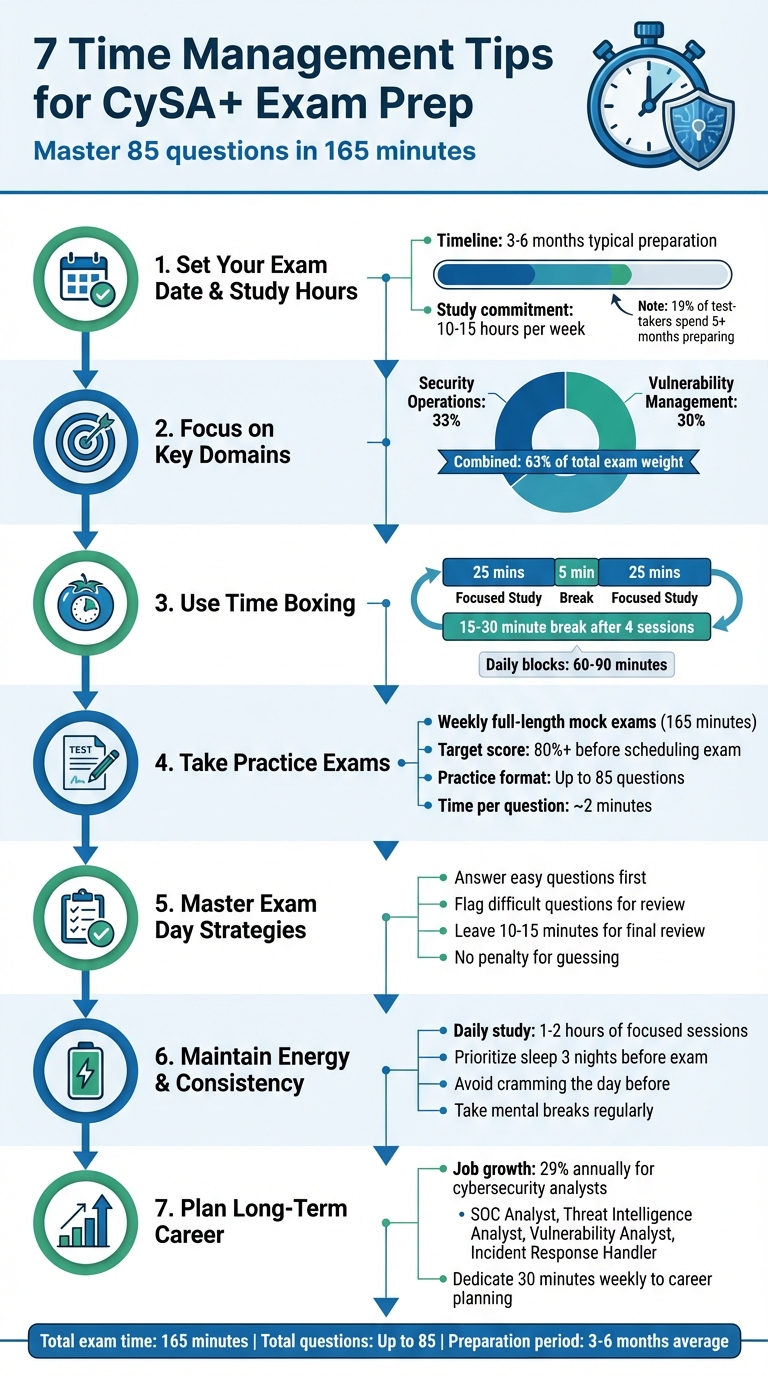
The CompTIA CySA+ exam is a challenging certification designed for cybersecurity professionals. With up to 85 questions to complete in 165 minutes, proper time management is critical. This guide breaks down seven practical strategies to help you prepare effectively while balancing your schedule. Here’s what you’ll learn:
- Set an exam date and weekly study hours: Commit to a realistic timeline, typically 3–6 months, with 10–15 hours of study per week. Use practice tests early to identify strengths and weaknesses.
- Focus on key domains: Prioritize Security Operations (33%) and Vulnerability Management (30%), as they make up most of the exam. Use official exam objectives to structure your study plan.
- Use time boxing: Study in short, focused intervals (e.g., 25-minute Pomodoro sessions) to avoid burnout and stay productive.
- Take practice exams: Simulate the test environment weekly to improve speed and accuracy. Aim for consistent scores of 80%+ before scheduling your exam.
- Plan for exam day: Answer easy questions first, flag harder ones, and leave time for review. Practice managing time on performance-based questions (PBQs).
- Maintain energy and consistency: Stick to daily study routines, prioritize sleep and nutrition, and avoid cramming.
- Think long-term: Use resources like Root School to align your certification with career goals in cybersecurity.
These strategies ensure you’re not just prepared for the test but also ready to advance your career. Let’s dive into the details.
7 Time Management Tips for CySA+ Exam Preparation
How to Study for the CompTIA CySA+ (and Pass the First Time)
1. Set Your Exam Date and Weekly Study Hours
Start by choosing your exam date. Scheduling your CySA+ exam sets a clear deadline and keeps you on track. Most people prepare over 3 months, but if you’re balancing a full-time job or other responsibilities, don’t try to rush it. In fact, nearly a third of test-takers take longer than 3 months, with 19% spending over 5 months preparing. Your timeline should reflect your experience and the time you can realistically dedicate to studying.
If you already hold Network+ and Security+ certifications or have 3–4 years of experience in a security operations center, you might need less preparation time. But if you’re new to these topics, expect to spend more time. Take an early practice test to pinpoint your strengths and weaknesses, then adjust your study schedule accordingly. Once you’ve done that, commit to a weekly study routine.
For a 3-month study plan, aim for 10–15 hours per week. Break this into 1–2 hours daily, with longer sessions on weekends if needed. Consistency is key - short, regular study sessions are far more effective than last-minute cramming. This approach helps you absorb and retain the complex material better.
To make the most of your study time, focus on the exam’s key areas. The Security Operations and Vulnerability Management domains make up 33% and 30% of the test, respectively, so prioritize these topics. Use CompTIA’s free official exam objectives to map out your study plan and ensure you’re covering the most critical content.
Finally, schedule your study sessions during times when you’re most alert and focused. Consistency and proper planning will help you avoid burnout while staying on track.
2. Create a Domain-Based Study Plan Using Official Exam Objectives
Start with the official CompTIA CySA+ (CS0-003) exam objectives. You can download this document directly from CompTIA's website. It breaks down every topic covered on the exam, giving you a clear guide to structure your study plan. Think of these objectives as your blueprint - they help you figure out exactly where you’re confident and where you need to sharpen your skills.
Use the objectives to assess yourself. Go through each domain and evaluate your strengths and weaknesses. This step is crucial because it helps you focus your energy on the areas that need the most attention. For instance, if you’ve been working as a SOC analyst, you might find Security Operations straightforward but struggle with Reporting and Communication. Knowing this early allows you to adjust your study plan to spend more time on your weaker areas. Essentially, these objectives act as your personalized roadmap for exam preparation.
Plan your study sessions by domain. Make sure to allocate time based on how much weight each domain carries on the exam. For example, Security Operations and Vulnerability Management together make up 63% of the test, so you’ll want to dedicate about two-thirds of your study time to these areas.
Focus on one or two domains each week. This method ensures you thoroughly understand each section before moving on, rather than skimming through topics and missing essential details. Use the sub-objectives as a checklist to track your progress and confirm when you're ready to tackle the exam.
3. Schedule Daily Study Blocks and Use Time Boxing
Break your study time into focused intervals using time boxing. One effective method is the Pomodoro Technique: set a 25-minute timer for a specific task - like reviewing vulnerability scanning techniques or identifying signs of malicious activity - and then take a 5-minute break to recharge. Align these focused intervals with your overall study plan to stay consistent.
This approach helps you fend off distractions. Whether you're diving into security frameworks or working through threat-hunting strategies, it’s easy to get sidetracked by your phone or social media. A running timer keeps you accountable and focused.
Plan your daily study sessions to maximize retention. Aim for 60–90 minute blocks of focused study time each day. In the first few weeks, spend 2–3 hours daily on reading and note-taking to build a solid foundation. As you advance, shift your focus to hands-on labs and practice questions during these sessions. Reserve weekends for longer, uninterrupted study periods where you can tackle full-length practice exams and simulate the 165-minute test environment.
After completing four Pomodoro intervals, take a more extended break of 15–30 minutes to recharge fully. Use these breaks for physical activities like stretching, walking, or grabbing a drink of water. Avoid scrolling through your phone, as it can easily lead to longer-than-intended breaks, disrupting your momentum.
Prioritize study time for high-weight domains. Since Security Operations (33%) and Vulnerability Management (30%) account for 63% of the exam, dedicate most of your Pomodoro sessions to these areas. On busy days when full study sessions aren’t feasible, use micro-learning blocks of 10–15 minutes during commutes or lunch breaks. Flashcards or short videos work well for quick reviews and help you keep progressing even with limited time.
4. Take Practice Exams to Build Speed and Find Weak Spots
Start with an early practice test to pinpoint your weak areas and refine your study strategy. Taking a diagnostic test early on can provide a clear picture of where you stand. It highlights the topics you need to focus on, helping you avoid wasting time on areas you already know well. The CySA+ exam includes up to 85 questions in 165 minutes, giving you about 2 minutes per question. Knowing your starting point is crucial to managing this time effectively. From there, make practice exams a regular part of your preparation.
Set aside one day a week for a full-length, 165-minute mock exam in a quiet, test-like environment. After completing the test, spend the next day reviewing every single question. Focus on understanding why the correct answers are right and why the incorrect ones are wrong.
"The real value of a practice test comes from the review process. Don't just look at your score. Dig into the explanations for each answer." – isecprep.com
Aim for a consistent score of 80% or higher before booking your exam date. Use your practice test reviews to improve. If you’re scoring below 70% in key areas like Security Operations (33% of the exam) or Vulnerability Management (30%), adjust your study time to focus more on those sections. Tackle easier questions first during practice and flag tougher ones to revisit later.
Don’t overlook performance-based questions (PBQs) - practice handling these under timed conditions. PBQs often appear at the start of the exam and may not include a visible timer. These hands-on tasks require quick thinking, so practicing them can help you manage your time better. And remember, there’s no penalty for guessing on the CySA+ exam, so don’t leave any question unanswered.
sbb-itb-8a31326
5. Practice Time Management Strategies for Exam Day
The CySA+ exam gives you 165 minutes to tackle up to 85 questions, which breaks down to about two minutes per question. To make the most of your time, start by answering the easier questions first and flagging the more difficult ones for later. This approach helps you build momentum and secure points on topics you're confident about.
If you come across a question that feels particularly tricky or time-consuming, mark it and move on. This strategy keeps you from spending too much time on a single problem and ensures you have enough time to address the rest of the exam. A helpful tip is to read each question twice - once to understand it and again to confirm your answer - keeping your pace steady.
Pay close attention to performance-based questions (PBQs), especially since these often appear at the beginning of the exam and the on-screen clock is hidden during this section. As CompTIA explains, "Most of the performance-based questions will appear at the beginning of the exam, and you won't be able to see a clock when working on the items." During practice sessions, set time limits for PBQs to avoid spending too much time on them. Refining your approach to these questions during mock exams will help you manage your time more effectively.
Use timed practice tools to identify areas where you may be slower and adjust your approach accordingly. Aim to finish the exam with 10–15 minutes left to review your answers. This buffer allows you to revisit flagged questions and double-check answers you're unsure about. As CompTIA advises, "Go into your exam with confidence and answer the questions at a pace that you feel comfortable with, while remembering that the CompTIA CySA+ exam consists of a maximum of 85 questions."
6. Maintain Energy and Consistency Throughout Your Prep
The CySA+ exam demands sustained focus and sharp analytical thinking for the full 165 minutes, so it’s crucial to show up on test day with your brain in top form. As mentioned earlier, a clear study schedule must go hand in hand with strategies to maintain both mental and physical stamina. Most candidates spend 3 to 6 months preparing for this exam. Think of it as a marathon, not a sprint.
Consistency is key. Instead of cramming for hours on end, stick to shorter, focused study sessions. Aim for 1–2 hours of concentrated study each day. This approach not only improves retention but also helps you avoid burnout. Regular breaks are essential - they give your brain the chance to recover and stay fresh. This steady rhythm aligns with the study schedule outlined earlier and prepares you for the long haul of exam day.
"Taking mental breaks is just as important for the mind as taking physical breaks are for the body. The mind needs to rest just like the body because, indeed, the mind is the body."
Beyond study habits, managing your energy is just as important. Sleep and nutrition aren’t optional - they’re essential. Plan your main study sessions during the times of day when you’re most alert, such as early mornings or after work. As the exam date gets closer, prioritize getting quality sleep for at least three nights before the test. Fatigue can seriously impact your ability to concentrate. On the day before the exam, resist the urge to cram. Instead, focus on resting and trusting the effort you’ve already put in.
"The day before the exam, they should just relax. They have prepared for weeks or months. They now just have to trust that they are competent enough to pass. Sleep well. Eat well. In this way, their body and mind are prepared for the battle ahead."
- jarrelrivera, Instructor
Take advantage of small pockets of time, like commutes, to review flashcards using apps like Pocket Prep (available for about $15–$20 per month). Celebrate small wins along the way to keep your motivation high. Building the endurance to stay sharp for a nearly three-hour exam doesn’t happen overnight - it’s the result of consistent, thoughtful preparation.
7. Use Root School for Long-Term Career Planning
Now that you’ve got a solid plan for tackling the CySA+ exam, it’s time to think about the bigger picture: how this certification fits into your long-term career goals. Passing the CySA+ exam is just one milestone on your journey toward a thriving career in cybersecurity. The steps you take after earning your certification are just as important. That’s where Root School (https://root-school.com) comes in. They specialize in helping cybersecurity professionals turn certifications into real-world job opportunities.
The CySA+ certification opens doors to roles like SOC Analyst, Threat Intelligence Analyst, Vulnerability Analyst, and Incident Response Handler. And here’s the exciting part: cybersecurity jobs are on the rise, with analyst positions expected to grow by 29% annually.
Root School offers resources that can help you navigate your career path effectively. From career and certification eBooks to detailed cybersecurity salary guides, they provide tools to answer important questions like: What’s the next step after CySA+? Should I specialize, and if so, in what area? How can I position myself for the roles I want? These resources can be integrated into your regular study routine to keep your career goals on track.
"CySA+ is the preferred qualifying credential for intermediate-level cybersecurity professionals with hands-on experience as an incident response analyst or security operations center analyst."
- CompTIA
Strategic career planning is just as critical as studying for the exam. Dedicate 30 minutes each week to explore these career resources and evaluate how your new skills align with market demands. By planning your certifications and career moves thoughtfully, you’ll be setting yourself up for long-term success in the cybersecurity field.
Conclusion
Getting ready for the CySA+ exam isn’t just about learning the material - it’s about managing your time effectively to tackle all domains and complete 85 questions in 165 minutes. The seven strategies discussed earlier offer a clear plan to help you stay on track, maintain focus, and maximize every study session. Whether you’re juggling a full-time job or dedicating all your time to studying, having a structured approach can make all the difference.
Most candidates spend around 6–12 weeks preparing for the exam. This timeframe highlights the importance of consistent, daily effort to develop the critical thinking and practical problem-solving skills the CySA+ demands. Last-minute cramming won’t cut it if you want to build lasting knowledge and skills.
Tina Tran emphasizes this point:
"Knowing how long to study for CySA+ helps you set realistic milestones, stay focused, and avoid the burnout that comes with last-minute cramming".
By setting your exam date early, breaking down the domains based on their weight, using time-boxing techniques, and practicing under simulated exam conditions, you’re not just preparing for the test - you’re building the confidence and competence needed to succeed.
But passing the exam is just the start. Once certified, it’s time to put your credentials to work. Platforms like Root School (https://root-school.com) can help you turn your certification into opportunities in roles such as SOC Analyst, Threat Intelligence Analyst, or Incident Response Handler.
Use these strategies to not only pass the CySA+ exam but also kickstart a rewarding cybersecurity career.
FAQs
How can I manage my time effectively to prepare for the CySA+ exam while working full-time?
Balancing CySA+ exam preparation with a full-time job is entirely doable with the right plan in place. The key is to create a schedule that fits into your busy life and stick to it. Start by carving out consistent study times during weekday evenings and weekends. Aim for about 8–10 hours of study each week, breaking it into smaller, manageable chunks - like 1–2 hours on weeknights and 3–4 hours on one weekend day.
Focus your efforts on the exam objectives that matter most, especially the areas where you feel less confident. To make the most of your time, try techniques like the Pomodoro method, which encourages short, focused study sessions to keep you productive without overwhelming yourself. Keep track of your progress each week and tweak your schedule if needed to stay on course.
And here’s a crucial tip: set aside at least one day a week to relax and recharge. Giving yourself that downtime will help you stay motivated and maintain your energy as you work toward earning your CySA+ certification.
How can I effectively manage my time during the CySA+ exam?
Managing your time effectively during the CySA+ exam can make a big difference in your performance. Begin by using timed practice tests before the actual exam to get a feel for how to pace yourself. Once you're in the test, take the time to carefully read each question to ensure you understand it, but don’t let yourself get stuck - flag tougher questions and circle back to them later. Try to maintain a steady time-per-question strategy so you can finish within the time limit. Keeping calm and staying focused will help you use your time wisely and tackle the exam with confidence.
How can earning the CySA+ certification enhance my cybersecurity career?
Earning the CompTIA CySA+ certification is a powerful way to advance your cybersecurity career. It showcases your ability to detect, analyze, and respond to security threats using behavioral analytics - skills that are crucial for protecting digital assets in today’s ever-evolving threat environment. Recognized by both government and private-sector organizations, this certification aligns with the U.S. Department of Defense’s 8140/8570.01-M directive and ISO 17024 standards. It’s a solid credential for roles like SOC analyst, vulnerability analyst, and cybersecurity engineer.
The demand for cybersecurity professionals continues to grow, with countless job openings requiring the expertise covered by CySA+. This certification not only qualifies you for entry-level positions but also equips you for more advanced responsibilities, such as leading incident response teams or influencing security policies. Earning CySA+ demonstrates your practical, hands-on skills, helping you stand out in a competitive job market while paving the way for sustained career growth.