If you're starting a cybersecurity career in 2026, certifications are your best first step. They prove your skills and help you land entry-level roles. For beginners, here are the top certifications to consider:
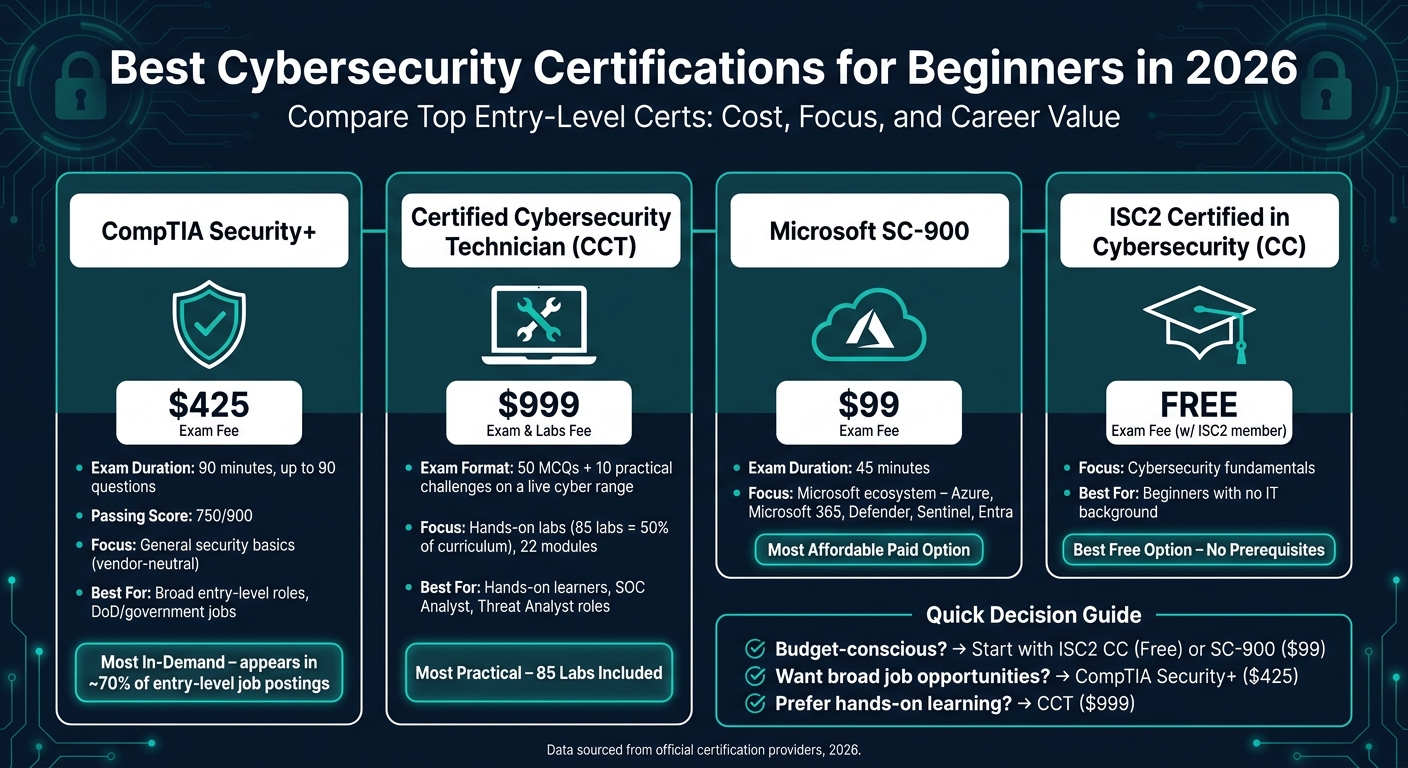
- CompTIA Security+: The most recognized entry-level certification in the U.S., required for many jobs, including government roles. Cost: $425.
- Certified Cybersecurity Technician (CCT): Hands-on training with labs and practical challenges. Ideal if you prefer learning by doing. Cost: $999.
- Microsoft SC-900: Focused on Microsoft security tools like Azure and Defender. Affordable and great for Microsoft-heavy environments. Cost: $99.
- ISC2 Certified in Cybersecurity (CC): A free option for those new to cybersecurity, covering basic concepts.
Quick Comparison
| Certification | Cost | Focus Area | Ideal For |
|---|---|---|---|
| CompTIA Security+ | $425 | General security basics | Broad entry-level roles |
| Certified Cybersecurity Technician (CCT) | $999 | Practical skills with labs | Hands-on learners |
| Microsoft SC-900 | $99 | Microsoft ecosystem | Microsoft-focused companies |
| ISC2 Certified in Cybersecurity (CC) | Free | Cybersecurity fundamentals | Beginners with no IT background |
Choose based on your goals and starting point. For most, CompTIA Security+ is a great foundation, but hands-on learners might prefer CCT. If you're on a budget, ISC2 CC or SC-900 are excellent options. Focus on one certification to start, then build experience.
How to Choose Your First Cybersecurity Certification
Assess Your Starting Point
Your background plays a big role in deciding which certification to pursue first.
| Starting Point | Recommended First Cert | Why |
|---|---|---|
| No IT experience | Google Cybersecurity Certificate or ISC2 CC | No prerequisites; builds foundational skills for beginners |
| IT help desk | CompTIA Security+ | Validates current skills; aligns with HR screening requirements |
| Student or recent grad | ISC2 CC or Microsoft SC-900 | Affordable and adds credibility in corporate settings |
| Hands-on learner | CCT or eJPT | Lab-based learning with real-world simulations |
Use this chart to match your background to the right certification and narrow your options quickly.
Key Factors to Consider When Picking a Certification
Once you've identified a certification that aligns with your experience, it's time to weigh its relevance and cost-effectiveness. A well-chosen certification should give you the biggest career boost for your investment.
Focus on credentials that employers value. Your certification should help you land a job, not just look good on paper.
"The certification itself means nothing if it does not open doors. Track which credentials appear in the job postings you want, not which ones have the best marketing." - Josh Mason, StationX Career Research
To pinpoint the most in-demand certifications, search for your target roles (like "Junior SOC Analyst") on job boards. For example, CompTIA Security+ shows up in roughly 70% of job postings for entry-level cybersecurity roles. If you're aiming for positions requiring Department of Defense (DoD) compliance, Security+ is also a recognized option.
Budget is another key consideration. The Security+ exam costs around $404–$425. If you're on a tight budget, ISC2's Certified in Cybersecurity is often free through their eligibility program, and Microsoft SC-900 costs about $99. Spending more on a certification doesn't always mean better results, especially when you're just starting out.
Rather than waiting to stack multiple certifications, focus on earning one solid credential and gaining hands-on experience. Employers value practical skills combined with a recognized certification far more than a long list of credentials without real-world application.
sbb-itb-8a31326
5 Beginner Cybersecurity Certifications that are ACTUALLY Worth Taking in 2026
Top Cybersecurity Certifications for Beginners in 2026
Best Cybersecurity Certifications for Beginners 2026: Side-by-Side Comparison
If you're just starting out in cybersecurity, here are three certifications worth considering in 2026.
CompTIA Security+
CompTIA Security+ is a widely recognized entry-level certification in the U.S. cybersecurity field. Its vendor-neutral approach makes it applicable across industries.
"CompTIA Security+ is the premier global certification that establishes the essential skills required for core security functions and a career in IT security." - CompTIA
The current SY0-701 exam focuses on five key areas, with Security Operations carrying the most weight at 28%. Here's how the domains break down:
| Domain | Exam Weight |
|---|---|
| Security Operations | 28% |
| Security Program Management & Oversight | 20% |
| Threats, Vulnerabilities, and Mitigations | 22% |
| Security Architecture | 18% |
| General Security Concepts | 12% |
The exam includes Performance-Based Questions (PBQs) that mimic real-world scenarios, and you'll have 90 minutes to tackle up to 90 questions. A passing score is 750 out of 900. The exam voucher costs $425, and the SY0-701 version is expected to retire in late 2026.
To prepare effectively, download the official exam objectives and pinpoint any areas where you need improvement. If you're looking for a more hands-on approach to learning, the Certified Cybersecurity Technician (CCT) might be a better fit.
Certified Cybersecurity Technician (CCT)
For those eager to dive into practical skills early, the CCT offers hands-on training from the start. With 85 labs making up half the curriculum, this program emphasizes real-world experience. The exam itself is conducted on a live cyber range and includes 50 multiple-choice questions alongside 10 practical challenges.
"The CCT exam taught me a lot about cybersecurity domains that we need to know in our early career... such as ethical hacking, SOC, incident response plans and threat intelligence." - Muamer Huseinovic, Student
The CCT covers 22 modules, including network defense, digital forensics, ethical hacking, and SOC operations, aligning with over 40 job roles like SOC Analyst and Threat Analyst. The full package - which includes one year of course access, six months of lab access, and a proctored exam voucher - costs $999.
Another advantage? The CCT pairs well with other certifications. As Bjorn Voitel, CEO of Next Academy, explains:
"If you achieve the CCT you should be well prepared to also take the Security Plus, for example without any additional preparation."
This makes it a great choice if you want to build practical skills first and then pursue broader certifications like Security+.
If you're planning to work in environments reliant on Microsoft technologies, the next certification might be your best bet.
Microsoft Security, Compliance, and Identity Fundamentals
The SC-900 certification is Microsoft's entry-level option for security, focusing on its ecosystem, including Azure, Microsoft 365, Microsoft Defender, and Sentinel. At just $99, it's an affordable starting point.
The exam covers four main areas: foundational security and compliance concepts, Microsoft Entra (identity and access management), Microsoft security solutions, and compliance tools. It's a short exam, lasting only 45 minutes.
This certification is ideal for roles in companies heavily invested in Microsoft technologies. While it doesn’t offer the broad, vendor-neutral foundation of Security+, it demonstrates familiarity with Microsoft’s tools - a valuable asset for organizations using Azure and Microsoft 365. Before taking the exam, Microsoft suggests brushing up on Azure and Microsoft 365 basics to make the material easier to grasp.
Building a Certification Roadmap as a Beginner
Match Certifications to Your Career Goals
When starting your certification journey, it’s crucial to focus on what aligns with your career aspirations rather than chasing credentials that seem impressive but may not serve your goals. A common pitfall for beginners is pursuing certifications without a clear direction, which often leads to wasted time and money.
Instead, tailor your certification choices to the job roles you’re targeting. Look at job postings in your desired field and identify the qualifications that employers are seeking. This approach ensures your efforts are practical and relevant.
Here’s a quick guide mapping popular entry-level career goals to suggested certification paths:
| Career Goal | Recommended Sequence |
|---|---|
| Generalist / IT Security | ISC2 Certified in Cybersecurity (CC) → CompTIA Security+ → CompTIA Network+ |
| SOC Analyst | CompTIA Security+ → CompTIA CySA+ → GIAC GCIH |
| Cloud Security | CompTIA Security+ → Microsoft SC-900 → CCSP |
| Penetration Tester | CompTIA Security+ → CEH → OSCP |
| GRC / Compliance | CompTIA Security+ → CISA → CRISC |
Notice how CompTIA Security+ serves as the foundation for nearly every path. This certification meets DoD 8140 requirements and is frequently listed in entry-level job postings, making it a key credential for U.S. government and defense-related roles.
Once you’ve defined your career goals, the next step is to choose a study path that matches your current skill level and expertise.
Suggested Certification Study Paths
A well-structured study plan ensures your certifications build practical, hands-on skills as you progress. Where you start depends on your existing knowledge and technical background.
- If you’re new to the field: Start with the free ISC2 Certified in Cybersecurity (CC) program offered through their "One Million Certified" initiative. This program provides a solid introduction to cybersecurity fundamentals, preparing you for the next step: CompTIA Security+.
- If you already have IT basics: Begin with CompTIA Security+, then use job postings to identify your next move. For example, roles like SOC Analyst frequently mention CompTIA CySA+, appearing in about 35% of related job listings.
Conclusion: Getting Started with Root School
Key Takeaways
Breaking into cybersecurity doesn’t require years of experience - it starts with a clear plan. Choosing the right certification based on your goals can open doors to roles like SOC analyst, cloud security specialist, or compliance expert. What's more important than stacking certifications is pairing one well-selected credential with hands-on lab experience. This approach builds a strong foundation and sets you up for practical, actionable next steps.
Next Steps with Root School
Root School provides a structured, beginner-friendly pathway to help you take that first step. Their 360-hour bootcamp includes CompTIA Security+ preparation, an official exam voucher, practical labs, and career coaching. This program ensures you're not just passing exams but gaining real-world skills employers value.
"Skip the noise, train on what attackers actually do, and graduate people who are useful from day one." - Daute Delgado, Founder of Unihackers
With 4.8 million unfilled cybersecurity jobs worldwide and a 29% growth rate projected for analyst roles, the demand is undeniable. The journey to your first role in cybersecurity may be shorter than you think, especially with a guided, hands-on approach like Root School’s.
FAQs
Which certification should I get first if I have zero IT experience?
If you’re new to IT and looking for a solid starting point, CompTIA Security+ is an excellent choice. It’s well-known, approachable for beginners, and highly respected by employers. This certification lays a strong groundwork in cybersecurity principles and practices, making it a great first step for launching a career in the field.
How long should I study before taking Security+ (SY0-701)?
If you're planning to take the Security+ (SY0-701) exam, it's a good idea to dedicate about 8 to 12 weeks to studying. For beginners, spending roughly 8 weeks on focused preparation can help establish a strong understanding of the material and boost your confidence before the test.
What hands-on projects should I do after my first certification?
After earning your first cybersecurity certification, the next step is to sharpen your practical skills. Get hands-on experience with tools like Wireshark, Nmap, or SIEM platforms. A great way to do this is by setting up a home lab where you can simulate network attacks, analyze traffic, or practice incident response scenarios. These projects not only deepen your understanding but also prepare you for roles like SOC analyst and make your skills more relevant to real-world cybersecurity challenges.