If you're starting your journey in cloud security, deciding between CCSK (Certificate of Cloud Security Knowledge) and CCSP (Certified Cloud Security Professional) can be tricky. Here's a quick breakdown:
- CCSK is ideal for beginners. It requires no prior experience, costs $445, and provides an introduction to cloud security basics. The exam is online, open-book, and covers technical and business-focused topics.
- CCSP is for experienced professionals. It requires 5 years of IT experience (3 in security, 1 in cloud), costs $599, and focuses on advanced cloud security practices. The exam is closed-book and taken at testing centers.
Quick Tip: Start with CCSK to build a foundation. It counts as 1 year toward CCSP's experience requirement, making it a logical first step.
Quick Comparison
| Factor | CCSK | CCSP |
|---|---|---|
| Experience | None | 5 years IT (3 in security, 1 in cloud) |
| Exam Format | Online, Open-book | Testing Center, Closed-book |
| Cost | $445 (2 attempts) | $599 |
| Maintenance | None | $125/year + 90 CPEs every 3 years |
| Audience | Beginners | Mid-to-senior professionals |
| Average Salary | $121,932 | $148,009 |
Both certifications are highly respected, but your choice depends on your current skills and career goals. Keep reading for a deeper dive into their differences and how to choose the right one for you.
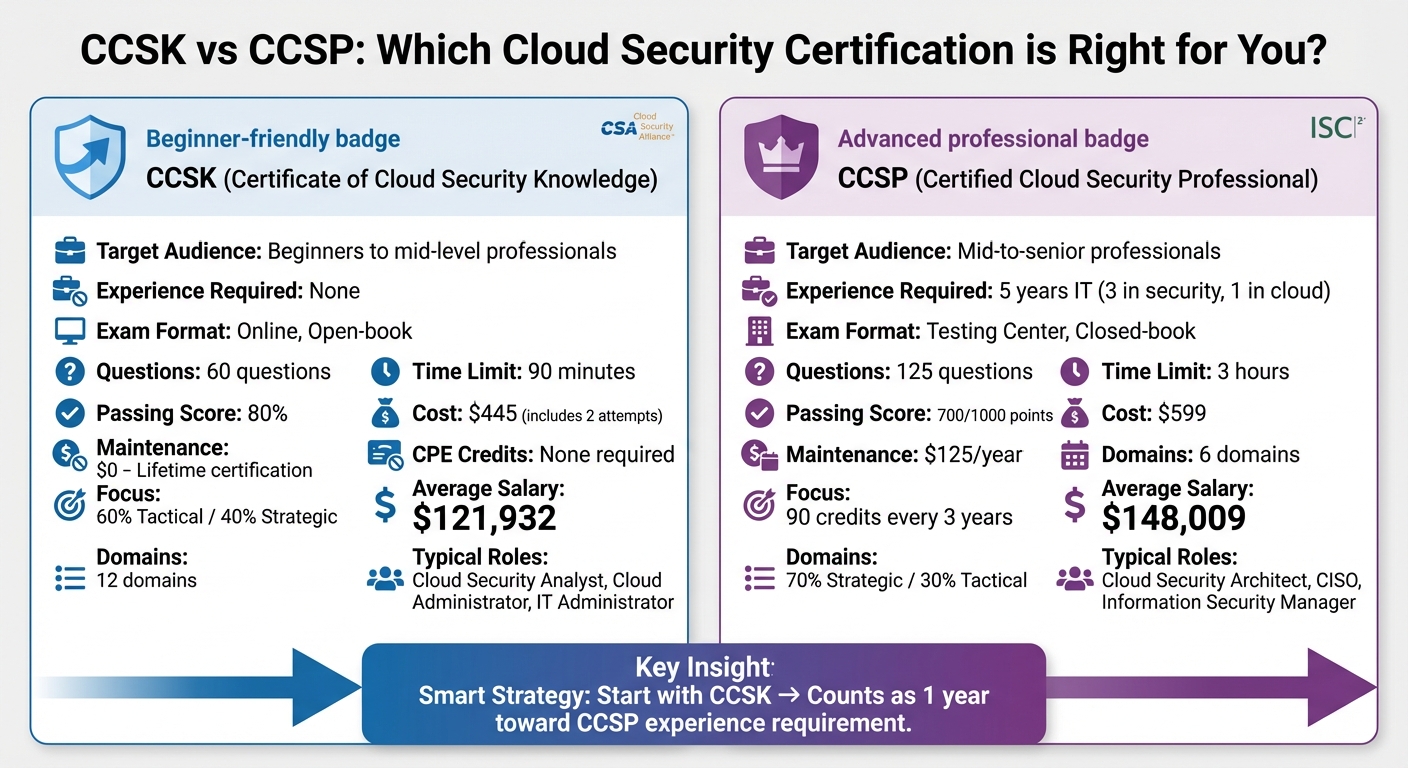
CCSK vs CCSP Certification Comparison for Cloud Security Professionals
CCSP Certification vs CCSK - Which Cloud Security is better ??
What is CCSK?
The Certificate of Cloud Security Knowledge (CCSK) is a vendor-neutral certification offered by the Cloud Security Alliance (CSA) that focuses on cloud security fundamentals. CIO Magazine has referred to it as "the mother of all cloud computing security certifications", and it holds the distinction of being the very first industry certification dedicated to cloud security when it debuted in 2011.
One of the standout features of the CCSK is its accessibility - there are no prerequisites. You don't need prior work experience or specific qualifications to sit for the exam, making it an excellent starting point for beginners. The certification provides a broad introduction to cloud security, covering topics like cloud computing basics, governance, identity management, data security, and incident response. Its curriculum is thoughtfully divided, with about 60% focusing on technical aspects and 40% addressing business-driven cloud security.
The exam itself consists of 60 questions, and you’ll have 120 minutes to complete it. To pass, you’ll need to score at least 80%. While the exam is open-book and non-proctored, it’s far from easy - the average passing rate is just 62%. Graham Thompson, an Authorized Trainer at Intrinsec Security, puts it this way:
"Properly written open-book exams remain challenging. I believe it would be impossible to answer 60 questions in 120 minutes if you have to research every question".
The latest Version 5 curriculum has been updated to address modern security challenges across 12 domains. It includes topics like Artificial Intelligence (AI), Zero Trust architectures, and DevSecOps, ensuring that the material reflects the latest trends and best practices.
At $445, the CCSK includes two exam attempts, valid for two years, and offers great value. Unlike many certifications, it doesn’t require annual maintenance fees or Continuing Professional Education (CPE) credits to stay active. Up next, we’ll dive into the CCSP certification, designed for seasoned professionals.
What is CCSP?
The Certified Cloud Security Professional (CCSP) is a globally respected certification, developed collaboratively by (ISC)² and the Cloud Security Alliance (CSA). It's designed to validate the expertise needed to design, manage, and secure cloud-based data, applications, and infrastructure. Unlike the entry-level CCSK, the CCSP is aimed at seasoned IT and security professionals, making it a step up for those already established in the field.
The CCSP exam is a closed-book test with 125 multiple-choice questions to be completed in 3 hours. It evaluates six core domains, each weighted differently. The exam is administered at Pearson VUE testing centers, and candidates need a minimum score of 700 out of 1,000 points to pass.
To be eligible for the CCSP, candidates must have at least 5 years of paid work experience in IT, including 3 years in information security and 1 year in one of the six CCSP domains. However, holding a CISSP certification automatically fulfills these requirements. For those who lack the required experience, there's an option to take the exam and become an "Associate of (ISC)²." This designation allows up to 6 years to gain the necessary work experience.
The exam costs $599, and maintaining the certification requires paying a $125 annual fee and earning 90 Continuing Professional Education (CPE) credits every three years. Compared to CCSK, the CCSP delves deeper into governance, traditional security practices, and privacy considerations. Its content is roughly 70% strategic and 30% tactical, making it ideal for senior-level roles like Cloud Architect, Security Engineer, or Systems Architect.
On average, CCSP-certified professionals earn approximately $148,009 annually, underlining the certification’s value in the job market. The credential is accredited by the American National Standards Institute (ANSI) and meets ISO/IEC 17024 standards, ensuring its global recognition. As (ISC)² explains:
"CCSP is for the experienced security professional and obtaining it signals a senior-level understanding of and experience with cloud, as well as with traditional information security".
CCSP vs CCSK: Side-by-Side Comparison
Choosing between the CCSK and CCSP certifications can be easier when you understand their core differences in purpose and audience. The CCSK is offered exclusively by the Cloud Security Alliance (CSA), while the CCSP is a joint effort between (ISC)² and the CSA. The CCSK is beginner-friendly, requiring no prior work experience, making it accessible for those just starting out. On the other hand, the CCSP demands a more seasoned background, requiring five years of paid IT experience (three in information security and one in a cloud-related role). If you already hold a CISSP, the CCSP experience requirement is waived. Additionally, candidates who pass the CCSP exam but lack the required experience can earn an Associate designation from (ISC)², giving them six years to meet the experience criteria.
The exams themselves are structured quite differently. The CCSK is an online, open-book test featuring 60 questions to be completed in 90 minutes, with a fee ranging from $395 to $445 (which includes two attempts). The CCSP, however, is a closed-book exam conducted at Pearson VUE centers, consisting of 125 questions to be completed in 3 hours, with fees ranging from $599 to $699. The passing score for the CCSK is 80%, while the CCSP requires a scaled score of 700 out of 1,000.
Another distinction lies in certification maintenance. The CCSK is a one-time certification with no ongoing fees. In contrast, CCSP holders must pay an annual $125 maintenance fee and earn 90 Continuing Professional Education (CPE) credits every three years.
Comparison Table
| Factor | CCSK | CCSP |
|---|---|---|
| Issuing Organization | Cloud Security Alliance (CSA) | (ISC)² (in collaboration with CSA) |
| Experience Required | None | 5 years IT (3 in security, 1 in cloud) |
| Exam Format | Online, Open-book | Testing Center, Closed-book |
| Question Count | 60 | 125 |
| Time Limit | 90 minutes | 3 hours |
| Passing Score | 80% | 700 out of 1,000 points |
| Exam Cost | $395 - $445 | $599 - $699 |
| Annual Maintenance | $0 | $125 + 90 CPEs every three years |
| Knowledge Focus | ~60% tactical, 40% strategic | ~70% strategic, 30% tactical |
| Target Audience | Beginners to mid-level professionals | Mid-to-senior professionals |
| Average Salary | $121,932 | $148,009 |
The focus areas of the exams further highlight their differences. The CCSK leans towards a 60/40 split between tactical (technical) and strategic (business) knowledge, covering 12 domains based on CSA Guidance, the Cloud Control Matrix, and ENISA reports. Meanwhile, the CCSP emphasizes strategic elements, with a 70/30 split, across six domains that expand on governance, traditional security, and privacy concerns. As Graham Thompson, an authorized trainer, succinctly puts it:
"CCSP = CCSK + Expanded Governance Items + Traditional Security + Privacy".
sbb-itb-8a31326
Pros and Cons for Beginners
For those just starting in cloud security, the CCSK offers a straightforward entry point since it doesn’t require any prior experience. The exam is open-book, conducted online, and lasts 90 minutes. It’s also budget-friendly, offering two attempts at a competitive price. Once you pass, there are no ongoing fees or continuing education requirements, making it an accessible option for beginners. However, some hiring managers may perceive the open-book format as less rigorous, and the test itself is no walk in the park. As Graham Thompson, an authorized trainer at Intrinsec Security, explains:
"Expertise in both tactical and strategic domains is rare, and that is what makes the CCSK exam so hard. I've seen hardcore techies fail, and I've seen MBAs fail".
The CCSP, on the other hand, comes with different challenges and benefits. It requires substantial IT experience, but beginners can start with the Associate pathway. This route provides access to (ISC)²’s resources, such as webinars, local chapters, and networking opportunities. In terms of salary potential, CCSP holders tend to earn an average of $148,009 annually, compared to $121,932 for CCSK holders.
A smart strategy for beginners is to use the CCSK as a stepping stone. Passing the CCSK counts as one year of the work experience required for the CCSP. This makes it a logical way to build foundational skills before tackling the more advanced certification.
Beginner Pros and Cons Table
| Factor | CCSK Pros | CCSK Cons | CCSP Pros | CCSP Cons |
|---|---|---|---|---|
| Entry Barrier | No experience needed | Perceived as less rigorous | Associate path available | Requires 5 years of experience |
| Exam Format | Open-book, online exam | Dual tactical/strategic focus | Closed-book exam ensures credibility | Must take exam at a testing center |
| Cost | Affordable, includes two attempts | - | Higher salary potential ($148,009 avg) | $599 exam fee + $125/year maintenance |
| Maintenance | Lifetime certification, no fees | - | Access to (ISC)² networking | Requires 90 CPE credits every 3 years |
| Career Path | Counts as 1 year toward CCSP | Suited for entry- to mid-level roles | DoD-approved for government roles | Assumes prior security knowledge |
Which Certification Should Beginners Choose?
Choosing the right certification depends on where you are in your career and where you’d like to go. If you’re just starting out in IT or cloud security, the CCSK is an excellent first step. It doesn’t require prior experience and offers a strong foundation in cloud security concepts. As John Berti explains, the CCSK serves as a stepping stone to the more advanced CCSP certification. Plus, the CCSK’s online, open-book exam makes it a practical option for those juggling studies with other responsibilities.
For professionals with at least five years of IT experience - three of which should be in security and one in cloud - the CCSP is a better choice. This certification is highly respected by employers, opens doors to senior roles, and often comes with the potential for higher salaries. If you don’t yet meet the experience requirements, you can still take the CCSP exam and become an Associate of ISC2. This gives you six years to gain the required work experience while building on the CCSK foundation.
The two certifications also differ in focus. The CCSK leans more toward tactical skills, with about 60% of its content addressing specific cloud security issues and the CSA Guidance. On the other hand, the CCSP emphasizes strategic topics - around 70% of its material covers governance, architecture, and broader information security concepts. If you’re aiming for hands-on technical roles, the CCSK might be a better fit. However, if leadership or architectural positions are your goal, the CCSP is often what hiring managers look for.
Cost and maintenance are another factor to consider. The CCSK is more affordable and doesn’t require ongoing fees or continuing education. In contrast, the CCSP involves a higher upfront investment and requires earning 90 CPE credits every three years to maintain the certification.
A smart approach for career growth is to start with the CCSK and use it as a stepping stone. It can count as one year toward the CCSP’s experience requirement, offering immediate credibility while accelerating your path to full certification. If you already hold a CISSP, the CCSP experience requirements are waived entirely, making it a logical next step - even if your cloud experience is limited. Ultimately, your choice of certification now will shape your career trajectory in cloud security.
Career Paths After Certification
Both certifications pave the way for distinct roles in cloud security, each tailored to specific career stages and responsibilities.
CCSK holders are well-suited for entry to mid-level positions such as Cloud Security Analyst, Cloud Administrator, IT Administrator, and Risk Management Professional. These roles center on the technical side of cloud security - tasks like monitoring threats, implementing security controls, and ensuring compliance across platforms such as AWS, Azure, and Google Cloud. The average annual salary for CCSK-certified professionals is $121,932.
On the other hand, CCSP holders aim for senior and executive-level positions, including Cloud Security Architect, Information Security Manager, Chief Information Security Officer (CISO), and Enterprise Architect. These roles focus on strategic decision-making, designing secure cloud environments on a larger scale, and overseeing organizational security policies. CCSP-certified professionals earn an average annual salary of $148,009. By the end of 2024, more than 20,000 professionals worldwide will have earned the CCSP, and 39% of cybersecurity professionals identify cloud security as the most understaffed area.
When comparing career trajectories, CCSK roles lean heavily toward technical expertise, while CCSP roles emphasize governance and long-term strategy. If you prefer hands-on technical challenges, CCSK prepares you for positions like Cloud Support Specialist or Compliance Specialist. However, if you're drawn to leadership and shaping organizational policies, CCSP can lead to roles like DevSecOps Engineer or Cloud Security Consultant.
CCSP certification also provides additional perks. Earning this credential grants ISC² membership, which includes access to professional development tools, technical webinars, and a global network of over 140,000 security professionals. Furthermore, the CCSP is recognized by the US Department of Defense as a baseline credential for IAT Level III and IASAE III positions, opening doors to careers in government and defense sectors.
With 90% of organizations now relying on cloud services and 64% of respondents in a 2025 study ranking cloud security as a top priority, both certifications hold strong value in this fast-growing field. If you're aiming for technical roles, CCSK is your go-to certification. For those seeking strategic leadership positions, CCSP is the better fit. These career paths align with earlier discussions of certification benefits, offering a clear direction for advancing in cloud security.
Conclusion: Making Your Decision
The choice between CCSK and CCSP largely depends on where you are in your career. If you're new to cloud security and looking for a starting point, CCSK is the way to go. It’s an open-book, online exam costing $395–$445. On the other hand, CCSP is designed for experienced professionals, requiring at least five years of IT experience. It’s a closed-book test administered through Pearson VUE, with a $599 exam fee. Additionally, CCSP has ongoing requirements, including an annual $135 maintenance fee and earning 90 CPE credits every three years.
"CCSK is often viewed as a good start along the path to earning a CCSP later. CCSP truly demonstrates excellence and commitment to the discipline." - ISC²
For those just starting, CCSK is a great way to build foundational knowledge while also contributing toward CCSP’s experience requirement. If you pass the CCSP exam before meeting the experience criteria, you can become an Associate of ISC², giving you six years to gain the necessary work experience.
In short, CCSK is ideal for tactical roles like Cloud Security Analyst or Cloud Administrator, where hands-on skills are key. Meanwhile, CCSP is better suited for strategic leadership roles like Cloud Security Architect or CISO, where broader expertise and decision-making are critical. Think about your current skills and long-term goals to decide which certification aligns best with your career path in cloud security.
FAQs
What’s the difference between CCSK and CCSP for career growth?
The CCSK (Certificate of Cloud Security Knowledge) is a certification aimed at those entering or transitioning into cloud security roles. It covers the basics of cloud security principles, governance, and risk management. This makes it a great choice for beginners or professionals moving into roles like cloud analysts, IT administrators, or systems architects. Since it doesn’t require prior work experience, it’s an accessible way to start building a strong understanding of cloud security.
On the other hand, the CCSP (Certified Cloud Security Professional) is designed for seasoned professionals. To qualify, you need at least five years of paid IT experience, including three years in information security and one specifically in cloud security. This certification is geared toward advanced roles such as cloud architects, security engineers, or enterprise architects. It’s recognized as a mark of expertise and often leads to leadership opportunities, with salaries in the U.S. frequently surpassing six figures.
For those just beginning their journey, the CCSK lays the groundwork for a career in cloud security. Meanwhile, the CCSP is ideal for professionals aiming to advance into senior or leadership roles.
How does the CCSK certification help meet the CCSP experience requirement?
The Certificate of Cloud Security Knowledge (CCSK) is acknowledged by (ISC)² as a way to partially meet the experience requirements for the Certified Cloud Security Professional (CCSP) certification. To qualify for the CCSP, you need five years of paid IT work experience, with at least three years in information security and one year specifically focused on cloud security. However, holding the CCSK can waive the one-year cloud security requirement, allowing you to concentrate on completing the rest of the experience criteria.
For those just starting out, earning the CCSK can be a strategic step toward achieving the CCSP. It lays the groundwork for understanding cloud security while helping you fulfill part of the CCSP's prerequisites. Root School offers specialized CCSK training designed to prepare you for the exam and support your growth in the cybersecurity field.
Should I start with the CCSK certification if I'm new to cloud security?
The CCSK is a great choice for those new to cloud security. It’s designed for entry-level professionals and doesn’t require any prior work experience, making it an approachable option for beginners.
By earning this certification, you’ll gain a solid understanding of cloud security basics. This foundational knowledge can be a stepping stone as you advance in your cybersecurity career. If you’re just starting out, the CCSK offers a straightforward way to begin your journey.