If you want to get into cybersecurity for less money and in less time, community college can make sense. In many cases, tuition is about $3,056 per year versus $11,260+ at a public four-year school, and some students can finish in 18–24 months.
Here’s the short version:
- Best for: people who want a lower-cost path to entry-level cyber or IT work
- Main upside: lower tuition, lower debt, flexible class times, and cert prep
- Main downside: transfer problems, less depth, fewer advanced tracks, and uneven program quality
- What to check first: regional accreditation, CAE-C status, current labs, cert alignment, and local employer ties
This path works best if your goal is a first job, not deep specialization right away. I’d look hard at whether credits transfer, whether labs cover cloud, scripting, and log analysis, and whether the school can show job placement or internship links.
Quick Comparison
| Factor | Community College Cybersecurity Program | 4-Year Cybersecurity Program |
|---|---|---|
| Cost | Lower; about $3,056/year on average | Higher; about $11,260+/year at public schools |
| Time to finish | Often 18–24 months | Usually 4 years |
| Focus | Job skills and entry-level training | Broader study with more depth |
| Schedule | Often evening, online, hybrid, weekend | Often more daytime-based |
| Cert prep | Often built into classes | Often limited or optional |
| Transfer path | Can be uneven, especially with AAS credits | Not usually an issue inside one school |
| Specialization | More limited | More room for advanced study |
| Networking | More local and smaller-scale | More alumni and recruiter reach |
If you want a fast start and can live with some tradeoffs, this route can be a smart first step.
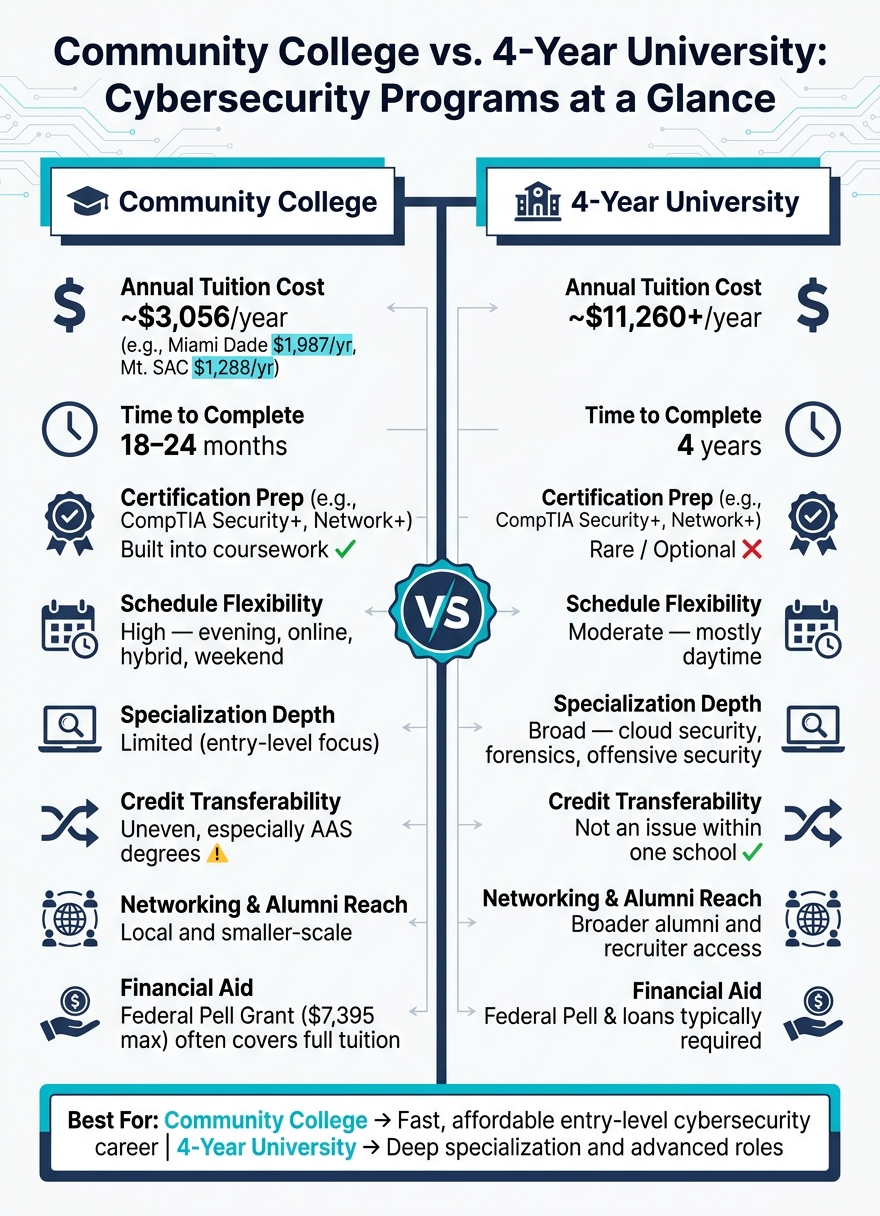
Community College vs. 4-Year University Cybersecurity Programs: Key Differences
Pros of Community College Cybersecurity Programs
Lower Cost and Less Student Debt
The biggest upside is pretty simple: community college can cut the cost of getting job-ready.
The price difference is hard to ignore. The average annual tuition for a community college cybersecurity program is about $3,056, compared with roughly $11,260 or more at a public four-year university. Over two to four years, that gap can turn into a lot of money.
For 2024–2025, the maximum Pell Grant award is $7,395, which can cover tuition and books at many community colleges. Some schools are even lower. Miami Dade College charges $1,987 per year for in-state students, and Mt. San Antonio College costs $1,288 per year. At that level, many students can finish with little or no debt. Starting in July 2026, new Workforce Pell Grants will also apply to short-term cybersecurity certificates.
Flexible Schedules and Career-Focused Training
A lot of community college programs are built with working adults in mind. Many schools offer evening, weekend, hybrid, and fully asynchronous online options. That makes it easier to keep a job while building new skills.
The training also tends to be hands-on from the start. Students work through labs in packet analysis, system hardening, firewall setup, and log review using firewalls, IDS, and log tools. Pitt Community College in North Carolina is a good example. It offers a 24/7 remote lab environment with physical equipment and virtual machines, so students can practice from home whenever it fits their schedule.
Certification Prep and Faster Job Readiness
Many programs line up with A+, Network+, Security+, and other common entry-level certs. That can make the path to a first cybersecurity job shorter and more direct.
| Decision Factor | Community College | 4-Year University |
|---|---|---|
| Annual Cost | ~$3,056 | ~$11,260+ |
| Time to Job | 18–24 months | 4 years |
| Cert Prep | Built into coursework | Rare/optional |
| Schedule Flexibility | High (evening/online/hybrid) | Moderate (mostly daytime) |
| Financial Aid | Federal Pell & state grants | Federal Pell & loans |
Entry-level cybersecurity technician jobs often start around a median salary of $45,500. If total degree costs stay under $10,000, the return on investment can look strong. That matters most for students who want to get into the field fast instead of spending four years on a broader degree.
sbb-itb-8a31326
'They teach you everything you need to know': MCC's cyber security program ranked 16th nationally
Cons of Community College Cybersecurity Programs
The lower price and shorter timeline come with tradeoffs.
The biggest drawbacks are credit-transfer issues and less technical depth.
Transfer-Credit Problems and Limited Specialization
A lot of students get caught off guard by how often technical credits don’t transfer cleanly. When credits get lost, finishing a bachelor’s degree can take more time and cost more money. This happens most often with AAS degrees, which usually transfer less cleanly than AS or AA programs.
Specialized labs and technical classes are the first places where things can go sideways. In many cases, those credits transfer only as electives, which means they don’t count toward major requirements at a four-year school.
Many associate programs also stay close to entry-level material. You may not find advanced paths like cloud security architecture, offensive security, or digital forensics. That can still work if your goal is an entry-level SOC analyst or help desk job. But it can narrow your options if you want to move into more specialized roles fast.
And even if your credits do transfer, program quality still matters.
Program Quality Varies by Campus
Not all campuses offer the same experience. Course content, lab setup, and instructor background can vary a lot from one school to another. Cybersecurity moves fast, so an outdated lab can lose its usefulness in a hurry. Some schools also have a hard time keeping virtual labs and course material up to date.
Hiring instructors is part of that problem. As John Sands, Professor of IT at Moraine Valley Community College, explained:
"It can be hard to compete with the private sector, where cybersecurity professionals earn much higher salaries."
Because of that, some programs lean heavily on adjunct instructors or faculty members who may not have recent industry experience. Before you enroll, look closely at the course list. A good program should cover things like:
- scripting basics
- cloud fundamentals
- log analysis
- modern security tools
It shouldn’t focus only on older networking topics.
About 380 institutions have the NSA’s Center of Academic Excellence in Cybersecurity (CAE-C) designation, and roughly one-third of them are community colleges. CAE-C status is one of the clearest signs that a program meets a steady, high bar.
The other tradeoff is weaker access to internships, alumni, and employer networks.
Prestige and Networking Tradeoffs
For advanced, leadership, or specialized cybersecurity jobs, a bachelor’s degree often carries more weight. Smaller colleges usually have fewer alumni in senior leadership roles and weaker pipelines to major defense contractors and federal agencies. That said, community college instructors who also work in the field can become useful contacts - if you take the time to build those relationships.
How to Judge Whether a Program Is Worth It
Community college can be a smart way into cybersecurity, but only if the program is credible, up to date, and tied to actual hiring. And that’s where things get tricky: quality can vary a lot from one campus to the next. A low-cost program isn’t always a good deal.
Accreditation, CAE Status, and Curriculum Quality
Start with the basics: regional accreditation and CAE-C status. Those two checks affect financial aid, transfer options, and how the program is viewed by employers and four-year schools. Put plainly, they help answer a simple question: Will this credential count when it’s time to move forward?
Then look at the coursework itself. You want current, hands-on training, not classes that feel stuck in another era. Pay close attention to whether students get practice in cloud security, incident response, ethical hacking, and lab work using real equipment and virtual machines. It also helps if the program lines up with certifications such as CompTIA Security+, Network+, or Cisco CCNA.
Job Placement, Employer Ties, and Local Demand
Once a program passes the credibility check, the next step is more practical: can it help you get interviews?
Claims on a college website don’t mean much by themselves. Outcomes do. Ask for job placement rates, internship access, and the names of employers that hire from the program. If a school has employer ties that lead to internships or co-ops, that’s a strong sign the program has traction in the local market.
It’s also smart to check local hiring demand and starting pay before you enroll. A program might look good on paper, but if the nearby job market is thin, that matters.
How to Turn School Into a First Cybersecurity Job
After you enroll, the goal shifts. Now it’s about turning classwork into proof that you can do the job.
Use labs, certification prep, and career services to build a portfolio, earn certs, and meet people in the field before graduation. Job fairs and employer meet-and-greets can help too. Done right, school stops being just a place where you take classes and starts becoming your path to a first cybersecurity role.
Conclusion: When Community College Is a Smart Cybersecurity Choice
Community college cybersecurity programs make the most sense when cost, flexibility, and a practical path to your first job sit at the top of your list.
The main upside is pretty simple: you can get into the field faster, take on less debt, and build job-ready skills without paying for four years of tuition. That makes these programs a strong option for working adults, parents, and veterans who need evening, weekend, or online classes.
That said, this path only makes sense if the school passes a few basic quality checks. The tradeoffs are real. Program quality can vary, specialization may be limited, and transfer value often depends on articulation agreements.
So before you commit, look for a few key signals:
- NSA/DHS CAE-C designation
- A curriculum tied to certifications like CompTIA Security+ and Network+
- Links to local employers that can lead to internships
Community college won’t fit every cybersecurity goal. But if you want an affordable, regionally accredited route into entry-level cybersecurity without the cost of a four-year degree, it can be a smart move. Pick this route if you want a low-cost, practical way into the field and you’re okay trading some depth for speed. Also, make sure the program is regionally accredited, has current labs, and shows clear ties to employers.
FAQs
Will an associate degree be enough to get hired?
Yes, an associate degree can be enough for entry-level and junior cybersecurity roles.
Many grads land jobs like:
- Security analyst
- SOC technician
- Junior network administrator
That said, some large employers and government agencies may ask for a bachelor’s degree. In the private sector, though, hiring managers often care more about what you can do than the diploma alone.
That’s where hands-on work matters. Certifications, internships, and lab work can make you a much stronger candidate.
How can I tell if a cyber program is actually worth it?
Check whether the program fits your career goals and matches what employers look for. Start with regional accreditation, hands-on labs or simulations, and coursework that lines up with certifications like CompTIA Security+ or CISSP.
It also helps to ask about the instructors’ on-the-job experience, job placement rates, and local employer partnerships. Those details can tell you a lot about whether a program will help you move from learning to getting hired.
Root School helps aspiring cybersecurity professionals work through these steps and land their first job.
What should I do if I want to transfer later?
If you plan to transfer to a four-year university, check your target school’s credit policy before you pay for extra training. Look for articulation agreements, transfer guides, and courses that fit your major’s requirements, not just general electives.
The university you transfer to makes the final call. So make sure your courses line up with its degree plan, and send in all required documents by the transcript deadlines.