Cybersecurity certifications are a gateway to better career opportunities, but preparing for them requires a solid plan. With exams like CompTIA Security+ costing $404 and requiring a score of 750/900 to pass, you can’t afford to wing it. A structured study schedule ensures you stay consistent, avoid burnout, and focus on the right areas.
Here’s a quick breakdown to get started:
- Assess Your Time: Dedicate 6–9 hours per week, adjusting based on your responsibilities and the certification requirements (e.g., 120–180 hours total for Security+).
- Set a Goal: Choose a certification aligned with your career goals and schedule your exam 2–3 months out.
- Divide Content: Use official exam outlines to prioritize topics by weight and difficulty.
- Weekly Plan: Schedule shorter weekday sessions (45–90 minutes) and longer weekend blocks. Include hands-on labs, practice questions, and reviews.
- Practice Tests: Start early, aim for 80%+ scores, and simulate test conditions to build confidence.
Consistency is key. Treat study time as unmissable appointments with yourself, and adjust your schedule as needed. By following this approach, you’ll be well-prepared to pass your exam and advance in your cybersecurity career.
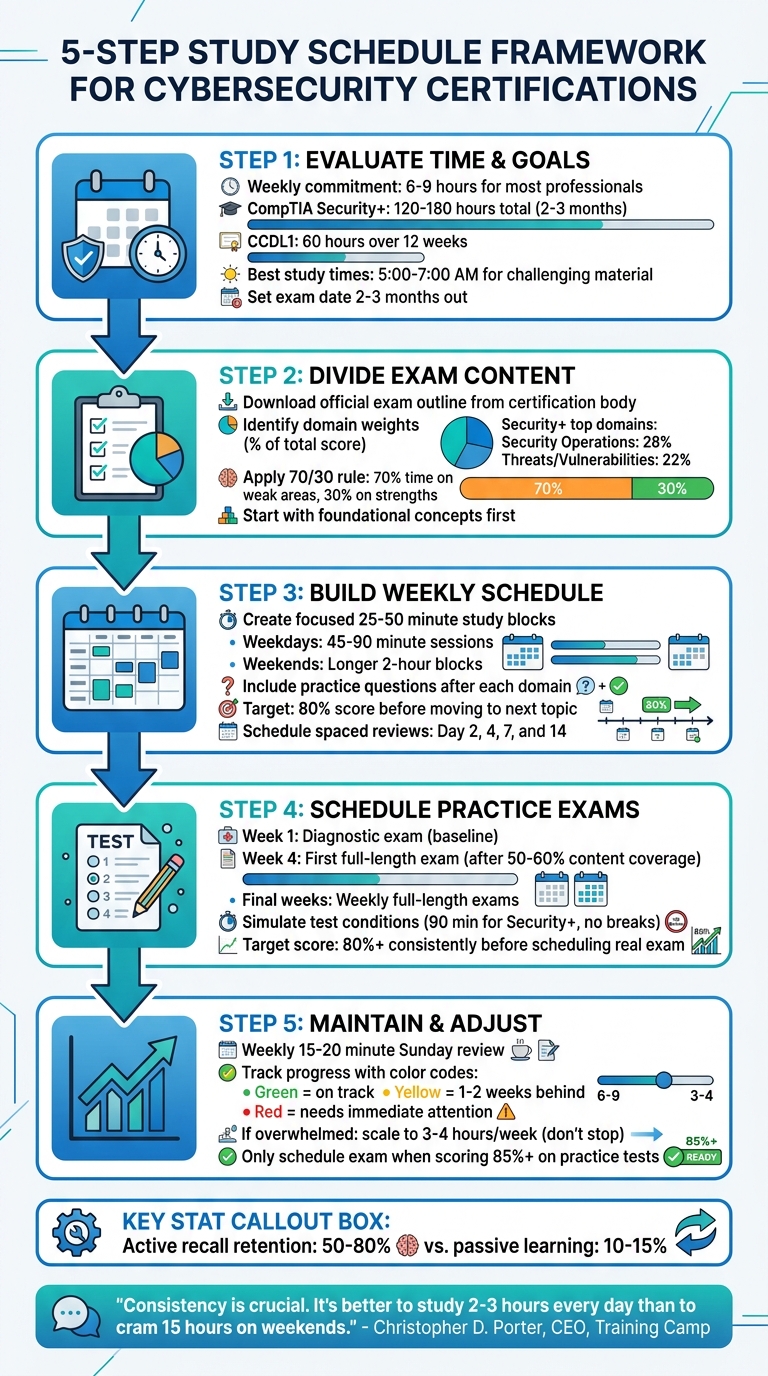
5-Step Study Schedule Framework for Cybersecurity Certifications
Step 1: Evaluate Your Time, Goals, and Responsibilities
Calculate Your Weekly Study Hours
Take a close look at your weekly schedule to pinpoint reasonable study windows. For most working professionals, dedicating 6–9 hours a week is manageable without risking burnout. The time commitment for certification prep varies: for example, CompTIA Security+ typically requires 120–180 hours over two months (around 14–21 hours per week), while CCDL1 demands about 60 hours over 12 weeks (roughly 6–9 hours weekly). If you’re starting from scratch, even 30 minutes a day (about 3.5 hours per week) can help you establish a steady habit that you can gradually expand.
"Consistency is crucial. It's better to study 2-3 hours every day than to cram 15 hours on weekends." - Christopher D. Porter, CEO, Training Camp
Block out specific time slots in your calendar and treat them as non-negotiable, like important meetings. Early mornings, between 5:00 and 7:00 AM, are often ideal for tackling challenging material when your focus is sharp and distractions are minimal. Save lighter tasks, like reviewing flashcards or answering practice questions, for evenings when your energy might be lower. Don’t forget to include hands-on labs in your schedule, as they can significantly enhance your preparation.
Once you’ve figured out how much time you can dedicate, it’s time to set your certification goal and align your study plan accordingly.
Define Your Certification Target
Choose a certification that aligns with your career aspirations. For entry-level positions, CompTIA Security+ is often a good choice, while higher-level roles, such as managerial positions, typically require certifications like CISSP or CISM. If you’re drawn to offensive security or penetration testing, certifications like CEH or PenTest+ might be more appropriate.
A useful tip is to browse job postings on LinkedIn for roles you’re aiming for to identify the certifications employers prioritize. With 3.5 million unfilled cybersecurity jobs worldwide and 86% of professionals recognizing the value of certifications, earning the right credential could open new doors - provided it matches your career goals. Set a specific exam date about three months out, and create weekly milestones to track your progress. For instance, aim for a 12% readiness score by the end of week one to stay on track.
Once you’ve chosen your certification, adapt your study sessions to fit both your energy levels and daily schedule.
Balance Study Time with Personal and Work Obligations
Now that you know your available study hours and certification target, it’s time to integrate your study plan into your daily routine. Schedule challenging topics for mornings when your mind is sharpest, and save lighter review tasks for the evenings. If work gets particularly hectic, scale back to 3–4 hours per week instead of stopping altogether - consistency is key.
Incorporate study sessions into your existing habits. For example, review flashcards during lunch breaks, after your morning coffee, or while commuting. Even small increments, like 15 minutes here and there, can accumulate to over 7 hours of study time per month. On days when you’re feeling drained, commit to just 5 minutes of study - often, that small action will lead to a longer session. Spend 15 minutes planning your week on Sunday evenings to reduce decision fatigue and keep yourself accountable.
sbb-itb-8a31326
HOW TO Schedule Study Time for Cyber Security Certifications
Step 2: Divide the Exam Content into Sections
Breaking the exam content into smaller, manageable sections is key. Certification bodies like ISC2, ISACA, and CompTIA provide an official exam outline that lists all the domains, subtopics, and knowledge statements you need to know. Start by downloading this outline - it’s your study roadmap.
These outlines also highlight domain weights, which reveal the percentage each domain contributes to your total score. For instance, in the CISM exam, the domains "Information Security Program" and "Incident Management" make up 63% of the exam score. Similarly, Security+ dedicates 28% of its weight to Security Operations and 22% to Threats, Vulnerabilities, and Mitigations - together, that’s half the exam. Use these percentages to guide how much time you dedicate to each domain. If a domain accounts for 33% of the exam, it should get roughly 33% of your study hours. This breakdown will help you allocate your time effectively as you move forward.
Assign Time Based on Topic Weight and Difficulty
Focus your efforts on the domains with the highest weight. For example, in Security+, prioritize Security Operations (28%) and Threats/Mitigations (22%). In CySA+, concentrate on Security Operations (33%) and Vulnerability Management (30%).
Don’t just rely on the weights - factor in your personal knowledge gaps. Take an early practice quiz to identify weak areas and create a "weakness map". If a heavily weighted domain is also an area where you score below 65%, dedicate extra study sessions to it. Use the 70/30 rule: spend 70% of your time improving weak areas and 30% maintaining your strengths. This approach ensures you’re not just revisiting what you already know. Once you've prioritized your focus, dive into mastering the core concepts.
Start with Core Concepts
Begin your study plan with foundational domains. For Security+, this means starting with Domain 1 (General Security Concepts) and Domain 3 (Security Architecture). These sections cover critical topics like the CIA triad (Confidentiality, Integrity, Availability), security controls, and compliance frameworks - concepts that appear throughout the exam.
For management-level certifications like CISM, start with strategic domains such as Governance and Risk Management. These areas establish the mindset needed for the rest of the exam. As one CISM prep resource explains, the correct answer often revolves around business alignment, risk-based decision-making, and stakeholder communication - not specific technologies. Building this strategic perspective early will make advanced topics easier to understand later. Balance these study segments with your work and personal responsibilities to stay on track.
Step 3: Build Your Weekly Study Schedule
Now that you’ve outlined your exam domains, it’s time to create a detailed weekly study plan. Breaking your study time into manageable chunks across multiple days can significantly improve long-term retention compared to cramming everything into one long session. A structured schedule also makes it easier to incorporate active recall and regular reviews into your routine.
Organize Study Sessions into Focused Blocks
Divide your weekly study hours into focused sessions lasting 25–50 minutes, each with a specific goal. For example, if you have 8 hours to study, you could plan two 45-minute sessions during the week, a 2-hour block on Saturday, and a 90-minute session on Sunday. Assign each session to a particular domain or task, and use clear labels to keep track of what you’re working on.
Align your study tasks with your natural energy levels. For instance, tackle challenging conceptual material during your peak energy times - often in the morning - and save lighter tasks like reviewing notes or answering practice questions for evenings, when your focus may not be as sharp. If you’re studying after work, shorter sessions can help you avoid burnout.
"Your study time is a meeting with yourself. You wouldn't skip a meeting with your manager because you 'didn't feel like it.'" - IT Support Group
Add Practice Questions to Your Weekly Routine
Incorporating practice questions into your study sessions is essential. Active recall, which involves testing yourself, can lead to retention rates of 50–80%, compared to just 10–15% for passive activities like watching videos. Don’t wait until the end of your study plan to use practice questions - start integrating them after covering each new domain. This approach helps you identify gaps in your understanding while the material is still fresh.
Follow the 80% rule: once you consistently score 80% on practice questions for a topic, move on to the next area. When reviewing your answers, take the time to read the explanation for every question, even the ones you got right. Understanding why the correct answer works - and why the others don’t - will deepen your comprehension.
Plan Time for Review and Schedule Updates
In addition to your focused study blocks, set aside time each week to review your progress and update your schedule. Spend 15–20 minutes every Sunday evaluating what you accomplished versus what you planned. Mark off completed topics and adjust the next week’s plan based on any changes or unexpected challenges.
Make spaced repetition a key part of your routine by scheduling reviews of previously learned material. For example, revisit new concepts on Day 2, Day 4, Day 7, and Day 14 after first learning them. This method helps transfer information into long-term memory and ensures you don’t forget earlier material by exam day. A consistent, well-thought-out weekly schedule will also prepare you to integrate full-length practice exams into your study plan.
Step 4: Schedule Full-Length Practice Exams
Incorporating full-length practice exams into your study plan is a crucial step in preparing for success. These exams help you measure your readiness while building the stamina needed for test day. Start with a diagnostic exam to identify areas that need extra attention before diving into your study material. This initial step allows you to adjust your study schedule based on your strengths and weaknesses. Once you've covered about 50–60% of the content (around Week 4), take your first full-length exam to see how much progress you've made.
As you approach the final stretch of your study timeline, increase the frequency of full-length exams to once a week. This helps you develop endurance and refine your pacing for timed tests, like the 90-minute CompTIA Security+ exam. During the last week, shift your focus to targeted drills rather than taking additional full-length exams.
Take Practice Exams in Test-Like Conditions
To get the most out of practice exams, recreate the actual test environment as closely as possible. Find a quiet space, free from distractions, and complete the exam in one sitting - no breaks, no phone, no interruptions. If your exam will be remote-proctored, set up your practice space exactly as it will be on test day, including lighting, seating, and desk arrangement. For in-person exams, rehearse your exam-day routine, including your travel route and timing.
Stick to the official time limit - 90 minutes for the Security+ SY0-701 exam - and practice pacing strategies like flagging and skipping questions you're unsure about so you can revisit them later. Occasionally, try practicing in less-than-ideal conditions, such as a slightly noisy environment, to strengthen your focus. After each exam, use your results to identify areas that need additional review and fine-tune your study plan.
Review Results to Target Weak Areas
After finishing each practice exam, review every question - correct and incorrect. This approach ensures your reasoning is solid and not based on lucky guesses. Carefully analyze your mistakes to uncover gaps in understanding, confusion over terminology, or misinterpretation of questions. Use the domain-specific breakdown from your results to identify your three weakest areas and devote about 70% of your remaining study time to improving in those domains. At the same time, continue reinforcing your stronger areas to maintain balance.
Before scheduling your actual exam, aim to consistently score above 80% on practice tests. Keep in mind that test-day nerves can lower your score by 5–10%, so this buffer ensures you're well-prepared.
"The real purpose of a good simulator is not to show you what you know - it's to reveal how you think." - ExamCollection
Step 5: Maintain Consistency and Make Adjustments
Creating a study schedule is just the first step - the real challenge lies in sticking to it while handling life’s inevitable curveballs. Think of your plan as a flexible guide rather than a rigid timetable. Each week will teach you more about what works best for you, so let your schedule evolve to match your needs. This kind of flexibility is key to staying on track over the long haul.
Monitor Your Progress Weekly
Set aside 15–20 minutes every Sunday to reflect on your progress and plan for the week ahead. This small habit can help you avoid decision fatigue and spot patterns that might be slowing you down. Take note of which study blocks you completed and which ones you missed - this will help you pinpoint the time slots that aren’t working.
Using a simple tracker or spreadsheet can make this process easier. Some people use color-coded systems to stay organized: Green for on track, Yellow for 1–2 weeks behind, and Red for areas needing immediate attention. For example, if you’re preparing for the CompTIA Security+ exam, you can track your practice test scores as a measurable indicator - aiming for 75% accuracy by Week 3 and 85% by your final week. Regularly reviewing and tweaking your schedule ensures it stays aligned with your goals and progress.
Adjust Your Schedule When Needed
Life happens, and when it does, being able to modify your schedule is essential. If you’re dealing with a demanding work project or a personal emergency, don’t pause your studies altogether. Instead, scale back. For example, if you usually study 8 hours a week, consider cutting it down to 3 hours during high-stress periods. This lighter approach keeps your momentum going, and it’s often easier to pick up where you left off than to restart from scratch.
If you frequently miss a particular time slot, it’s worth rethinking that part of your plan. Shortening the session or moving it to a time when you have more energy can make a big difference. For example, if 90-minute evening sessions aren’t working, try splitting them into two 45-minute blocks - one at lunch and one in the evening. If you miss a session, use your catch-up block instead of skipping it entirely. And if your practice test scores stay below 70%, it might be worth paying the rescheduling fee (which is often much less than the $404 exam voucher) to give yourself more time for preparation.
Conclusion
Creating a study schedule is about designing a system that fits your life while guiding you steadily toward exam day. It starts with assessing your available time, breaking down exam domains by their weight and difficulty, and organizing your study sessions into focused blocks. These blocks should include learning new material, hands-on practice, and regular review. Full-length practice exams then help identify areas that need more work.
Regularly reviewing your progress ensures your schedule stays effective and adaptable. The key to success? Balancing consistency with flexibility. Christopher D. Porter, CEO of Training Camp, emphasizes this point:
"Consistency is crucial. It's better to study 2-3 hours every day than to cram 15 hours on weekends."
This steady routine not only builds strong habits through spaced repetition but also allows for adjustments when life gets hectic. Scaling back temporarily is far better than stopping completely. Aim to schedule your exam only when you're consistently scoring 85% or higher on full-length practice tests. Hitting this benchmark boosts your confidence and ensures you're fully prepared, minimizing the risk of costly retakes.
For certifications like CompTIA Security+, most candidates need 2–3 months of focused study at 2–3 hours per day. Your timeline might vary based on your background and the certification you're pursuing, but the most important factor is steady progress. Use practice exams to identify weak areas and refine your plan based on real data.
Treat your study time like an unmissable appointment. Focus on active learning techniques instead of passive reading, and remember that consistent daily sessions are far more effective than last-minute cramming. By aligning your study blocks with your personal and work commitments, you create a plan that works for you. With discipline and an adaptable approach, you'll not only be ready to pass your exam but also take a meaningful step forward in your cybersecurity career.
FAQs
How do I pick the right certification for my career goal?
When selecting a certification, think about your career aspirations, the skills you currently have, and what the industry is looking for. If you're aiming for entry-level roles, certifications like Security+ can be an excellent starting point. For more advanced positions, you might need something like CISSP or CASP+.
Choose certifications that match the type of role you're targeting - whether it's in security analysis, management, or a specialized area. Also, make sure the certification you pursue is respected and sought after by employers in the cybersecurity field.
What should I do if I can’t study 6–9 hours every week?
If dedicating 6–9 hours a week to studying feels overwhelming, tailor your plan to fit the time you can realistically commit. Consistency is more important than sheer volume. For instance, you could aim for 3–4 hours per week, broken into shorter, manageable sessions. This approach helps you stay on track without feeling overloaded. The goal is to create a structured plan that aligns with your schedule, keeping you productive without risking burnout.
When am I ready to schedule the real exam?
When you've wrapped up your study plan, gone over the exam outline, and feel confident in your grasp of the material, it's time to schedule your exam. Taking practice tests is a great way to gauge how prepared you are and identify any areas that might need extra attention. Plus, setting an exam date can give you that extra push to stay motivated and focused as you continue your preparation.