Your degree can change your starting pay, but not by as much as many people think. In U.S. entry-level cybersecurity jobs, starting salary often lands anywhere from $55,000 to $100,000+, and the ranges overlap a lot across associate, bachelor’s, master’s, bootcamp, and cert-only paths.
Here’s the short version:
- Associate degree: often $58,000–$80,000
- Bachelor’s degree: often $65,000–$85,000
- Master’s degree: often $75,000–$100,000+
- Bootcamp or non-degree path: often $55,000–$90,000
What moves pay the most at this stage?
- Security+
- SIEM skills like Splunk or Microsoft Sentinel
- Cloud basics like AWS Cloud Practitioner or AZ-900
- Internships
- Help desk or IT support work
- A small portfolio with labs, dashboards, or incident write-ups
One stat stands out: 56% of hiring managers say entry-level hires need 4–9 months to work on their own. That helps explain why employers often pay for job readiness, not just school level.
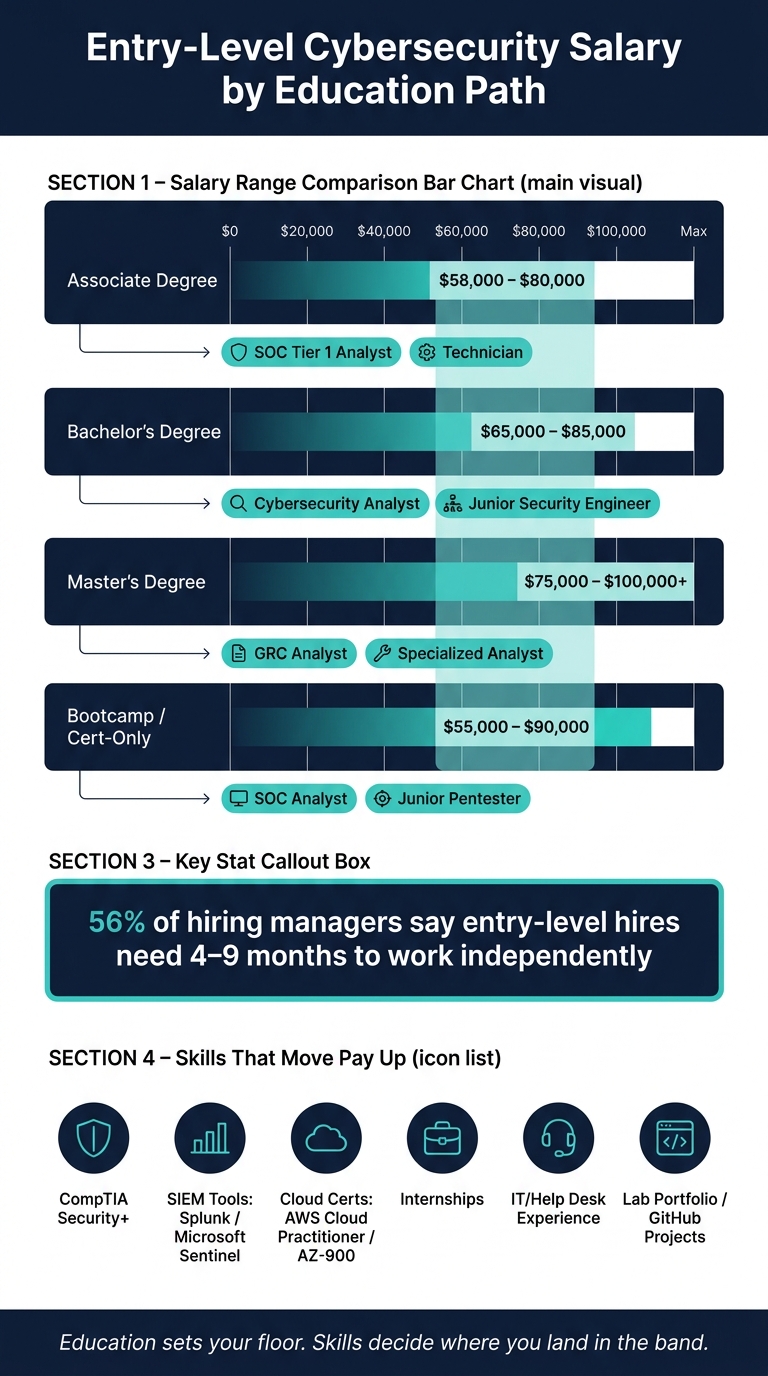
Entry-Level Cybersecurity Salary by Education Path (2024)
Cybersecurity Beginner Salary: What to Really Expect
sbb-itb-8a31326
Quick Comparison
| Path | Usual Starting Pay | Common First Jobs | What often helps pay move up |
|---|---|---|---|
| Associate degree | $58,000–$80,000 | SOC Tier 1, technician | Security+, labs, basic IT work |
| Bachelor’s degree | $65,000–$85,000 | Security analyst, junior engineer | Certs, internships, SIEM skills |
| Master’s degree | $75,000–$100,000+ | GRC analyst, focused analyst roles | Focus area, certs, proof of skills |
| Bootcamp / cert-only | $55,000–$90,000 | SOC analyst, junior pentester | Strong labs, certs, portfolio |
Bottom line: I’d sum it up like this: education helps set your floor, but your skills, certs, and proof of work usually decide where you land in the band.
Entry-Level Cybersecurity Salary Ranges by Education Path
Starting Pay for Associate, Bachelor's, and Master's Degree Holders
Associate degree holders often start in the $58,000 to $80,000 range in SOC Tier 1 or technician roles, especially when they pair the degree with Security+ and hands-on labs.
Bachelor's degree holders usually land in the $65,000 to $85,000 range in analyst or junior engineer roles. The pay bump over an associate degree is there, but it’s not huge.
Master's degree holders tend to start around $75,000 to $100,000+, most often in GRC or more specialized analyst roles. That said, non-degree candidates can still reach similar starting pay if they can show they’re ready to do the job.
Starting Pay for Bootcamp and Non-Degree Candidates
Bootcamp and certification-only candidates can still compete on salary. Research puts their starting pay between $55,000 and $90,000, with SOC Analyst roles showing up most often as the first step in.
The higher end of that range usually goes to people who bring more than a certificate. Labs, a project portfolio, and job-related certifications can make a clear difference.
Comparison Table: Entry-Level Cybersecurity Salary by Education Path in the United States
| Education Path | Typical Starting Salary Range (USD) | Common Entry Roles | Notes |
|---|---|---|---|
| Associate Degree | $58,000 – $80,000 | SOC Technician, Tier 1 Analyst | Entry-level estimate |
| Bachelor's Degree | $65,000 – $85,000 | Cybersecurity Analyst, Junior Security Engineer | Entry-level estimate |
| Master's Degree | $75,000 – $100,000+ | GRC Analyst, Specialized Analyst | Entry premium modest vs. bachelor's |
| Bootcamp / Non-Degree | $55,000 – $90,000 | SOC Analyst, Junior Pentester | Range reflects certification and lab strength |
These ranges overlap a lot because employers often care just as much about certifications, labs, and interview prep as they do about the degree itself. The next section breaks down what tends to push pay up or down within each path.
How Much Education Actually Changes Starting Pay
Where the Pay Premium Is Real and Where Bands Overlap
These pay ranges overlap for a simple reason: employers pay for readiness, not just credentials. More education can improve your odds of landing an entry-level role, but the jump in starting pay from one credential to the next is usually modest. In many cases, salary bands for adjacent education levels blend together. Location, industry, and clearance eligibility often shape starting pay more than degree level does.
Employers also look at degrees, certifications, and lab work as separate signs of job readiness. And that matters. 56% of hiring managers say entry-level hires need 4–9 months to work independently, which keeps day-one skills in play when pay is set. So while education helps set the floor, certs and hands-on proof often do more to move the number upward.
Comparison Table: Pay Differences Between Education Levels
| Education Transition | Typical Increment (USD or %) | Conditions |
|---|---|---|
| Bootcamp → Associate Degree | Variable; mainly a credibility gain | Needs Security+ and a technical portfolio to matter |
| Associate → Bachelor's Degree | Slightly higher starting pay | Gap is small; Security+ and prior IT experience can close it |
| Bachelor's → Master's Degree | Not clearly defined for entry-level roles | Pay difference between these credentials is narrow at the entry level |
Education level sets the baseline. Skills shape how far above that baseline you start. The next section looks at which certifications and skills tend to widen those salary bands.
Certifications, Skills, and Experience That Affect Pay Within Each Education Level
Why Security+ and Hands-On Skills Matter Alongside a Degree
A degree can help you get past the first screen. After that, pay usually comes down to what you can show.
Within the same education path, certifications and hands-on proof often decide whether you start near the bottom or top of the salary band. Entry-level SOC Analyst roles usually start between $65,000 and $85,000. That gap often has less to do with coursework and more to do with whether you can show practical ability.
CompTIA Security+ is the clearest starting point. It is the most-requested entry-level certification and a common baseline for DoD-related roles.
After Security+, SIEM experience can make a big difference at the entry level, especially with tools like Splunk or Microsoft Sentinel. There’s a clear gap between a candidate who says, “I know what a SIEM is,” and one who can walk through how they triaged an alert, checked logs, and sorted signal from noise. Hiring teams notice that fast.
Cloud knowledge matters too, and more than many entry-level candidates think. Cloud security is the second most in-demand skill set, cited by 36% of employers. A starter credential like AWS Cloud Practitioner at about $100 or Azure Fundamentals AZ-900 at about $165 shows that you understand the systems where a lot of modern security work now happens.
Experience outside the classroom can shift pay in a similar way. Paid internships are linked to higher wages after graduation, which makes them more than just resume filler.
The same goes for IT support or help desk experience. If someone has one to three years in a general IT role and then moves into cybersecurity, they often get a pay premium of about 30%. That makes sense. They’re not learning ticketing, troubleshooting, user issues, and system basics from scratch on day one.
A small portfolio can help tie all of this together. A GitHub profile with home lab work, such as Nessus reports, Splunk dashboards, and incident write-ups, gives employers something concrete to review. Proof of work beats claimed skill.
Conclusion: What Education Means for First-Year Cybersecurity Pay
Across the education paths in this article, one thing stands out: education tends to lift the starting point more than the top end. A bachelor's degree is still the most common route into entry-level SOC roles, while an associate degree can still help candidates get in the door, usually at somewhat lower pay.
Bootcamp graduates and non-degree candidates can compete too. But there’s a catch. They usually need to show they’re job-ready through certifications, lab work, and hands-on experience.
That said, pay still shifts based on the role and the market. Education can open the door, but your skills and proof of work usually decide where you land within those salary ranges.
FAQs
Does a degree matter more than certifications?
It depends on the employer and what you want from your career. For many entry-level cybersecurity jobs, certifications and hands-on skills often matter more than a degree, especially in the private sector.
That said, a bachelor’s degree is often expected by large organizations, federal agencies, and defense contractors. It’s not always required, but it can help you earn more and make it easier to get through resume screening.
Which entry-level cybersecurity roles pay the most?
The top-paying entry-level cybersecurity roles are Junior Penetration Tester and Security Auditor.
A Junior Penetration Tester earns about $116,104 on average, with pay often ranging from $90,000 to $140,000.
A Security Auditor earns about $114,282, with a usual range of $85,000 to $135,000.
That puts both roles ahead of other entry-level jobs in the field, such as Cybersecurity Analyst at about $93,519 and Vulnerability Tester at about $85,000.
How can I raise my starting salary without a master’s?
You can increase your starting salary without a master’s if you focus on high-value certifications and hands-on work. Certifications like CompTIA Security+ or CEH can add $5,000 to $25,000 to base pay.
That said, certs alone usually won’t do all the heavy lifting. Employers also want proof that you can do the job, not just pass an exam. That’s where practical work matters.
A few examples:
- GitHub projects
- Home labs
- Internships
These help show practical skill in a way hiring teams can see fast. If you can point to work in areas like cloud security, incident response, or threat hunting, you’re in a better spot to grow your pay early in your career.