Looking to start a career in Governance, Risk, and Compliance (GRC)? Certifications are a great way to build expertise and stand out in the job market. Here’s a quick guide to the best entry-level GRC certifications:
- CompTIA Security+: Perfect for beginners with no prerequisites. Focuses on cybersecurity basics and is widely recognized across industries. Cost: $425.
- GRCP (GRC Professional): Beginner-friendly, covering governance, strategy, risk, compliance, and audit principles. Open-book exam. Cost: $499–$575.
- CISA (Certified Information Systems Auditor): Known as the gold standard for IT auditing. Requires 2–5 years of experience (or can be earned as an Associate). Cost: $575–$760.
- CRISC (Certified in Risk and Information Systems Control): Ideal for those interested in enterprise risk management. Requires 3 years of experience (or Associate status). Cost: $575–$760.
- CGRC (Certified Governance, Risk, and Compliance): Focuses on managing systems within risk frameworks, especially for regulated industries. Requires 2 years of experience (or Associate pathway). Cost: $599–$749.
These certifications cater to different career paths, from auditing to risk management. Choose based on your interests, background, and goals.
Quick Comparison
| Certification | Cost (USD) | Prerequisites | Exam Duration | Career Focus |
|---|---|---|---|---|
| CompTIA Security+ | $425 | None | 90 minutes | Cybersecurity basics, entry-level roles |
| GRCP | $499–$575 | None | 2 hours | Broad GRC knowledge, beginner-friendly |
| CISA | $575–$760 | 2–5 years* | 4 hours | IT auditing, compliance roles |
| CRISC | $575–$760 | 3 years* | 4 hours | Enterprise risk management |
| CGRC | $599–$749 | 2 years* | 3 hours | Risk frameworks in regulated industries |
*Note: Associate pathways allow you to take the exam before meeting experience requirements.
Certifications like these not only validate your skills but also help you secure roles in a growing field. Keep reading to learn more about each certification and how to prepare effectively.
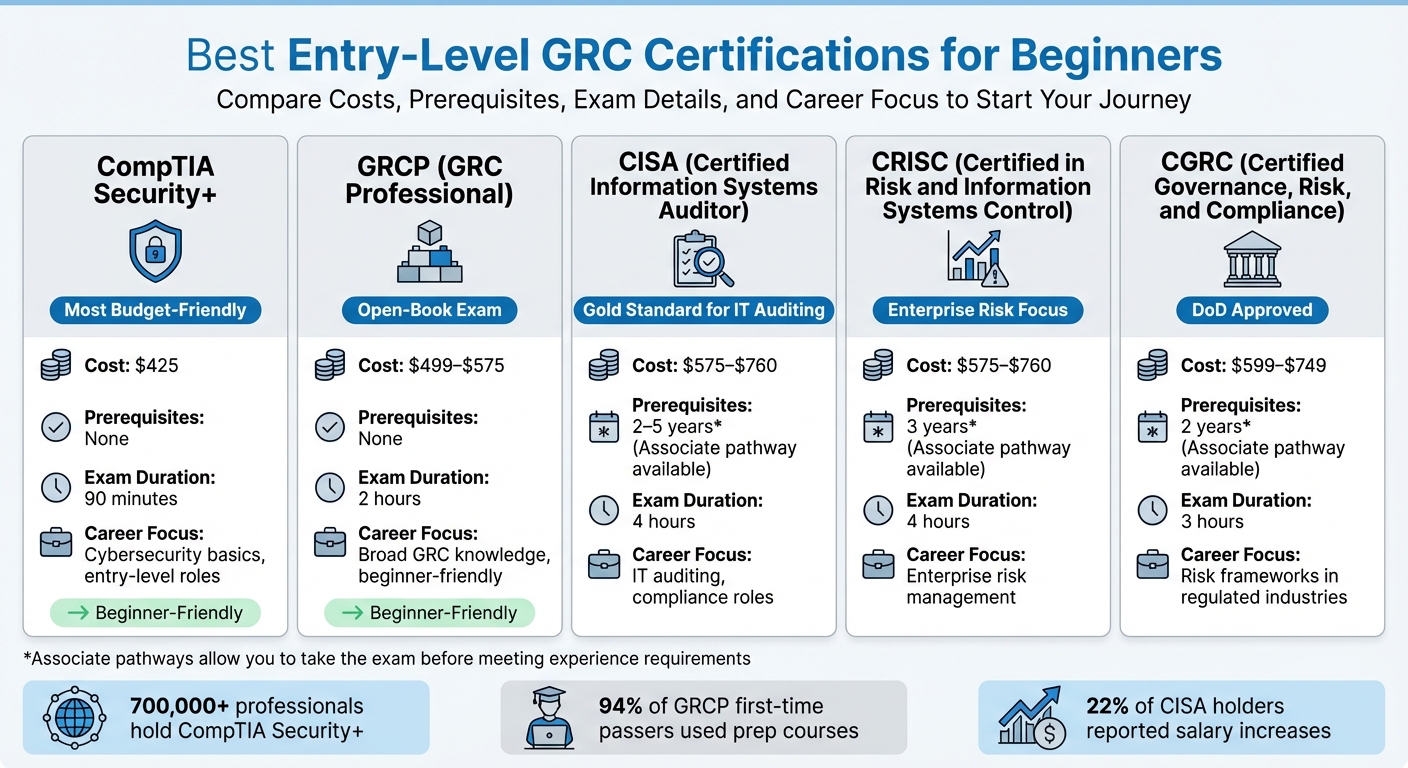
Entry-Level GRC Certifications Comparison: Cost, Prerequisites, and Career Focus
The Smart Way to Choose GRC Certifications That Actually Get You Hired
sbb-itb-8a31326
Best Entry-Level GRC Certifications
If you're looking to break into the world of Governance, Risk, and Compliance (GRC), these certifications can serve as excellent starting points. Each offers its own benefits, depending on your career goals and existing experience. Here's a closer look at some of the most accessible options to kickstart your GRC journey.
CompTIA Security+
CompTIA Security+ is a great foundational credential for anyone interested in GRC. It focuses on cybersecurity basics, making it ideal for those just starting out. The best part? There are no prerequisites, so even complete beginners can pursue this certification. It's widely recognized in the industry, with 17% of entry-level GRC job postings specifically listing it as a requirement. If you're aiming for your first role in GRC, this certification can help you stand out.
GRCP (GRC Professional)
Offered by OCEG, the GRCP certification is one of the easiest ways to enter the GRC field. You don't need any prior professional experience, and the cost - US$499 - covers both the training materials and the exam. The certification provides a thorough understanding of governance, strategy, risk, compliance, and audit principles.
The exam is open-book and includes 100 questions to be completed in two hours. This format reflects real-world scenarios, where professionals often rely on resources to solve problems. As OCEG puts it:
GRCP is the perfect way to start your career. By understanding and applying all critical disciplines, you have a broad foundation to build a career in any GRC role.
Preparation time varies, but most successful candidates recommend taking a preparatory course - 94% of first-time passers credit this step for their success.
CISA (Certified Information Systems Auditor)
The CISA certification, offered by ISACA, is often referred to as the "gold standard" for IT auditing. While it typically requires five years of professional experience, a university degree can reduce this to two or three years. The exam costs US$575 for ISACA members and US$760 for non-members.
CISA focuses on auditing information systems, evaluating controls, and ensuring compliance with regulatory standards. Even if you haven't met the experience requirement yet, many employers value candidates who are working toward this certification early in their careers.
The exam includes 150 multiple-choice questions spread across five domains, and a passing score is 450 out of 800. To maintain the certification, you'll need to earn 20 Continuing Professional Education (CPE) credits each year.
CRISC (Certified in Risk and Information Systems Control)
For those interested in specializing in enterprise risk management, CRISC is an excellent choice. It requires three years of experience in at least two of four key domains: IT Risk Identification, IT Risk Assessment, Risk Response and Reporting, and Information Technology and Security.
The exam costs US$575 for ISACA members or US$760 for non-members, with an additional US$50 application fee after passing. The four-hour test includes 150 questions, and you'll need a score of at least 450 out of 800 to pass. Like CISA, you can take the exam before meeting the experience requirement and apply for certification once you've gained the necessary experience. Maintaining the certification requires earning 20 CPE credits annually.
CGRC (Certified Governance, Risk, and Compliance)
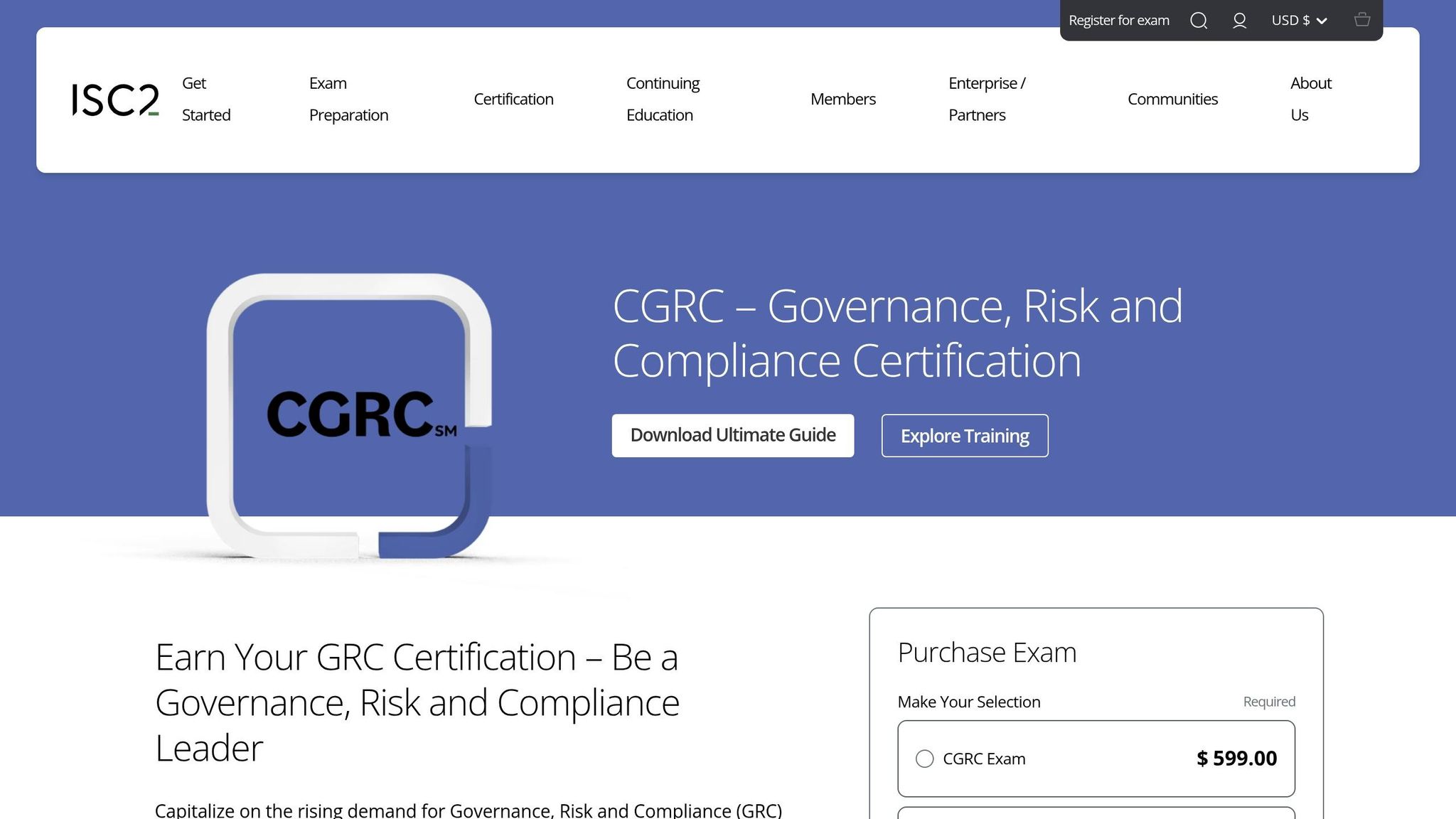
Previously known as CAP, the CGRC certification from ISC2 focuses on managing information systems within risk management frameworks. It costs US$599 and requires two years of paid work experience in one or more of its five domains. However, ISC2 offers an "Associate" pathway, allowing you to take the exam immediately and earn the full certification once you've gained the required experience.
CGRC is particularly valuable for roles in federal, defense, and other regulated industries. It's even approved for U.S. Department of Defense positions. The exam includes 125 questions to be completed in three hours, covering domains like Governance, Risk Management, Compliance, Security Operations, and Information Security Program Management. To keep the certification valid, you'll need to earn 90 CPE credits every three years.
Each of these certifications provides a pathway into GRC, tailored to different interests and career goals. Whether you're starting from scratch or building on existing knowledge, there's an option here that can help you take the next step.
Certification Comparison
Comparison Table
Here's a breakdown of five key certifications, comparing their cost, prerequisites, exam duration, and career benefits:
| Certification | Cost (USD) | Prerequisites | Exam Duration | Career Impact |
|---|---|---|---|---|
| CompTIA Security+ | $425 | None | 90 minutes | High; essential for passing HR filters and required for many U.S. Department of Defense roles. Over 700,000 professionals worldwide hold this credential. |
| GRCP | $499–$575 | None | 2 hours | Moderate; covers a broad range of GRC disciplines. Notably, 94% of first-time passers credit preparatory courses for their success. |
| CISA | $575–$760 | 5 years* | 4 hours | High; widely recognized as the gold standard for IT auditing roles. Impressively, 22% of certified professionals reported receiving a raise after earning this certification. |
| CRISC | $575–$760 | 3 years* | 4 hours | High; highly regarded for aligning IT risk management with executive decision-making. |
| CGRC | $599–$749 | 2 years* | 3 hours | High; tailored for regulated industries requiring formal system authorization. Requires 60 CPE credits every three years. |
*Note: Candidates for CISA, CRISC, and CGRC can take the exams before meeting the experience requirements. Passing earns them "Associate" status, allowing them to work toward full certification while gaining the necessary experience.
Key Insights
When it comes to cost, CompTIA Security+ is the most budget-friendly option at $425, while GRCP offers a slightly higher price point at $499–$575, which includes training and the exam. ISACA certifications like CISA and CRISC are on the higher end but offer member discounts, making them a better deal for those eligible.
In terms of prerequisites, CompTIA Security+ and GRCP are accessible to beginners, as they require no prior work experience. On the other hand, CISA, CRISC, and CGRC demand 2–5 years of experience. However, the exam-first option for these certifications lets candidates earn "Associate" status while building their experience.
Each certification offers unique career advantages. For instance, CompTIA Security+ is highly recognized across industries. As EntryToCyber puts it, "If you only get one certification, make it Security+. No debate.". Meanwhile, CRISC and CGRC cater to niche roles - CRISC for enterprise risk management and CGRC for positions in regulated sectors requiring formal system authorization.
This comparison showcases a range of pathways into GRC careers, from beginner-friendly options to certifications tailored for specialized roles.
How to Choose Your First GRC Certification
What to Consider
When deciding on your first GRC certification, it's important to align your choice with both your current role and long-term career goals. For instance, if you're pursuing a career in auditing, CISA is widely recognized as the go-to certification. On the other hand, if risk management is your focus, CRISC might be a better match. For those working in federal government or defense roles, CGRC is tailored to the specific risk management frameworks often required in those sectors.
Your technical background also plays a key role. If you come from a non-technical field like law, business, or liberal arts, consider certifications that emphasize policy and governance, such as GRCP. For those with an IT background, CompTIA Security+ is a solid starting point to establish a technical foundation.
Certifications vary in their prerequisites. For example, GRCP is beginner-friendly and doesn't require prior experience, making it accessible to newcomers. In contrast, certifications like CISA and CISM typically require about five years of experience. Some ISC2 certifications offer an "exam-first" pathway, allowing you to take the exam and earn an Associate designation while working toward the required experience.
Preparation time also differs. GRCP candidates report spending anywhere from 2 to 40 hours studying, depending on their background. As Payal Wadhwa advises:
Choose certifications that align with both your current responsibilities and future specialization goals.
Once you've identified the right certification, the next step is to explore learning resources that can help you succeed.
Learning Resources
For practical training and career guidance, Root School (https://root-school.com) is an excellent resource for those new to GRC. It offers targeted programs designed to help aspiring cybersecurity professionals land their first GRC role. Training covers essential topics like frameworks (e.g., NIST CSF, ISO 27001) and the communication skills needed to explain technical risks to non-technical audiences.
To build your foundational knowledge, consider free or affordable courses on platforms like YouTube, Coursera, and LinkedIn Learning. These introductory courses on governance and risk assessment can help you confirm your interest before committing to more advanced certifications. When you're ready to dive deeper, official training materials from organizations like OCEG, ISACA, and ISC2 can provide the in-depth knowledge needed to succeed.
Conclusion
Choosing your first GRC certification is a key step that can shape your cybersecurity career in meaningful ways. The right certification not only validates your skills but also opens up leadership opportunities and has the potential to increase salaries by 25% to 35%. As ExpertCisco puts it:
Certification in Risk and Compliance now stands as a strategic necessity rather than an optional credential.
Each certification offers a unique focus: GRCP is perfect for those new to the field without a technical background, CISA is essential for auditing professionals, CRISC hones in on risk management, and CGRC is tailored for federal or defense-related positions.
Beyond certifications, success in GRC requires strong communication and problem-solving skills. Being able to explain technical risks to executives and work effectively across departments is critical. Volunteering or interning in areas like policy writing can also provide valuable hands-on experience and help establish your credibility as you pursue your studies.
The GRC field is evolving quickly, with trends like AI governance, ESG reporting, and new digital resilience laws expected to gain prominence by 2026. Starting with a foundational certification allows you to stay adaptable and explore advanced specializations as the industry changes. Many seasoned professionals eventually pair certifications - for example, combining CRISC with CISM or CISA with CRMA - to deepen their expertise.
If you're ready to take the next step, Root School (https://root-school.com) offers programs designed to help cybersecurity newcomers secure their first GRC role. Pairing the right certification with continuous learning and practical experience can set you on the path to a successful and dynamic career.
FAQs
Which GRC certification should I start with if I have no experience?
For those just starting out with no prior experience, the GRC Professional (GRCP™) certification from OCEG is an excellent entry point. It covers the basics of Governance, Risk, and Compliance (GRC) concepts, offering practical skills and foundational knowledge that make it approachable for newcomers to the field.
What does “Associate” status mean for CISA, CRISC, or CGRC?
The "Associate" status for CISA, CRISC, or CGRC is an entry-level recognition. It highlights foundational knowledge and skills in governance, risk, and compliance (GRC), serving as a stepping stone toward achieving full certification later on.
How can I gain GRC experience while studying for a certification?
To build experience in GRC (Governance, Risk, and Compliance), start by getting involved in tasks like reviewing security policies, helping with risk assessments, or assisting in compliance audits. Entry-level positions such as GRC analyst or compliance analyst are great opportunities to put your theoretical knowledge into action.
You can also work with frameworks like HIPAA, PCI-DSS, or SOX during internships or volunteer projects. This hands-on exposure not only deepens your understanding but also helps you prepare for certification exams.