The U.S. cybersecurity job market is booming, with over 514,000 open positions as of 2026. This field offers high salaries (median $124,910 in 2024) and rapid job growth (29–33% projected between 2032–2034). Employers are prioritizing certifications and hands-on skills over traditional degrees, making it easier for newcomers to enter the industry.
Key Steps to Start Your Career:
- Focus on Entry-Level Roles: Positions like SOC Analyst, GRC Analyst, or IT Security Specialist are ideal starting points.
- Earn Certifications: Start with CompTIA Security+ and build up with Network+ or CySA+.
- Gain Practical Experience: Use internships, IT roles, or personal labs to showcase your skills.
- Tailor Your Resume: Highlight certifications, hands-on projects, and technical skills.
- Search Strategically: Use platforms like LinkedIn, CyberSeek, and USAJOBS.gov to find opportunities.
Why Now? The demand for cybersecurity professionals continues to outpace supply, creating a unique opportunity for career growth. Start building your skills today to take advantage of this talent gap.
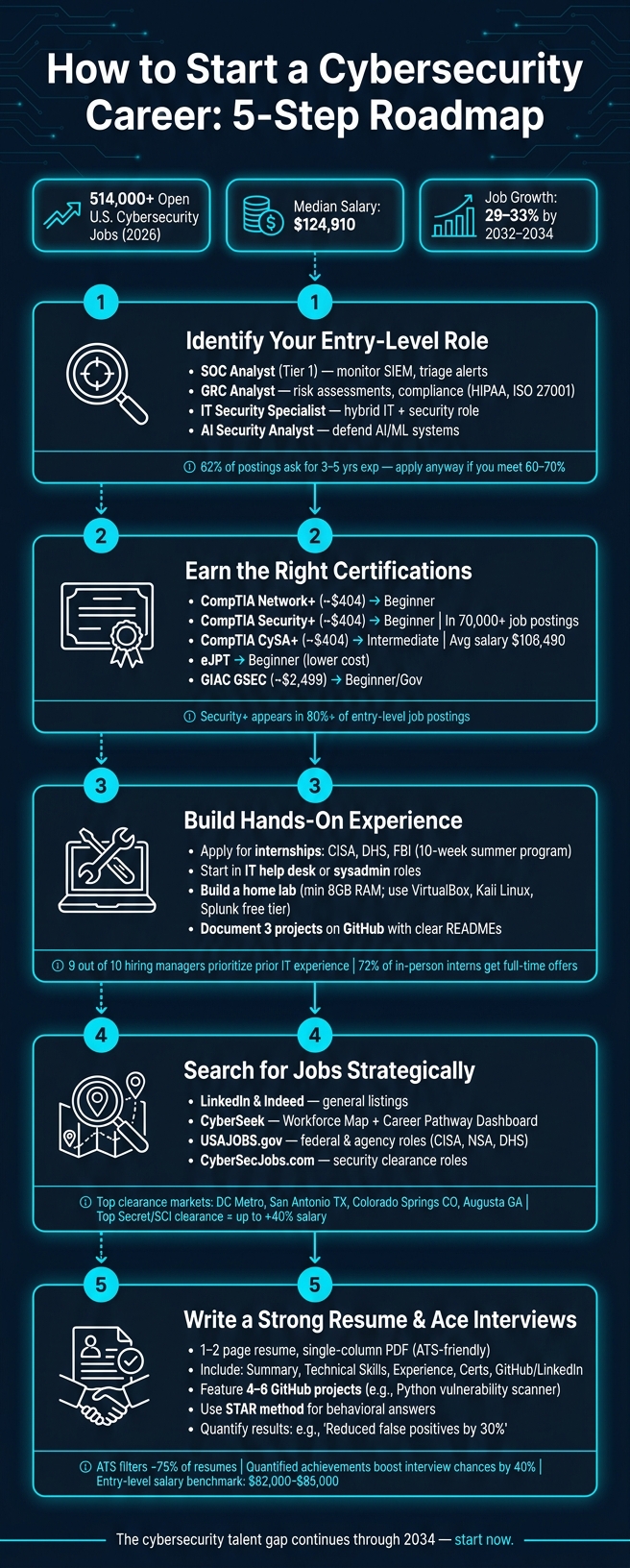
How to Start a Cybersecurity Career: 5-Step Roadmap
How to Land Your First Cybersecurity Job (Step-by-Step Roadmap)
sbb-itb-8a31326
Step 1: Identify Entry-Level Cybersecurity Roles
Start by pinpointing realistic entry-level positions and understanding what these roles entail on a day-to-day basis.
Common Entry-Level Roles in Cybersecurity
A popular starting point in cybersecurity is the role of a SOC Analyst (Tier 1). In this position, you'll monitor SIEM platforms like Splunk or Microsoft Sentinel, triage alerts, and escalate potential threats. Ajay Nawani, CEO of SharkStriker INC, highlights the importance of this role:
"It is a common misconception that all security analysts do is deal with alerts all day. They play a vital role in keeping an organization's data, progress, and reputation secure."
If your background isn't technical, the GRC (Governance, Risk, and Compliance) Analyst role could be a good fit. This role is particularly suited for those with experience in finance, auditing, or legal fields. GRC analysts focus on tasks like conducting risk assessments, maintaining documentation, and ensuring compliance with frameworks such as HIPAA or ISO 27001.
For those already working in IT, the IT Security Specialist role offers a smooth transition into cybersecurity. This hybrid position blends IT support duties with security responsibilities, such as managing user access and administering antivirus solutions. Another emerging option is the AI Security Analyst role, which involves safeguarding AI/ML systems and defending against AI-driven threats. However, this role often demands a stronger technical background.
Skills and Certifications Employers Look For
The CompTIA Security+ certification is widely recognized as the starting point for most entry-level cybersecurity roles. In fact, it appears in more than 80% of job postings for these positions and serves as a key filter in applicant tracking systems. Employers also prioritize candidates with a solid understanding of networking concepts (e.g., TCP/IP, DNS, HTTP/S), familiarity with Linux and Windows Active Directory, and hands-on experience with at least one SIEM platform.
Soft skills are equally critical. Cybersecurity professionals often need to translate complex technical details into clear, concise reports for non-technical stakeholders. Additionally, as automation and AI become more prevalent, 64% of job listings for 2026 now require some knowledge in these areas, even for entry-level roles.
How to Choose Your First Role
Your background plays a key role in determining the best entry-level position for you. Here's a quick guide:
| Background | Ideal First Role |
|---|---|
| IT helpdesk or support | SOC Analyst (Tier 1) |
| Audit, accounting, or legal | GRC Analyst |
| Software development | Junior AppSec or DevSecOps Engineer |
| Military intelligence | Threat Intelligence Analyst |
| Healthcare administration | Healthcare Security Compliance |
Keep in mind that 62% of entry-level job postings mention 3–5 years of experience. Don't let that discourage you. Many job descriptions are aspirational, so apply if you meet at least 60–70% of the requirements. Use home lab projects and certifications to close any skill gaps. Next, we'll dive into how to build the practical skills needed for these roles in Step 2.
Step 2: Build the Skills and Certifications You Need
To land your target role, it’s crucial to identify the specific skills required. By 2026, employers are focusing heavily on proven abilities, meaning you’ll need to back up your skills with practical evidence.
Core Skills for Cybersecurity Work
No matter the cybersecurity specialization, a solid technical foundation is non-negotiable. Start with a deep understanding of networking basics. You need to know how protocols like TCP/IP, DNS, and HTTP function, how network traffic flows, and how to spot unusual activity. As CompTIA explains:
"Before you can secure a network, you must understand how it functions. Otherwise, you are learning security skills and applying them to a network you don't understand."
Beyond networking, focus on mastering Windows administration and Linux command-line (Bash) operations. Familiarize yourself with key security principles such as the CIA triad (confidentiality, integrity, availability), least privilege, multi-factor authentication, and encryption. These are must-know concepts for interviews and certification exams. Additionally, basic scripting skills in Python or PowerShell are becoming standard, with Python mentioned in 30–40% of technical job postings. These core skills lay the groundwork for both certifications and real-world application.
Top Certifications for Beginners
If you’re just starting out, CompTIA Security+ is the certification to prioritize. It’s referenced in over 70,000 U.S. job postings, is a requirement for many government and DoD positions under DoD 8140, and can boost entry-level salaries by $5,000 to $10,000 compared to non-certified candidates. At approximately $404 per exam attempt, it’s one of the best early-career investments you can make.
Before tackling Security+, consider earning CompTIA Network+ to solidify the networking knowledge that Security+ assumes you already have. Once you’ve achieved Security+, CompTIA CySA+ is a logical next step if you’re aiming for roles in SOC (Security Operations Center) or incident response. CySA+ certified professionals earn an average of $106,490 as of 2026.
Here’s a helpful certification path for beginners and intermediates:
| Certification | Best For | Level | Exam Cost |
|---|---|---|---|
| CompTIA Network+ | Building a networking foundation | Beginner | ~$404 |
| CompTIA Security+ | Required for most entry-level roles; DoD 8140 compliance | Beginner | ~$404 |
| CompTIA CySA+ | Ideal for SOC Analyst and incident response positions | Intermediate | ~$404 |
| eJPT | Focused on junior penetration testing fundamentals | Beginner | Lower cost |
| GIAC GSEC | Premium entry-level credential, especially for government roles | Beginner (High Cost) | ~$2,499 |
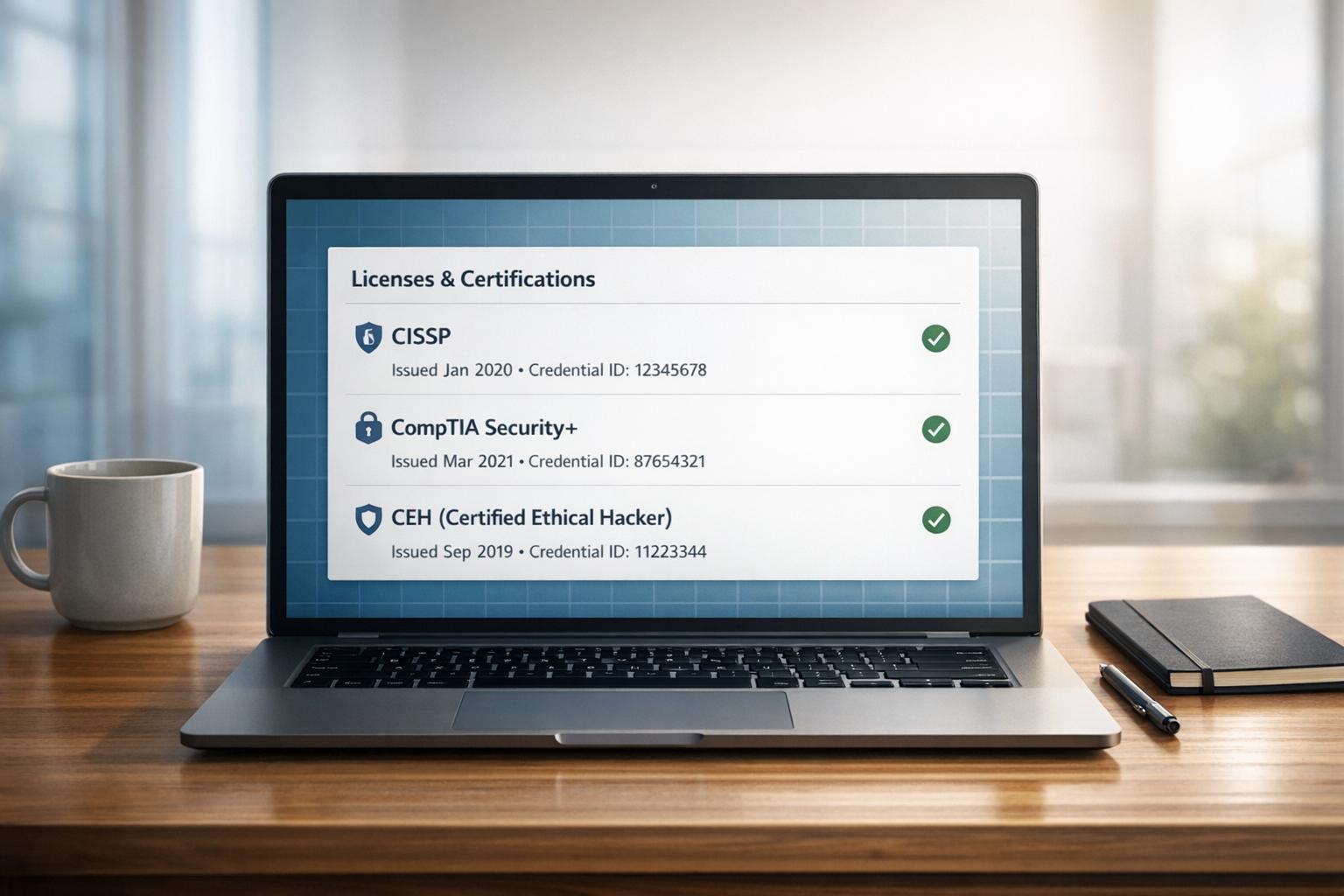
Keep in mind that CISSP is not an entry-level certification. Despite being listed in over 82,000 job postings, it requires five years of verified experience, making it a long-term goal rather than a starting point.
Once you’ve earned certifications, practical lab experience is essential to stand out in the job market.
Building Skills with Root School
Certifications get you noticed; hands-on experience gets you hired. While certifications validate your knowledge, hands-on labs let you demonstrate your abilities. Root School’s courses combine structured lessons with practical labs, helping you apply what you’ve learned in realistic, simulated environments. Whether you’re preparing for Security+ or building expertise with tools like Splunk and Microsoft Sentinel, Root School’s lab-based approach ensures you’re ready to meet employer expectations from day one.
Step 3: Gain Hands-On Experience
While certifications and skills are important, nothing beats real-world experience when it comes to proving what you can actually do. Certifications might show you know the theory, but hands-on experience demonstrates that you can apply it. With over 500,000 unfilled cybersecurity jobs in the U.S. alone, employers are eager to hire - but here’s the catch: 9 out of 10 hiring managers prioritize candidates with prior IT experience. That makes gaining practical experience a must.
Internships, IT Jobs, and Volunteer Work
One of the best ways to gain experience is through a cybersecurity internship. Programs like those offered by CISA, DHS, or the FBI's 10-week summer internship give you a chance to work in real-world security environments while building valuable connections. Defense contractors like Leidos, SAIC, and Booz Allen Hamilton also recruit interns and often sponsor security clearances - a credential that can boost entry-level salaries by $10,000–$25,000. Keep in mind, though, that recruiting for summer internships typically begins between August and November of the previous year, so applying early is key.
If an internship isn’t an option, consider starting with an IT help desk or system administration job. These roles allow you to work closely with security teams, giving you hands-on experience with networking, troubleshooting, and access management - all critical skills in cybersecurity. Volunteering your tech expertise for a local nonprofit or small business is another way to build practical experience and add real projects to your resume.
Once you’ve gained some workplace exposure, take it a step further by creating your own personal lab.
Setting Up a Home Lab
A home lab is your sandbox - a place where you can practice, experiment, and even fail without consequences.
"In a homelab, failure is part of the plan. You can break things, misconfigure settings, crash servers... and that's where the real learning happens." - Gracie Emmanuel
To get started, you’ll need a system with at least 8GB of RAM, though 16–32GB is better if you want to run multiple virtual machines (VMs). Use a free hypervisor like VirtualBox and download free operating system images. For example, the Microsoft Evaluation Center provides Windows 10 Enterprise and Windows Server images free for 90 to 120 days, which is perfect for practicing Active Directory administration and testing attack scenarios. Pair this with tools like Kali Linux for offensive security and Security Onion or Splunk’s free tier (up to 500MB/day of log ingestion) for defensive monitoring.
To get the most out of your lab, focus on building three distinct projects that highlight your skills in detection, automation, and reporting.
Once you’ve completed your projects, the next step is to showcase them effectively.
Presenting Your Experience in Applications
Your lab work is only as valuable as how well you document and present it.
"Hiring managers read your code more than your resume." - Spyboy Blog
Host your projects on GitHub, and include clear READMEs that explain the problem you tackled, your approach, and the results. When adding lab experience to your resume, be specific. Instead of saying you "practiced with Splunk", write something like: "Built a SIEM environment that ingested 2.4 million events to develop and test custom detection rules." Using the STAR method (Situation, Task, Action, Result) can help you turn any project or internship task into a compelling resume entry.
This same principle applies to internship deliverables. Successful interns often leave behind tangible contributions, like SOP checklists, detection rules, or hardening scripts. If you create something your employer can continue to use after you leave, it shows your value and increases your chances of getting a full-time offer. In fact, 72% of in-person interns receive full-time job offers.
Step 4: Search for Cybersecurity Jobs Effectively
With your skills and certifications ready, it’s time to focus on landing the right cybersecurity role. The key is knowing where to search and how to make yourself stand out to recruiters.
Where to Find Cybersecurity Job Listings
While platforms like LinkedIn and Indeed are great starting points, there are resources tailored specifically for cybersecurity professionals. For example, CyberSeek provides tools like a Workforce Map to track hiring demand by location and a Career Pathway Dashboard to compare roles and salaries side by side. These tools can help you identify opportunities that align with your goals.
If you’re considering federal roles, USAJOBS.gov is the main portal. It lists positions ranging from entry-level analysts to specialized roles within agencies like CISA, NSA, and DHS. For positions requiring security clearances, check out CyberSecJobs.com. Security clearances can significantly boost your earning potential, with a Top Secret/SCI clearance paired with a Full Scope Polygraph increasing salaries by up to 40%.
"A security clearance isn't a background check - it's a career-long asset that compounds in value every year you hold it." - CyberSecJobs Editorial
Certain regions in the U.S. are hotspots for cleared cybersecurity roles. The DC Metro area (including Northern Virginia and Maryland), San Antonio, TX, Colorado Springs, CO, and Augusta, GA are the top markets for these jobs. If you’re open to relocating, targeting these areas could speed up your job search.
How to Organize and Improve Your Job Search
Efficiency is key when navigating the job market. On USAJOBS, create a profile, save searches, and set up email alerts for new postings. Use specific keywords like "SOC Analyst Tier 1", "Junior Penetration Tester", or certifications such as "Security+" and "DoD 8140" to refine your search. Additionally, making your resume searchable allows recruiters to find and contact you directly.
If you’re a student or recent graduate, don’t overlook the Pathways Programs filter on USAJOBS. It highlights entry-level federal positions tailored for early-career professionals. Keep in mind that about 10% of cybersecurity job listings now mention AI-related skills, so showcasing any relevant expertise could give you an edge.
Once your search strategy is in place, tap into your network to uncover opportunities that might not be advertised.
Using Your Network to Find Opportunities
Many cybersecurity positions are filled through referrals and connections rather than public job postings. Building relationships before actively job-hunting can make all the difference.
"Effective networking means engaging with communities and building genuine relationships." - Orca Security
One of the best ways to connect with others in the field is by volunteering at local or virtual cybersecurity events. Event organizers often have strong networks, and volunteering gives you direct access to them. On LinkedIn, consider engaging with professionals by asking thoughtful questions about their work. Genuine curiosity can lead to meaningful conversations and opportunities that a standard application might not.
If you’re just starting out, explore structured programs like the U.S. Digital Corps, a two-year fellowship for early-career technologists, or CyberCorps: Scholarship for Service (SFS), which offers tuition funding in exchange for federal cybersecurity work after graduation. These initiatives provide direct entry points into federal agencies and valuable professional networks.
Step 5: Write a Strong Resume and Prepare for Interviews
Once you've built your network and identified opportunities, the next step is to make sure your resume and interview skills are polished enough to help you land the job.
How to Write a Cybersecurity Resume
By now, you've gained hands-on experience and built up your technical skills. The challenge is to effectively showcase these on paper.
Your resume should highlight your abilities in a way that stands out:
"Cybersecurity hiring is skill-driven, proof-driven, and signal-based. Companies don't hire resumes. They hire evidence of capability." - Spyboy Blog
Keep your resume concise - 1 to 2 pages in 10–12 point font is ideal for easy reading. Include the following sections:
- Professional Summary: A brief 2–3 line overview answering, "What can this person do for us right now?"
- Technical Skills: Highlight your core competencies.
- Work Experience: List roles in reverse chronological order.
- Certifications and Education: Mention relevant qualifications.
- Portfolio Links: Add links to your LinkedIn profile and GitHub portfolio.
Your GitHub portfolio is a key asset. Feature 4–6 real projects, such as a Python-based vulnerability scanner or security scripts. In today’s job market, a well-documented GitHub portfolio often carries more weight than a traditional resume. If you've worked on labs through platforms like TryHackMe or Hack The Box, include links to your profiles along with detailed writeups of your methods - covering reconnaissance, exploitation, and mitigation.
"A medium HTB rank with excellent explanations beats a high rank with zero documentation." - Spyboy Blog
To improve your chances with Applicant Tracking Systems (ATS), stick to a single-column PDF format. ATS systems filter out about 75% of resumes before they reach a human, so use standard section headings and include both acronyms and full terms (e.g., "Security Information and Event Management (SIEM)"). If you're transitioning careers, a functional resume format can help. For those with relevant experience and technical skills, a combination format works best.
How to Prepare for Cybersecurity Interviews
Once your resume is ready, it’s time to focus on acing interviews.
Cybersecurity interviews typically have three stages: a screening call, a technical assessment, and a behavioral interview. Each stage tests different aspects of your expertise.
Brush up on key areas like networking fundamentals (e.g., TCP/IP, subnetting), operating systems (e.g., analyzing Windows event logs, writing Bash/PowerShell scripts), and security frameworks like the NIST Cybersecurity Framework and CIS Critical Security Controls. For SOC-related roles, practice writing basic Splunk SPL queries and explaining how SIEM correlation rules function.
AI skills are also becoming increasingly important. Be ready to discuss how you’ve used AI to improve security workflows, rather than just listing tools:
"Strong candidates show how they've used AI as a force multiplier in real security workflows, rather than simply listing tools or buzzwords." - Shane Barney, CISO, Keeper Security
For behavioral interviews, use the STAR method (Situation, Task, Action, Result) to structure your answers. Focus on measurable outcomes from your hands-on projects. For instance, you could say, "Reduced false positives by 30% by refining alert thresholds in Splunk." Employers appreciate candidates who can demonstrate growth by discussing past challenges and the steps taken to improve. Highlighting quantified achievements can increase your chances of getting an interview by 40%.
"The ideal candidate has the 'hustle' to find the flaw but the integrity to protect the user." - Kate Terrell, Chief Human Resources Officer, Menlo Security
How to Evaluate and Negotiate a Job Offer
When evaluating a job offer, it’s important to know the market rate. Entry-level cybersecurity analysts typically earn between $82,000 and $85,000 annually. Use this as a benchmark when negotiating your salary.
Conclusion: Take Your First Steps Into Cybersecurity
The strategies we’ve discussed lay the groundwork for starting your cybersecurity journey. This field calls for action now. With a growing demand for skilled professionals and a talent shortage projected to continue through 2034, there’s no better time to dive in.
This guide provided a step-by-step approach to help you break into cybersecurity. Each step is designed to build your skills and confidence, ensuring you're prepared from the very beginning.
The key is to take that first step. As Chad Cragle, CISO at Deepwatch, wisely advises:
"Don't wait for 'perfect readiness'. Start applying for entry-level roles, internships, or apprenticeships as soon as you can demonstrate curiosity and a willingness to learn."
Root School is here to support you on this journey, offering structured programs that guide you from the basics to job-ready expertise.
The need for cybersecurity professionals is urgent, and the path forward is ready for you.
FAQs
Do I need a degree to get a cybersecurity job?
You don’t always need a degree to kick off a career in cybersecurity. Many employers value certifications such as CompTIA Security+ or CISSP, as well as practical skills and real-world experience. While certain large organizations or government agencies might lean toward candidates with a degree, most private-sector roles emphasize your ability to showcase hands-on expertise and a solid understanding of the field. Earning certifications and crafting a strong resume can pave the way for success, even without a formal degree.
Which certification should I get first: Network+ or Security+?
For those new to cybersecurity, the CompTIA Security+ certification is often the go-to starting point. It serves as a foundational credential, perfectly aligned with entry-level cybersecurity roles, and proves you have essential security knowledge.
Although Network+ focuses on networking fundamentals, Security+ is frequently a requirement for many entry-level jobs and offers a more solid base for growing your career in cybersecurity.
What home lab project will impress hiring managers most?
Creating a home lab is an excellent way to grab a hiring manager's attention. By working on projects like building a cybersecurity lab, you can showcase your practical skills and problem-solving abilities. Use this space to simulate real-world scenarios - think network monitoring, vulnerability assessments, or even penetration testing. This kind of hands-on experience not only demonstrates your technical know-how but also reflects your commitment to learning, traits that employers prioritize when considering entry-level candidates.