Want to start a career in penetration testing in 2026? Here’s what you need to know:
- Pentesting Demand: The field is growing fast, with salaries ranging from $70,000–$100,500 for entry-level roles and averaging $153,882 annually.
- Skills Employers Want: Master networking (TCP/IP, DNS), Linux/Windows systems, Active Directory (Kerberoasting, BloodHound), Python scripting, and tools like Burp Suite. Cloud security skills (AWS, Azure, GCP) are increasingly important.
- Certifications That Matter: Start with CompTIA Security+ and eJPT for beginners. For advanced roles, aim for OSCP, PNPT, or cloud-specific certifications.
- Hands-On Experience: Use platforms like HackTheBox, TryHackMe, or set up a home lab. Bug bounty programs can also showcase your abilities.
- Report Writing: Employers value clear, actionable reports. Build a portfolio with sanitized reports from labs or challenges to stand out.
- Career Path: Many start in related roles (SOC Analyst, Vulnerability Analyst) before transitioning to pentesting. IT experience (help desk, sysadmin) is a strong foundation.
Breaking into pentesting requires technical expertise, practical experience, and strong communication skills. Focus on building a portfolio, earning certifications, and practicing in controlled environments to land your first role.
How to Become a Pentester in 2026: Career Roadmap & Timeline
How to Become a Web Application Penetration Tester in 2026
sbb-itb-8a31326
The Pentesting Job Market in 2026
The cybersecurity field is facing a major workforce gap, with 4.8 million positions left unfilled in 2025 - a 19% increase compared to the previous year. Pentesting is one of the areas most impacted by this shortage, and as a result, employers are setting higher qualification standards for new entrants.
What Employers Want
Today’s hiring managers are looking for more than just familiarity with tools. 83% of cybersecurity job postings now demand hands-on experience, and pentesting roles are no exception. For example, Burp Suite proficiency is required in 55% of job postings, while Python scripting is mentioned in 40%. However, beyond technical know-how, what really matters is understanding the mechanics behind attacks, not just executing them.
Certain technical skills are particularly in demand. Active Directory expertise is a must-have, as it remains the backbone for identity management in 90% of corporate environments. This makes skills like Kerberoasting and BloodHound analysis essential for internal pentesting. Additionally, cloud testing roles are growing quickly - up by 47% - as more organizations migrate their infrastructures to AWS, Azure, and GCP.
Interestingly, one of the most sought-after skills isn’t technical at all:
A junior who can write clearly is rare. A junior who can write clearly and prioritize risk is even rarer. That's why reporting is such a strong differentiator.
- Ulrich Swart, Co-founder, Subverted.io
Employers know that the final report is what clients value most. The ability to clearly communicate technical findings and prioritize risks is a critical skill that sets standout candidates apart. These evolving demands are shaping the paths newcomers take to enter the field.
Common Ways to Get Your First Role
With rising expectations, many aspiring pentesters start their careers in adjacent cybersecurity roles. Applying directly for junior pentester positions without prior experience is becoming increasingly difficult. 75% of junior-level roles now require practical, hands-on experience from day one. This means candidates often need to build their skills elsewhere before stepping into pentesting.
Starting in roles like SOC Analyst or Vulnerability Analyst is a common pathway. These positions provide real-world exposure to enterprise environments, security tools, and defensive strategies - skills that ultimately strengthen offensive capabilities. For those already in IT roles such as help desk, system administration, or network support, there’s good news: 90% of employers view this experience as a solid foundation. The transferable skills gained in these roles can be surprisingly relevant when transitioning into pentesting.
Skills You Need to Build
Core Technical Skills
To succeed in penetration testing, you need a rock-solid technical foundation. Start with networking fundamentals - understand TCP/IP at the packet level, DNS, HTTP/HTTPS, subnetting, and how firewalls manage traffic. Without this knowledge, interpreting what you're testing becomes a challenge. You’ll also need to be comfortable with the Linux command line (especially Kali Linux) and Windows system administration, as most engagements will involve one or both environments.
A significant portion of internal testing revolves around Active Directory (AD). Skills like Kerberoasting, AS-REP roasting, ACL abuse (via tools like BloodHound), and identifying ADCS misconfigurations are essential - not just nice-to-haves. For web application testing, focus on the OWASP Top 10, securing APIs (both REST and GraphQL), and spotting business logic flaws that automated tools often miss.
Python is a must-have skill, appearing in 40% of pentesting job postings. It’s the preferred language for creating custom tools, automating reconnaissance, and tweaking existing exploits. Pair this with Bash and PowerShell to round out your scripting toolkit for post-exploitation tasks on Linux and Windows systems. On the tooling side, Burp Suite Pro is a staple, mentioned in 55% of offensive security job postings. It’s the go-to tool for web application testing.
As cloud adoption grows, understanding cloud security is increasingly important. Learn about IAM abuse, spotting misconfigurations, and exploiting serverless environments in platforms like AWS, Azure, and GCP. These skills are becoming essential for staying competitive in the field.
Once you’ve built these technical skills, the next step is just as critical: learning to effectively document and share your findings.
Why Report Writing Matters
Technical expertise alone won’t make you stand out. Your ability to clearly document and explain your findings is just as important. Remember, the report is what the client is paying for. While technical skills might land you the job, strong communication skills will keep clients coming back - and they’re something hiring managers prioritize.
"You get paid for reports and client communication, not for screenshots of shells." - Vidar Frostbjorn, Penetration Tester and Cybersecurity Consultant
A good report is more than a simple list of vulnerabilities. It needs an executive summary that non-technical stakeholders can understand, detailed technical findings with supporting evidence, CVSS 4.0 scores, and actionable remediation steps that developers or sysadmins can implement. Top firms like NCC Group and Bishop Fox often ask for sample reports during the hiring process. Having a polished, sanitized example from your home lab or practice challenges can give you a real edge.
Start building this skill now by writing a short report for every lab machine or CTF challenge you complete. These don’t have to be lengthy, but practicing the structure regularly will make professional reporting second nature when it matters most.
Certifications That Help You Get Hired
Certifications have become a key tool for employers to screen candidates efficiently. They provide a way to validate skills, especially when hiring managers have to sift through hundreds of resumes. By 2026, 60% of employers are expected to prioritize certifications with practical exams over those focused on theoretical knowledge. Simply put, certifications that prove hands-on abilities carry more weight than those based on memorization.
Certifications for Beginners
For those just starting their cybersecurity journey, CompTIA Security+ (SY0-701) is a great entry point. Priced at $425, it’s widely recognized and meets DoD 8140 requirements. While it doesn’t showcase advanced hacking skills, it helps you pass initial HR screenings and opens the door to interviews.
Another excellent option is the eJPT (eLearnSecurity Junior Penetration Tester), available for $249. This certification is entirely hands-on, requiring candidates to demonstrate basic exploitation skills in a live environment. Together, Security+ and eJPT provide a strong foundation for beginners. In fact, Security+ alone has been reported to increase salaries by an average of $10,000.
Intermediate and Advanced Certifications
Once you’ve mastered the basics, the next step depends on your career aspirations. Below is a comparison of some of the most sought-after certifications:
| Certification | Cost | Format | Best For |
|---|---|---|---|
| PNPT | $499 (includes training) | Multi-day with live debrief | Simulating real-world engagements and showcasing communication skills |
| OSCP | $1,749 (includes course and one attempt) | 24-hour practical exam | A widely recognized standard for mid-level roles |
| GPEN | $999 (exam only) | Hybrid (CyberLive) | Roles in Fortune 500 companies or government/defense sectors |
| OSCE3 | $5,247–$8,247 (total) | Three advanced practicals | Senior-level positions focusing on exploit development, evasion, and advanced web applications |
These certifications build upon foundational knowledge and prepare you for roles that demand specialized expertise.
The OSCP is often considered a baseline requirement for mid-level penetration testing roles. Achieving it can lead to salary increases of over $20,000. Meanwhile, the PNPT stands out for its live debrief component, which simulates real client interactions - an invaluable skill for consulting roles.
"Practical exams matter most: Certifications with hands-on components like OSCP, PNPT, and HTB CPTS carry significantly more weight with employers than multiple-choice exams because they prove you can actually perform penetration testing work." – Wiz
For those aiming for senior positions, the OSCE3 certification path is considered the gold standard as of 2026. This advanced track includes passing OSED, OSEP, and OSWE exams, covering areas like exploit development, evasion techniques, and advanced web application security. Additionally, cloud-focused certifications are highly valuable if your target employers use platforms like AWS, Azure, or GCP, especially for roles involving IAM exploitation or Kubernetes security.
Choosing the right certifications not only validates your technical skills but also demonstrates your ability to apply them in real-world scenarios, making you a stronger candidate overall.
How to Get Hands-On Experience
Certifications might help you get noticed, but it's hands-on experience that truly demonstrates your ability to hiring managers. The good news? You don't need a formal job to start building real skills. Practice in controlled environments and treat it as seriously as you would a professional task.
Legal Ways to Practice
The quickest way to develop practical skills is by practicing in legal and structured environments. HackTheBox (HTB) is a popular choice, especially for beginners. Its "Starting Point" labs guide users from basic to more advanced hacking techniques step by step. PortSwigger Web Security Academy is another fantastic resource, offering free modules that cover web application security topics like SQL injection and modern attack methods. If you're just starting out, TryHackMe's Pre-Security path provides a beginner-friendly introduction before tackling more advanced challenges.
For those who want more control, setting up a home lab is a great option. You can use VirtualBox (free) or VMware Workstation Player (free for personal use) to create a virtual environment. Pair Kali Linux as your attack machine with targets like Metasploitable 2 or DVWA to practice. Make sure to isolate your lab traffic by configuring virtual machines on a separate network (e.g., VMnet8 NAT) to keep it away from your home network.
Prefer cloud-based setups? Platforms like Vultr or DigitalOcean allow you to spin up disposable targets for as little as $5–6 per month. This is a convenient way to test configurations without cluttering your local system.
"Your pentesting lab is your practice car. Would you learn to drive by only watching videos?" - Bamidele Olanrewaju
Once you're comfortable with practice environments, consider joining bug bounty programs on platforms like HackerOne or Bugcrowd. Even a few validated findings can demonstrate your ability to identify real vulnerabilities in live systems. These programs not only hone your skills but also give you the chance to document your achievements with real-world examples.
How to Show Your Work
Finding vulnerabilities is just the start. How you present and document your findings sets you apart from other candidates. Employers value verifiable, well-documented projects that showcase your problem-solving and communication skills.
Start by building a GitHub portfolio. Include projects like Python vulnerability scanners, automated reconnaissance tools, or detailed writeups from challenges on platforms like HTB or TryHackMe. Security researcher Spyboy emphasizes this point: "Hiring managers read your code more than your resume."
Your portfolio should feature concise projects and sample reports with clear executive summaries, CVSS scores, and actionable remediation steps. For example, when documenting a lab exercise, explain your reconnaissance process, why the vulnerability existed, and how it could be fixed. This level of detail is what top companies look for when evaluating candidates' writing samples.
| Documentation Type | What It Shows Employers | Where to Publish |
|---|---|---|
| Technical Writeups | Analytical thinking and methods | Personal blog or Medium |
| GitHub Repositories | Coding and automation skills | GitHub |
| Bug Bounty Findings | Real-world problem-solving | HackerOne / Bugcrowd |
| Sanitized Reports | Professional communication | PDF portfolio |
The goal is to make your skills visible and undeniable. Employers increasingly prioritize demonstrated capabilities over credentials. Every lab you complete is an opportunity to create something tangible - treat it as such.
Building a Strong Resume and Preparing for Interviews
How to Write a Strong Pentesting Resume
When you're aiming for a pentesting role, your resume needs to do more than just list tools and buzzwords. It should showcase your hands-on experience and your ability to deliver results. Think of it as your first opportunity to prove your skills.
Start by highlighting tangible achievements like CTF results, bug bounty contributions, or lab reports. These speak louder than generic claims about your abilities. If you've worked with tools like Kali Linux, Python, Bash, or PowerShell, list them clearly, but avoid overexplaining their relevance - let your experience do the talking.
If you have Active Directory experience, make it a focal point. Whether it's Kerberoasting, BloodHound analysis, or uncovering ADCS misconfigurations, these skills are in high demand - especially since most corporate environments still rely on Active Directory in 2026.
Here's a tip many overlook: include a sanitized sample pentest report. Companies like NCC Group, Bishop Fox, and IOActive often ask for one during the hiring process. Use a retired HackTheBox or TryHackMe machine to create a report that includes an executive summary, CVSS scores, and clear remediation steps. Link this sample in your resume - it’s a great way to stand out.
If you're aiming for specialized roles, tailor your resume to reflect expertise in areas like cloud security (AWS, Azure, or GCP misconfigurations) or AI security (LLM exploitation). These niche skills are not only in demand but can also influence your starting salary.
Once your resume is polished and demonstrates both technical know-how and reporting skills, it’s time to focus on interview prep.
How to Prepare for Pentesting Interviews
A strong resume gets you in the door, but acing the interview is what secures the job. Pentesting interviews go beyond standard behavioral questions - they're designed to test your technical expertise, problem-solving skills, and ability to think on your feet.
Here’s what to expect and how to prepare:
| Assessment Type | What to Prepare |
|---|---|
| Technical Screen | Brush up on network protocols, the OWASP Top 10, Active Directory attacks, and Linux/Windows privilege escalation. |
| Scenario-Based | Be ready for cloud misconfigurations, API authorization flaws (BOLA), AI agent abuse, and lateral movement scenarios. |
| Live Assessment | Practice real-time vulnerability discovery, manual exploitation techniques, and creating reproducible proof-of-concepts. |
For the technical screen, make sure you can explain Kerberoasting - not just how it works but also how to detect it. Be prepared to discuss the difference between stored and reflected XSS and basic antivirus bypass techniques. These are common topics for both entry- and mid-level interviews.
Scenario-based exercises often focus on API security. For example, you might be asked to test for Broken Object Level Authorization (BOLA) by comparing object access with different user tokens. Cloud security is another hot topic, reflecting a 47% increase in cloud security testing since 2023. Understanding these concepts is crucial.
Lastly, for senior or director-level roles, networking can be just as important as technical skills. Many of these positions are filled through personal connections rather than job boards. Attending events like BSides, DEF CON, or local OWASP chapter meetings can help you connect with decision-makers before roles are even advertised. These gatherings are excellent opportunities to build relationships and get your name out there.
Preparation is key - both for your resume and your interviews. Nail these, and you'll be well-positioned to land your first pentesting role.
Conclusion: Steps to Start Your Pentesting Career in 2026
Breaking into a pentesting career in 2026 means proving what you can do, not just listing skills on a resume. As Spyboy aptly states, "Cybersecurity hiring is skill-driven, proof-driven, and signal-based. Companies don't hire resumes. They hire evidence of capability." Your GitHub projects, lab writeups, sample reports, and bug bounty results will likely carry far more weight than a simple rundown of tools.
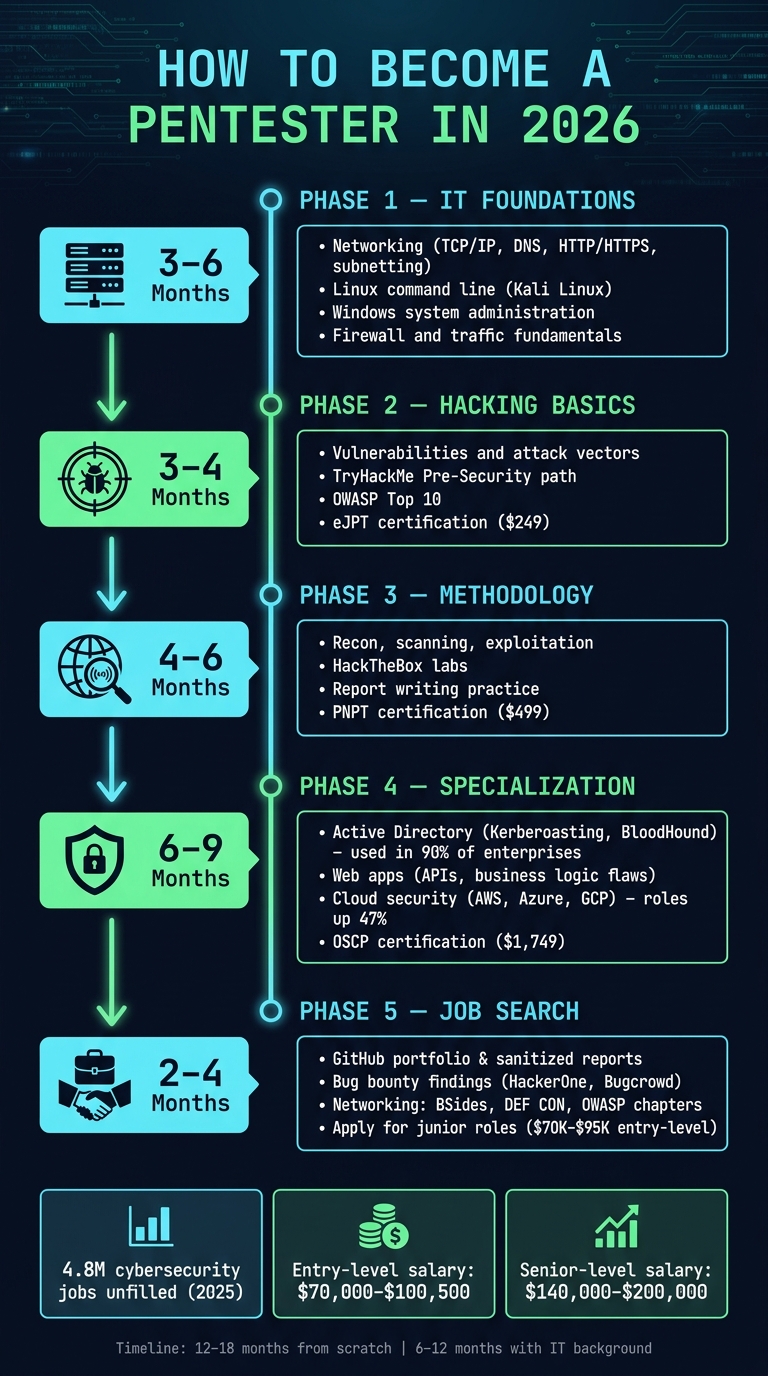
If you're starting from scratch, expect to dedicate 12–18 months to prepare for the job market. If you already have an IT background, this timeline shortens to 6–12 months. These timeframes give you a realistic idea of what it takes to be job-ready.
The process is clear: begin with IT and networking basics, dive into hands-on learning platforms, earn certifications like the eJPT or PNPT, and focus on specialized areas such as Active Directory (still used by about 90% of enterprises) or cloud security. Along the way, document your progress - every lab you complete, every CTF you tackle, and every report you write. Here's a breakdown of how your journey might look:
| Phase | Duration | Key Focus |
|---|---|---|
| IT Foundations | 3–6 months | Networking, Linux, Windows, TCP/IP |
| Hacking Basics | 3–4 months | Vulnerabilities, attack vectors, TryHackMe |
| Methodology | 4–6 months | Recon, scanning, exploitation, PNPT |
| Specialization | 6–9 months | Active Directory, web apps, cloud, OSCP |
| Job Search | 2–4 months | Portfolio, interviews, GitHub, bug bounties |
As you move through these phases, start applying for internships or junior roles to gain experience early. Building strong technical skills and a solid portfolio will help you transition from a learner to a professional. Don’t wait until you feel completely "ready" - start applying as soon as possible.
Entry-level pentesting roles in 2026 are expected to pay between $70,000 and $95,000, with senior roles reaching $140,000–$200,000. By focusing on your portfolio, networking, and reporting abilities early on, you can position yourself to hit these salary levels faster.
FAQs
What should I put in a pentesting portfolio?
A pentesting portfolio is your chance to demonstrate your offensive security skills in a structured and professional way. It should feature detailed documentation of your work, including vulnerability assessments, penetration test reports, and lab exercises conducted in authorized environments. Focus on showcasing key techniques like reconnaissance, exploitation, privilege escalation, and remediation.
To make your portfolio stand out, use a standard format that includes the following elements:
- Executive summaries: Provide a concise overview of each project.
- Scope: Clearly define the boundaries of your testing.
- Risk ratings: Assign and justify risk levels for identified vulnerabilities.
- Recommendations: Offer actionable steps to address issues.
This approach not only highlights your technical skills but also demonstrates your ability to communicate findings and solutions effectively - an essential skill in penetration testing.
Which certification should I get first for pentesting?
If you're just stepping into the world of penetration testing, CompTIA Security+ is a solid starting point. This entry-level certification is well-recognized across the industry and even meets DoD 8140 requirements, which adds to its credibility. It's designed to help beginners grasp the essential concepts of cybersecurity, offering a strong foundation to build upon.
While alternatives like CompTIA PenTest+ or the Google Cybersecurity Certificate can also be valuable, Security+ often stands out as the go-to choice for newcomers aiming to establish themselves in the cybersecurity field.
How can I get pentesting experience without a job?
To build hands-on pentesting experience, focus on legal platforms and personal projects. Platforms like TryHackMe and Hack The Box offer realistic environments to practice penetration testing techniques. Participating in Capture The Flag (CTF) competitions is another great way to sharpen your skills while tackling real-world security challenges. You can also work on developing open-source security tools to demonstrate your expertise. These activities not only help you master attack methods but also provide tangible proof of your abilities to potential employers, even if you lack formal job experience.