Scenario-based cybersecurity questions test how you handle real incidents, like phishing or ransomware attacks. Employers use these to evaluate your problem-solving, decision-making, and communication skills under pressure. Here's a simple, actionable 5-step framework to approach these questions effectively:
- Analyze the Situation: Identify key details, assess impact, and verify the alert's reliability.
- Contain the Threat: Isolate affected systems, capture evidence, and minimize damage.
- Investigate the Cause: Review logs, trace attack vectors, and map findings to frameworks like MITRE ATT&CK.
- Eliminate and Restore: Remove threats, patch vulnerabilities, and restore systems from clean backups.
- Document and Improve: Record actions, analyze gaps, and refine response plans.
This framework ensures a structured response while showcasing technical and analytical expertise. Practice with case studies, use tools like SIEM, and stay updated on threats to excel in interviews.
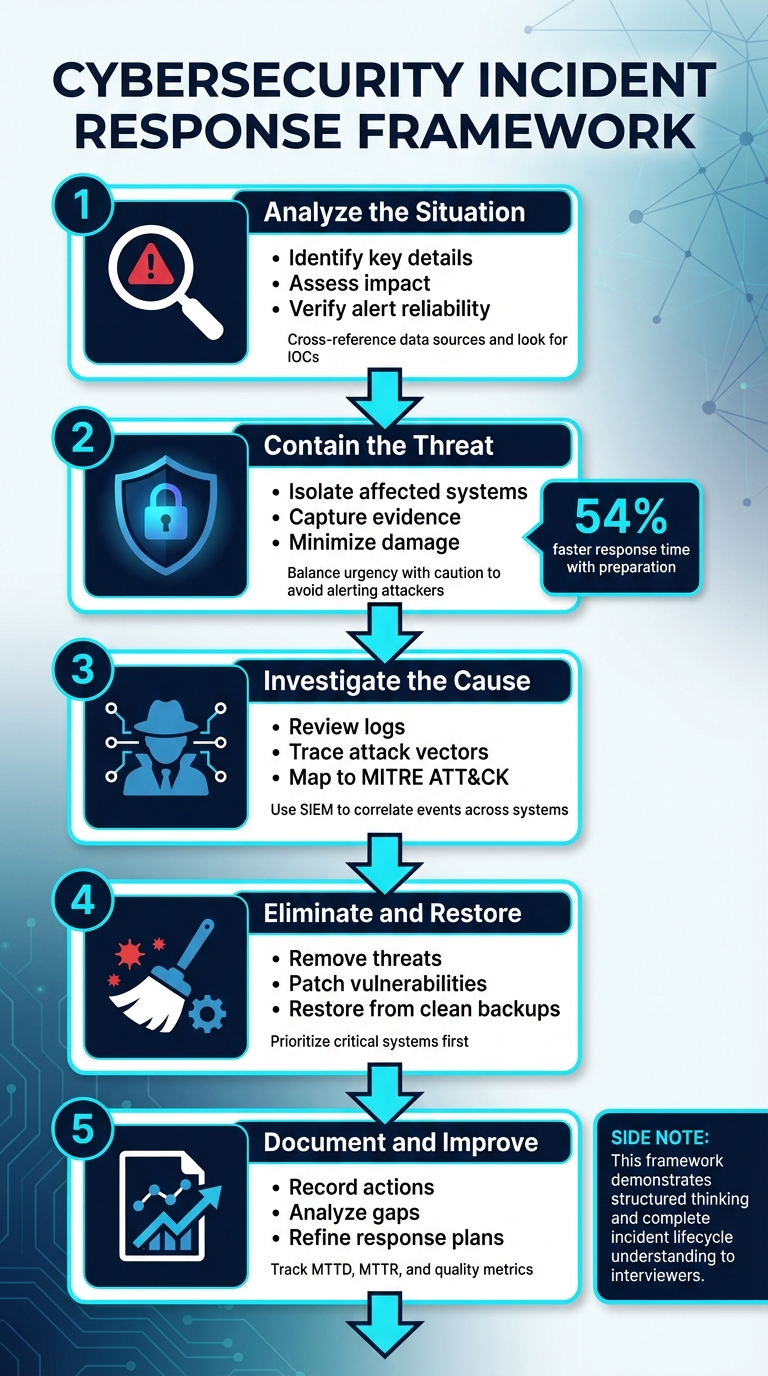
5-Step Framework for Solving Cybersecurity Scenario Questions
SOC Analyst Scenario-Based Interview Questions & Answers (2026) | SOC Analyst Interview Question
5-Step Method for Solving Scenario-Based Questions
When you're faced with a cybersecurity scenario during an interview, having a structured approach is key. This five-step method walks you through the process - from analyzing the situation to documenting your findings - showcasing your ability to handle incidents thoughtfully and systematically.
Step 1: Read and Analyze the Scenario
Start by identifying the key symptoms, such as unusual outbound traffic or system performance issues. Evaluate the potential impact by determining which critical systems are affected. This helps you form a hypothesis about what the activity might indicate, whether it's data exfiltration or a command-and-control connection.
Assess the credibility of the alert source - whether it's a SIEM notification, IDS alert, or user report - as this will shape the urgency of your response. Compare the activity against historical patterns to confirm whether it’s truly abnormal. As Pooja Rawat, a cybersecurity research analyst at InfosecTrain, explains:
To perform triage on SOC alerts, first prioritize them based on severity, source credibility, and the potential impact on the organization.
Cross-reference multiple data sources to build a complete picture. Look for indicators of compromise (like known malicious files) and indicators of attack (behavioral patterns suggesting ongoing threats). Once you've analyzed the situation, you're ready to take action to contain the threat.
Step 2: Contain and Mitigate the Threat
Once you've confirmed the threat, your focus shifts to containment. Disconnect affected systems from the network immediately, but avoid powering them down unless absolutely necessary, as this could erase valuable volatile memory evidence. For DDoS attacks, apply rate-limiting and block malicious IPs via your firewall instead of shutting down entire services. If specific accounts are compromised, lock them and reset passwords rather than disabling your entire directory service.
Before taking disruptive actions, capture system images and memory samples to preserve evidence. Organizations that prepare for incidents see faster response times - 54% quicker - and reduce costs by 39% during incidents.
Balance urgency with caution. As NetWitness advises:
Poorly planned containment can alert attackers and cause them to hide deeper in the environment, increasing investigation time and complexity.
Follow predefined incident response playbooks to ensure your actions are consistent and effective. For web vulnerabilities, consider deploying a Web Application Firewall (WAF) or segmenting the network to protect applications while allowing patching. If needed, involve external partners and enforce Multi-Factor Authentication (MFA) on compromised accounts to prevent further access.
With containment handled, you can focus on uncovering the root cause.
Step 3: Investigate and Find the Root Cause
After containing the threat, it's time to dig into how the incident occurred. Collect logs from network, endpoint, and authentication sources, and use your SIEM to correlate events across systems. Determine the attack vector - was it a phishing email, compromised credentials, or an exploited web vulnerability?
Map your findings to the MITRE ATT&CK framework to identify the attacker’s techniques. As Ruchi Bisht from InfosecTrain highlights:
The MITRE ATT&CK framework is an invaluable tool for guiding threat hunting exercises, particularly when dealing with suspected Advanced Persistent Threats (APTs).
If the incident involves cloud systems, focus on access logs (like IAM or CloudTrail), network traffic logs, and configuration data to uncover misconfigurations. Look for unusual login patterns or unauthorized use of external storage devices, which could point to insider threats.
Once you've pinpointed the origin, the next step is to eliminate the threat and restore operations.
Step 4: Remove Threats and Restore Systems
With the root cause identified, work to fully eliminate the threat. Remove malware, close exploited vulnerabilities, and apply necessary patches. Restore affected systems from clean backups, ensuring these backups weren’t compromised during the incident. Before bringing systems back online, test them thoroughly to prevent reinfection.
Prioritize restoration efforts based on business needs. Systems critical to revenue or customer service should come first, followed by supporting infrastructure. Keep stakeholders informed about service status throughout the process.
This phase reinforces your ability to manage incidents in a methodical and effective way.
Step 5: Document and Prevent Future Incidents
Documentation is where lessons learned translate into organizational growth. Begin with an immediate debrief (often called a "hot wash") to capture details while they're still fresh. Follow up with a formal After-Action Review (AAR) that outlines what worked, what didn’t, and any gaps in your response.
Prepare a detailed report that includes the scenario overview, key decisions made, timeline metrics like Time to Detect (MTTD) and Time to Respond (MTTR), and actionable recommendations with deadlines. Use this information to refine your incident response playbooks, update SIEM/EDR detection rules, and adjust alert thresholds to reduce false positives.
Track key performance indicators to guide improvements:
| Metric Category | Key Performance Indicators to Track |
|---|---|
| Timeline Metrics | Time to detect, escalate, contain, and recover |
| Quality Metrics | Communication accuracy, decision-making quality, and breakdowns |
| Technical Metrics | Vulnerabilities found, false positives, and user anomalies |
| Process Metrics | Policy/documentation gaps identified |
Turn the incident into a training opportunity. For example, if phishing was the entry point, run targeted simulations to educate employees. Share findings with legal, HR, and leadership to support risk-based decision-making. As IT Solutions aptly puts it:
The real value of incident response drills isn't just testing your plan - it's using what you learn to build faster, smarter, and more resilient responses in the future.
Common Cybersecurity Scenarios and How to Respond
Using the five-step framework as a guide, here’s how to tackle some of the most common cybersecurity challenges.
Phishing Attacks
Phishing emails can be tricky, but a closer look at the email headers can reveal key details like the Message-ID, originating IP, or SPF/DKIM/DMARC status. Use tools like MXToolbox to analyze email routing and uncover irregularities. To understand the reach of the incident, leverage tools like Message Trace or Content Search. Block the sender’s domain or IP through your mail gateway, and remove harmful emails from impacted mailboxes using administrative tools such as Search-Mailbox or New-ComplianceSearch.
Keep an eye out for signs of compromise, like unauthorized inbox rules, suspicious SMTP forwarding, or unusual delegated access. If a user clicked a malicious link or entered credentials, check endpoint detection logs, lock compromised accounts immediately, reset passwords, and bolster account security. Microsoft’s Spam Confidence Level (SCL) can help prioritize high-risk messages - emails scoring between 7 and 9 are flagged as high-confidence spam and should be investigated promptly.
Ransomware Incidents
Dealing with ransomware requires swift but careful action. Disconnect infected systems from all networks - wired, Wi-Fi, and Bluetooth - to stop the spread. However, avoid powering down machines unless absolutely necessary, as this can destroy critical forensic evidence. As Team ZCySec advises:
"Do NOT power off machines without guidance from forensic investigators - doing so may destroy valuable forensic data residing in memory or executing on disk".
After isolating affected systems, reset passwords for all accounts, especially those with administrative access, and disable active VPN sessions. Identify the ransomware variant using resources like the No More Ransom Project or ID Ransomware, and check if decryption tools are available. Pause syncing services like OneDrive or Exchange ActiveSync to prevent corrupted files from overwriting backups. Notify the appropriate authorities within the required timeframe. For recovery, focus on restoring critical assets first, ensure backups are offline and secure, and consult with agencies like the FBI or CISA before considering any ransom payment.
DDoS Attacks
When responding to a Distributed Denial-of-Service (DDoS) attack, it’s important to identify the type of attack. Volumetric attacks flood network bandwidth (e.g., UDP or ICMP floods), protocol attacks exhaust server resources (e.g., SYN floods), and application-layer attacks target specific services (e.g., HTTP floods). For example, in early 2024, Cloudflare reported mitigating 4.5 million DDoS attacks, handling 10.5 trillion HTTP requests and 59 petabytes of traffic.
To prepare for such attacks, lower DNS Time-to-Live (TTL) settings to allow quick IP redirection and establish emergency contacts with your ISP for traffic filtering. During an attack, use routers or firewalls to throttle harmful traffic, apply rate limiting, and rely on Content Delivery Networks (CDNs) to distribute the load and hide your origin server’s IP. Enabling JavaScript challenges at the CDN level can help filter out bot traffic. Additionally, configure egress filtering to stop your systems from sending response packets that could worsen network congestion. When recovering, bring services back online gradually, prioritizing critical systems first.
Data Breaches
Unlike DDoS attacks, which disrupt availability, data breaches require a mix of technical and regulatory responses. Start by securing compromised systems and identifying what data was accessed - this could include customer records, payment details, or proprietary information. Notify key stakeholders, including leadership, legal counsel, and your cyber insurance provider. Investigate how the breach occurred by analyzing logs and network activity to uncover backdoors or unauthorized accounts.
If personal data was exposed, notify affected individuals as required by law. Keep detailed records of all actions taken, as these will be essential for regulatory reporting and any legal follow-ups. Finally, update your detection rules and tighten access controls to prevent similar breaches in the future.
These practical responses, grounded in the five-step framework, highlight the hands-on expertise required to navigate cybersecurity challenges effectively.
sbb-itb-8a31326
Tips for Performing Well in Scenario-Based Interviews
Practice With Case Studies
Getting hands-on with realistic case studies can significantly boost your confidence when tackling scenario-based questions. Focus on examples that mirror real-world challenges like phishing attacks, ransomware incidents, or network breaches. Use the STAR method (Situation, Task, Action, Result) to structure your responses effectively. For instance, you might describe how you handled a ransomware attack, detailing how you "recovered 95% of systems within 48 hours". These examples should showcase a variety of skills such as incident response, vulnerability assessment, or risk management, while emphasizing measurable outcomes. This kind of preparation helps you articulate your decision-making process clearly during interviews.
Explain Your Thinking Clearly
Once you’ve practiced with case studies, focus on explaining your thought process step by step. Interviewers are keen to understand how you approach and solve problems. For instance, if you isolated a compromised system before conducting forensic analysis, explain how this action prevents evidence tampering and halts the spread of the threat.
Use frameworks like the CIA triad (Confidentiality, Integrity, and Availability) to frame your decisions, showing you can balance security needs with business priorities. Be honest about tradeoffs - like how encryption enhances data protection but may impact system performance. Aleksa Tamburkovski, a Cyber Security Engineer, emphasizes this approach:
Analysts need to prioritize based on the potential impact to the business.
Additionally, practice simplifying technical concepts for non-technical audiences. This skill is crucial when explaining complex issues to executives or stakeholders who may not have a technical background.
Learn the Tools and Stay Current
Familiarity with industry-standard tools is essential for giving grounded, practical answers. Make sure you’re comfortable with commonly used tools like SIEM and EDR solutions, as well as vulnerability scanning and traffic analysis tools.
Equally important is staying updated on industry trends. Follow trusted sources like Krebs on Security, The Hacker News, Dark Reading, and CISA advisories to keep up with the latest threats. For example, Gartner predicts that by 2025, cybersecurity will see increased government oversight, decentralized digital systems, and expanded use of generative AI. Coursera Staff highlights the importance of staying ahead:
Cybersecurity is a constantly evolving field... It's crucial to be at the forefront of industry changes to be successful as a cybersecurity professional.
Finally, understanding frameworks like MITRE ATT&CK and NIST 800-53 can set you apart, as they demonstrate your ability to map adversary tactics and adhere to established security standards.
Conclusion
Review of the 5-Step Framework
Addressing cybersecurity challenges requires a well-organized strategy, and the 5-step framework provides just that: read and analyze, contain and mitigate, investigate and find the root cause, remove threats and restore systems, and document and prevent future incidents. This method highlights a comprehensive way to handle cybersecurity incidents, demonstrating to interviewers that you approach threats with more than just reactive measures. Instead, you showcase a complete understanding of the incident lifecycle. By walking through each phase, you illustrate your ability to prioritize effectively, analyze deeply, and prevent strategically. During the investigation phase, aligning your process with industry standards like MITRE ATT&CK further underscores your expertise. With this framework in mind, you’re equipped to tackle the next phase of your interview preparation.
Next Steps for Interview Success
Now that you have the framework, it’s time to put it into practice. Start by creating a collection of measurable, story-driven examples using the STAR method. These examples should highlight your achievements - like "recovered 95% of systems within 48 hours" or "reduced false positives by 20%" - to give interviewers clear evidence of your impact. As Brandy Harris, Director at CyberEd.io, explains:
The STAR method allows candidates to present their experiences in a clear, structured way, making it easier for interviewers to understand their problem-solving skills and real-world impact.
Stay informed on the latest security threats through reliable sources, and tailor your responses to the company’s specific challenges by doing thorough research. This personalized approach not only enhances your preparation but also makes your answers more relevant and impactful. For more tools and resources to jumpstart your cybersecurity career, check out Root School at https://root-school.com.
FAQs
What is the MITRE ATT&CK framework, and how does it help in cybersecurity investigations?
The MITRE ATT&CK® framework serves as a trusted resource for understanding how cyber attackers operate. It catalogs adversary tactics, techniques, and procedures observed in actual cyberattacks, organizing this information into a matrix. This structure links the objectives attackers aim to achieve (tactics) with the methods they use to accomplish them (techniques). Regular updates ensure the framework reflects the latest threat trends, making it an essential tool for cybersecurity professionals to communicate and collaborate effectively.
During investigations, analysts use ATT&CK to break down alerts, trace attacker activity, and reconstruct attack scenarios. By comparing logs, endpoint data, or network traffic against the framework, they can pinpoint detection gaps, prioritize fixes, and generate threat reports using consistent terminology. Tools like ATT&CK Navigator further aid in visualizing vulnerabilities and improving defensive strategies. For those looking to grow in the cybersecurity field, practicing these techniques through Root School's resources can sharpen their investigative skills and prepare them for real-world scenarios.
What’s the best way to prepare for scenario-based cybersecurity interviews?
To stand out in scenario-based cybersecurity interviews, it's important to approach them methodically. Begin by familiarizing yourself with common challenges such as phishing attacks, malware outbreaks, ransomware incidents, and data breaches. Use the STAR method - breaking your answers into Situation, Task, Action, and Result - to provide structured and persuasive responses.
Prepare by drafting detailed responses for these scenarios, outlining the steps you’d take to investigate and resolve each issue. Then, practice delivering your answers out loud. Timing yourself can help ensure your responses are concise yet thorough. Mock interviews with colleagues or mentors are another excellent way to sharpen your communication and problem-solving abilities.
Make sure to stay informed about the latest cybersecurity threats, like zero-day vulnerabilities and supply chain attacks, so your answers align with current trends. Consistent practice and refining your approach will not only boost your confidence but also showcase your expertise effectively.
How should I handle phishing, ransomware, and DDoS attacks during a cybersecurity scenario?
Phishing, ransomware, and DDoS attacks each demand specific strategies to counter their distinct threats.
Phishing attacks are best combated by focusing on user awareness. This includes training people to spot suspicious emails, implementing email filters to block harmful links, and swiftly isolating any compromised accounts to prevent further damage.
Ransomware incidents call for immediate action. Disconnect affected systems to stop the spread, preserve forensic evidence for investigation, and rely on clean backups to restore data - paying the ransom is strongly discouraged as it encourages further attacks.
DDoS attacks require a different approach. Managing these involves filtering or throttling malicious traffic, leveraging DDoS protection services, and building redundancy into systems to ensure critical services remain accessible.
Addressing these threats effectively depends on understanding their unique nature and deploying the right response to limit damage.