If you're interested in Governance, Risk Management, and Compliance (GRC), this guide breaks down how to start and grow a career in this high-demand field. GRC focuses on ensuring organizations meet regulations, manage risks, and align security with business goals. Professionals in this area are crucial for addressing challenges like data breaches, evolving laws, and risk mitigation.
Key Takeaways:
- Why GRC? GRC roles are growing fast due to stricter regulations and increasing cyber threats. Entry-level salaries range from $60,000 to $85,000, while experienced professionals can earn over $124,000 annually.
- Education: Degrees in Business Administration, Cybersecurity, Finance, or Law are common starting points. Advanced degrees like an MBA can boost career prospects.
- Certifications: Start with Certified in Cybersecurity (CC) or Certified in Governance, Risk, and Compliance (CGRC) to stand out in the job market.
- Experience: Build hands-on experience through internships, volunteer projects, or entry-level roles like GRC Analyst or Compliance Analyst.
- Tools: Learn GRC platforms like RSA Archer, MetricStream, and LogicManager to gain practical expertise.
- Networking: Join communities like ISC2 or ISACA to connect with professionals and access job opportunities.
Steps to Get Started:
- Education: Choose a degree or courses focused on compliance, risk, or cybersecurity.
- Certifications: Earn beginner-friendly credentials like CC or CGRC.
- Experience: Gain practical skills through internships, mock projects, or volunteering.
- Tools: Learn software like RSA Archer or SAP GRC to apply concepts in real-world settings.
- Network: Attend events and join industry groups to meet mentors and discover job leads.
GRC offers a clear path for career growth, from entry-level roles to leadership positions like Chief Risk Officer or Chief Information Security Officer. Start building your skills today to tap into this growing field.
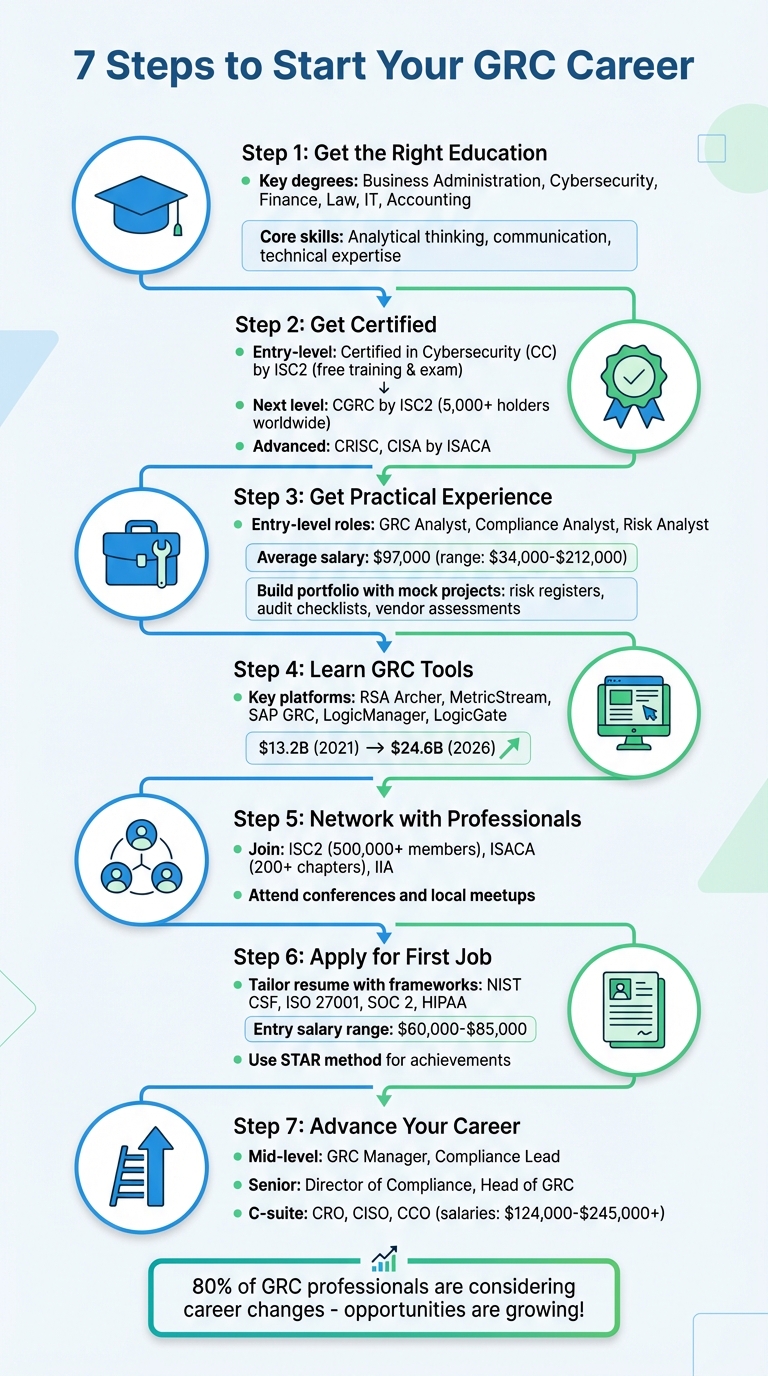
7-Step Career Path to Starting a GRC Career
Step 1: Get the Right Education
Relevant Degrees and Fields of Study
To thrive in a Governance, Risk, and Compliance (GRC) career, starting with the right educational foundation is key. Most professionals in this field earn bachelor's degrees that combine business acumen with technical expertise. Popular majors include Business Administration, Finance, Information Systems, Cybersecurity, Information Technology, Law, Accounting, or Computer Science. If you're leaning toward the cybersecurity aspect of GRC, degrees in Information Assurance or Computer Science provide the technical know-how to assess risks and implement security measures.
Courses in auditing, data privacy, legal compliance, risk analysis, and business strategy are especially valuable. For those eyeing leadership roles, advanced degrees like an MBA, or specialized programs in Cybersecurity Management or Organizational Leadership, can give you a competitive edge.
Interestingly, some certification bodies, such as OCEG, don't mandate specific degrees. This opens the door for individuals from various academic backgrounds to enter the field. Regardless of your path, a solid educational base is essential for mastering the skills that define success in GRC roles.
Core Skills for GRC Professionals
Once you've secured the right education, the next step is building a strong skill set tailored to GRC demands. This field requires a mix of analytical thinking, clear communication, and technical expertise. You'll need to identify risks, gauge their potential impact, and evaluate how well internal controls are functioning. Just as important is the ability to translate technical findings into actionable insights for non-technical stakeholders.
"GRC professionals must have business insight, technical competence, and ethical judgment to succeed." – Learn.org
While programming knowledge isn't a must, understanding areas like network security, vulnerability assessments, data protection, and cloud security is crucial. Strong project management skills are also essential to keep compliance projects on track and aligned with organizational goals.
"A career as a GRC Analyst might be good for you if you like to solve puzzles or analyze and solve problems." – Ken Underhill, Flatiron School
If you're someone who enjoys piecing together regulatory puzzles and preventing threats before they spiral out of control, GRC offers a career path that's both challenging and fulfilling.
sbb-itb-8a31326
How To Start A GRC Career in 2026 ( and get hired ! )
Step 2: Get Certified
Certifications are a powerful way to demonstrate your expertise in GRC frameworks, regulations, and risk management. They show employers that you're equipped with the knowledge and skills to help organizations remain compliant and secure. These credentials build on your education and foundational skills, giving you the practical qualifications employers look for in GRC professionals.
Entry-Level Certifications to Explore
If you're just starting out, the Certified in Cybersecurity (CC) by ISC2 is a great option. It's designed for beginners with no prior experience and includes free official training and a free exam .
Once you’ve gained some initial experience, consider the Certified in Governance, Risk and Compliance (CGRC) by ISC2. This certification is a well-recognized credential in the GRC field. As of January 14, 2026, there are over 5,000 CGRC holders worldwide. The CGRC focuses on integrating governance, risk management, and compliance using frameworks like the NIST Risk Management Framework (RMF) 800-37. If you pass the exam but don’t yet meet the required two years of professional experience, you can earn the title "Associate of ISC2" and have up to three years to fulfill the experience requirement .
"CGRC professionals utilize frameworks to integrate security and privacy within organizational objectives, better enabling stakeholders to make informed decisions." – ISC2
For those leaning toward IT risk management, the Certified in Risk and Information Systems Control (CRISC) by ISACA is a strong choice. It emphasizes enterprise risk and implementing information systems controls. Similarly, the Certified Information Systems Auditor (CISA) by ISACA is highly regarded for auditing and evaluating IT systems. Both of these certifications require professional experience and are more suitable for advanced stages in your career.
Tips for Preparing for Certification Exams
Passing certification exams isn’t just about memorizing answers - it’s about understanding how frameworks, controls, and compliance processes work together in real-world scenarios. For the CGRC, for example, a deep understanding of the NIST RMF 800-37 is critical, as it forms the foundation of the exam.
"The CGRC exam requires an expert level of understanding for the RMF and supporting tasks. The relationship between steps, tasks, and roles are necessary to pass the exam." – Dwayne Natwick, ISC2 Authorized Trainer
To prepare effectively, use a mix of resources like official study guides, flashcards, practice tests, and group study sessions. The ISC2 Community is a valuable platform for connecting with other candidates and experts. Additionally, signing up as an ISC2 Candidate gives you a free first-year membership, which includes discounts on training materials and textbooks.
Platforms like Root School offer structured courses that can help you master the material and build the skills needed to pass certification exams. Look for training providers that provide an "Education Guarantee", allowing you to retake courses for free if you don’t pass on your first try. With your certifications in hand, you'll be ready to gain the hands-on experience that will take your GRC career to the next level.
Step 3: Get Practical Experience
Certifications can show you understand GRC frameworks, but hands-on experience is what truly proves you can apply that knowledge. While many beginners can talk about ISO 27001 or NIST concepts, employers want to see evidence that you can take action - like building risk registers, preparing for audits, or assessing vendor security. GRC roles demand more than theoretical knowledge; they require judgment, cross-functional collaboration, and the kind of maturity that only comes from real-world practice.
"GRC roles are not just theory - they require structuring compliance programs, managing risk registers, performing audits, and documenting policies." – Artem Polynko, GRC Specialist
The reality is that most entry-level candidates lack this kind of practical experience. But here’s the good news: you don’t need a full-time GRC job to start building it. A portfolio of completed projects can be far more impactful than a resume that simply says "familiar with NIST CSF." By showcasing examples - like creating an audit checklist or scoring vendor risks - you can demonstrate applied knowledge that makes you stand out. These projects not only highlight your initiative but also set the foundation for landing entry-level roles.
Entry-Level Jobs and Internships
One of the best ways to gain practical experience is by starting in entry-level roles like GRC Analyst, Compliance Analyst, Risk Analyst, Privacy Analyst, or IT Audit Associate. These positions often involve tasks such as monitoring compliance, implementing policies, staying on top of regulatory changes, and supporting internal audits. In the U.S., GRC Analysts earn an average salary of $97,000, with pay ranging from $34,000 to $212,000 depending on experience and location.
Internships are another excellent way to get your foot in the door. Look for opportunities within risk management departments, compliance teams, or internal audit functions. If you’re already working in IT - maybe in a helpdesk or SOC role - consider exploring lateral moves within your organization. Volunteering to take on tasks like a gap assessment using frameworks like NIST CSF or ISO 27001 can help you gain experience without needing to change jobs.
Shadowing internal audits or compliance teams is another smart approach. Many managers are open to letting you observe their processes, which can give you early exposure to auditing techniques while helping you build relationships with GRC leaders. Plus, developing soft skills - like creating a collaborative, non-intimidating audit environment - can be just as important as technical expertise.
Volunteer and Freelance Work
If formal roles feel out of reach, volunteer projects can be a great alternative. Non-profits often need help with tasks like policy writing, risk assessments, and documentation but lack the budget for dedicated GRC staff. By offering your services, you can gain valuable experience while building a portfolio that demonstrates your abilities.
You can also create self-directed projects that mimic real GRC tasks. For instance, you could:
- Build a risk register for a fictional startup, scoring at least 10 risks (e.g., phishing or data breaches) on a 1–5 scale for likelihood and impact, then create a heat map in Excel.
- Draft a 25-question vendor security questionnaire based on the public security documentation of a major SaaS provider.
- Conduct a mock internal audit by developing a checklist for specific controls, gathering simulated evidence, and writing an audit report with a corrective action plan.
These kinds of projects help you practice essential skills like risk scoring, control mapping, evidence validation, and remediation planning. Platforms like Root School can guide you in structuring these exercises and sharpening the practical skills that employers value. Documenting these projects in your portfolio gives you real examples to discuss during interviews, showing employers that you can do more than understand the theory - you can deliver results.
Step 4: Learn GRC Tools and Software
Getting comfortable with GRC software is where theory meets action. These platforms take care of the heavy lifting - think real-time risk tracking, managing compliance workflows, collecting audit evidence, and creating reports for leadership. Without hands-on experience, applying these concepts in real-world scenarios can be a challenge. With the global GRC market expected to grow from $13.2 billion in 2021 to $24.6 billion by 2026, the demand for professionals skilled in these tools is only going up.
Modern GRC platforms go beyond reacting to risks - they use AI and data analytics to predict them. They also integrate with tools like Tableau and Power BI, making it easier to present complex data in a way that non-technical stakeholders can grasp. But learning these tools isn’t just about clicking buttons. You’ll need to understand how data moves through the system, how to align controls with frameworks like NIST or ISO 27001, and how to set up automated processes for collecting evidence. Building these skills not only sharpens your expertise but also prepares you to excel in GRC roles.
Common GRC Tools You Should Know
Once you see how automation transforms GRC, it’s time to explore the tools leading the charge. Key platforms include RSA Archer, MetricStream, SAP GRC, LogicManager, and LogicGate. Each has its strengths:
- RSA Archer: Known for enterprise-wide risk tracking and policy management.
- MetricStream: Streamlines audit processes and compliance management.
- SAP GRC: Integrates governance and risk into SAP ERP systems, ideal for SAP users.
- LogicManager: Focuses on managing performance through a risk-based approach.
- LogicGate: Automates compliance workflows and risk assessments.
While their specialties vary, these platforms share common features like automated evidence collection, control mapping, vendor risk management, and continuous monitoring. They help cut down on manual errors and ensure you’re not scrambling to meet audit deadlines. Plus, they provide a clear, real-time view of your organization’s risk landscape, which is crucial for making sound decisions.
Where to Learn GRC Tools
Start by building a strong understanding of frameworks like NIST CSF, ISO 27001, and COBIT. These will give you the foundation you need to navigate GRC tools effectively. From there, dive into structured courses that focus on practical skills like risk assessments, policy creation, and simulated cybersecurity exercises.
Many GRC platforms offer free resources like checklists, policy templates, and implementation guides. Working through these manually - such as drafting a vendor management policy or completing a security audit checklist - can help you grasp the processes the software automates. Professional organizations like ISACA and ISC2 also provide training and skill-building resources, often at discounted rates for members. For those just starting out, ISC2’s "Certified in Cybersecurity" program even includes free self-paced training and a complimentary exam for entry-level candidates.
Step 5: Network with Other Professionals
The field of Governance, Risk, and Compliance (GRC) is in constant motion, shaped by new regulations, cyberthreats, and frameworks. To keep up, building connections with other professionals is essential. Organizations like ISC2 and ISACA are excellent starting points, offering access to global communities. For instance, ISC2 boasts over 500,000 members, associates, and candidates worldwide. These groups provide more than just networking - they open doors to mentorship, job opportunities, and cutting-edge skills that may not yet be widely advertised.
"Governance, risk and compliance never stands still. It's a constantly evolving field that requires continuing education to stay in front cyberthreats and on top of trends." - ISC2
Local chapters add another layer of value. ISACA, for example, operates more than 200 chapters globally, creating opportunities for face-to-face networking and region-specific learning. By combining these connections with your technical skills and certifications, you can uncover new opportunities in GRC. Joining ISC2 as a Candidate provides free access to training discounts and a strong professional network. These relationships can also help you stay ahead of trends like AI governance and the shift toward comprehensive risk management strategies.
Join Professional Groups
Becoming a member of key organizations such as ISACA, ISC2, and the Institute of Internal Auditors (IIA) can significantly expand your resources and connections. Each group caters to specific aspects of GRC:
- ISACA focuses on governance, risk, and auditing.
- ISC2 emphasizes cybersecurity and certifications like the CGRC.
- IIA is ideal for those interested in internal auditing and compliance.
These organizations also host local chapters, offering a chance to meet professionals in your area, ask questions, and discover job openings that might not appear on traditional job boards.
Additionally, explore smaller, city-based cybersecurity groups. These local communities often organize meetups, workshops, and informal networking events, giving you direct access to industry professionals. Programs like ISACA's Member Experience Leadership Series not only help you build leadership skills but also earn CPE credits.
Go to Conferences and Events
Attending conferences is another powerful way to stay informed and connected. Events like the ISC2 Security Congress 2026 and ISACA global conferences provide insights into real-world developments and regulatory updates. With many events now offering virtual or hybrid formats, participation has become more accessible, regardless of your schedule or budget.
"ISACA's conferences help you connect with professionals worldwide and expand your knowledge wherever you are." - ISACA
Take full advantage of these events by engaging with speakers and asking follow-up questions. As ISACA member Alex Holden puts it, "Conferences give me an opportunity to find fellow cybersecurity professionals. I want to be immersed in the world". This level of immersion can lead to valuable mentorships, uncover hidden job opportunities, and keep you ahead of industry trends.
If you're committed to breaking into GRC, treat conferences as a critical part of your professional development - not just an optional networking activity.
Step 6: Apply for Your First GRC Job
Now that you’ve earned certifications and built a portfolio of hands-on projects, it’s time to land your first GRC role. Interestingly, over 80% of professionals in risk management, compliance, and internal audit are considering a job or career change. This creates opportunities for newcomers who can bring the right mix of technical skills and interpersonal abilities to the table.
Entry-Level GRC Positions
Most GRC careers begin with a few key entry-level roles. For instance, a GRC Analyst is responsible for monitoring compliance efforts, implementing security policies, and managing documentation to prepare for audits. Compliance Analysts focus on staying updated with regulations like GDPR or HIPAA, ensuring that organizational processes align with legal standards. If assessing risks is more your style, a Risk Analyst identifies potential threats - such as data breaches or operational disruptions - and develops strategies to address them. For those drawn to privacy concerns, a Privacy Analyst handles regulations like GDPR or CCPA and conducts privacy impact assessments. Lastly, IT Audit Associates work on evaluating internal controls and preparing for external audits.
In terms of compensation, the average salary for a GRC Analyst in the U.S. is around $97,000, with a range from $34,000 to $212,000 depending on factors like experience, location, and industry. As InfoSec expert Abhijith Soman puts it, "Certifications open doors - experience keeps them open". Take time to identify the role that aligns with your skills and interests before crafting your job application.
How to Write Your Resume and Cover Letter
Once you’ve chosen your target role, tailor your resume and cover letter to highlight the skills and experiences that match the job requirements. Customize your resume for each GRC position, emphasizing transferable skills like policy development, risk assessment, process management, and collaboration with stakeholders. This is especially important if you’re transitioning from a non-technical background such as law, business administration, or IT support.
Be sure to list your experience with frameworks such as NIST CSF, ISO 27001, SOC 2, HIPAA, and PCI-DSS. If you’ve worked with GRC tools like ServiceNow GRC, OneTrust, or RSA Archer, make those stand out on your resume. To set yourself apart further, create a GRC portfolio showcasing tangible examples like a sample information security policy, a mock risk register, or a control mapping to a specific framework. Include links to these examples in your application materials to demonstrate your practical expertise.
When detailing your work experience, use the STAR method (Situation, Task, Action, Result) to show how you’ve solved problems and delivered results. For example, instead of saying, "Managed compliance tasks", write something more impactful like, "Reduced compliance breaches by 30% by implementing a quarterly audit review process". This approach focuses on measurable achievements rather than just listing responsibilities.
If you don’t have direct GRC experience, highlight related roles where you managed access controls, followed security protocols, or worked on systems administration. You can also volunteer for internal GRC-related tasks in your current role to gain relevant experience.
Step 7: Advance Your GRC Career
Once you've landed your first role in Governance, Risk, and Compliance (GRC), the next step is to build on that foundation and grow your career. The GRC field has seen explosive growth - cybersecurity roles alone added 440,000 professionals between 2021 and 2023, with top-tier salaries climbing from $193,000 to $245,000, a 26.6% increase. This rapid expansion creates plenty of room for professionals ready to step up, develop leadership skills, and stay ahead of industry trends.
If you're looking to move from entry-level positions into leadership, here's how you can make that transition.
Moving into Leadership Positions
Stepping into leadership isn't just about managing tasks - it’s about shaping the way an organization thinks about risk and compliance. As GRC expert Harry West puts it:
"The shift here is from 'managing programs' to 'shaping culture.' And that takes both courage and clarity."
At the mid-level, you might focus on becoming a specialist in areas like Risk Analysis, Compliance Consulting, or Internal Auditing. From there, senior roles such as GRC Manager or Compliance Lead involve translating high-level strategies into actionable plans, managing teams, and aligning risk initiatives with business objectives. Leadership positions like Director of Compliance or Head of GRC require a broader focus - setting the vision, influencing organizational strategy, and ensuring alignment across departments. For those aiming even higher, C-suite roles like Chief Risk Officer (CRO), Chief Information Security Officer (CISO), or Chief Compliance Officer (CCO) demand strong executive presence and the ability to guide key stakeholders.
To set yourself apart, consider pursuing advanced certifications like Certified in Risk and Information Systems Control (CRISC), Certified Information Security Manager (CISM), or Certified in the Governance of Enterprise IT (CGEIT) . Beyond certifications, volunteering for cross-functional projects - such as leading internal audits or compliance initiatives - can help you gain visibility and broaden your experience. Seeking mentorship through organizations like ISACA, the Institute of Internal Auditors (IIA), or the GRC Institute can also provide valuable guidance. As Harry West reminds us:
"You don't need a title to lead. You just need clarity, action, and a willingness to serve."
Start building leadership experience now by coaching junior team members or taking charge of strategic projects. Leadership is as much about action as it is about titles.
Keep Learning and Developing Skills
Leadership roles require you to stay sharp and adapt to a constantly changing landscape. In GRC, new regulations, technologies, and business priorities are always emerging, making continuous learning essential. Many advanced certifications require Continuing Professional Education (CPE) credits to remain valid , which underscores the importance of staying up to date.
Specializing in high-demand areas like AI Governance, Environmental, Social, and Governance (ESG), or specific regulations such as GDPR or SOX can make you even more valuable in the job market . For instance, the growing focus on AI ethics and bias management has led to new certifications and training in AI governance . Mastering tools like RSA Archer and MetricStream can also enhance your qualifications for senior positions.
To tackle skill gaps, set 90-day learning goals - whether it’s improving your public speaking or understanding budget management. Local ISACA or IIA chapters often host leadership events that can help you grow your network and skills. Staying adaptable and committed to learning ensures you'll be ready for whatever challenges come your way in this dynamic field.
Conclusion: Begin Your GRC Career
The field of Governance, Risk, and Compliance (GRC) is open to professionals from all sorts of nontechnical backgrounds. As CyberGRC Troopers explain, "GRC is an ideal cybersecurity entry point, especially for those without a technical background... it focuses on policy-making, risk assessments, compliance, and business security governance - all of which can be learned without coding." Whether you're transitioning from accounting, healthcare, HR, or another industry, you can follow a clear path to enter this field. Start by building a solid foundation through relevant education, earning certifications like CompTIA Security+ or ISC2 CC, gaining hands-on experience through internships or volunteer roles, and networking with professionals in groups such as ISACA or ISC2. The demand for GRC professionals is growing, and the field offers competitive salaries.
If you're just starting out, entry-level GRC roles typically offer salaries ranging from $60,000 to $85,000, while seasoned professionals can earn over $124,000 per year . The ISC2 CGRC certification is widely recognized and can make you stand out in this expanding job market. Additionally, emerging areas like AI governance, ESG integration, and new regulations such as the NIS2 directive are creating even more opportunities for skilled GRC professionals.
Once you've established foundational knowledge and certifications, the next step is to gain practical experience. This could involve volunteering, creating a mock GRC portfolio, or shadowing an internal audit team. Free resources like the ISC2 "One Million Certified in Cybersecurity" program provide entry-level training and exam vouchers to help you get started. Joining a local ISACA chapter is another excellent way to connect with mentors who can guide your career journey.
For more structured learning, platforms like Root School offer specialized training to help you secure your first GRC role. Don’t wait - take action today. Enroll in a course, connect with GRC professionals on LinkedIn, or start drafting your own compliance roadmap. The first step you take now could be the beginning of a fulfilling GRC career.
FAQs
What skills do you need to succeed in a GRC career?
To thrive in a Governance, Risk, and Compliance (GRC) career, you'll need a blend of soft skills and technical know-how. Strong organizational abilities and a sharp eye for detail are key when managing policies, overseeing compliance processes, and preparing reports. A curious mindset - asking questions like "Why does this happen?" or "What if this occurs?" - can uncover risks and lead to better strategies.
On the technical side, understanding frameworks like NIST CSF and ISO/IEC 27001 is critical for tackling risk management and compliance tasks. Familiarity with IT basics, computer networking, and cybersecurity principles (think concepts like the cyber kill chain) can give you an edge. By combining analytical thinking, organizational skills, and a solid grasp of cybersecurity fundamentals, you'll be well-prepared to succeed in this field.
How can I get hands-on experience in GRC as a beginner?
Gaining hands-on experience in Governance, Risk, and Compliance (GRC) as a beginner doesn’t have to be overwhelming. One great way to start is by volunteering with small businesses or nonprofits. These organizations often need help with tasks like drafting compliance policies or performing basic risk assessments, and they’re usually open to support from eager learners.
Another option is contributing to open-source projects. You could assist by creating or reviewing policies or even conducting informal risk evaluations. This not only gives you practical experience but also helps you understand the kinds of compliance challenges organizations face. Plus, it’s a great way to build your portfolio.
Don’t overlook the value of networking. Joining online communities, study groups, or attending local events can connect you with mentors and seasoned professionals who might offer guidance and insights.
Pairing these real-world experiences with ongoing education and relevant certifications can help you develop the skills needed to kickstart a career in GRC.
What are the top certifications to help you grow in a GRC career?
Certifications like the GRC Professional (GRCP) and Certified in Governance, Risk, and Compliance (CGRC) from ISC2 are among the most well-known in the field of governance, risk, and compliance. These credentials highlight your knowledge of key GRC concepts and practices, which employers often look for when hiring.
By earning these certifications, you show that you can work with governance frameworks, evaluate risks, and maintain compliance with regulatory requirements - skills that are essential for growing your career in the GRC field.