Want to stand out in cybersecurity? Project narratives are your secret weapon to showcase soft skills that technical resumes can’t fully capture. By turning your work into structured stories using frameworks like STAR (Situation, Task, Action, Result), you can highlight critical qualities like communication, leadership, and problem-solving.
- Why it matters: Soft skills - like explaining risks to non-technical teams or staying calm during incidents - are often what set candidates apart in cybersecurity.
- How to do it: Use project narratives to connect your technical achievements to interpersonal strengths. Focus on measurable outcomes and specific examples to make your stories impactful.
- Key tip: Employers value stories 22x more than raw data. Narratives help you stand out in resumes, portfolios, and interviews.
Ready to craft your own? Learn how to structure and present them effectively below.
Identifying Key Soft Skills for Cybersecurity Projects
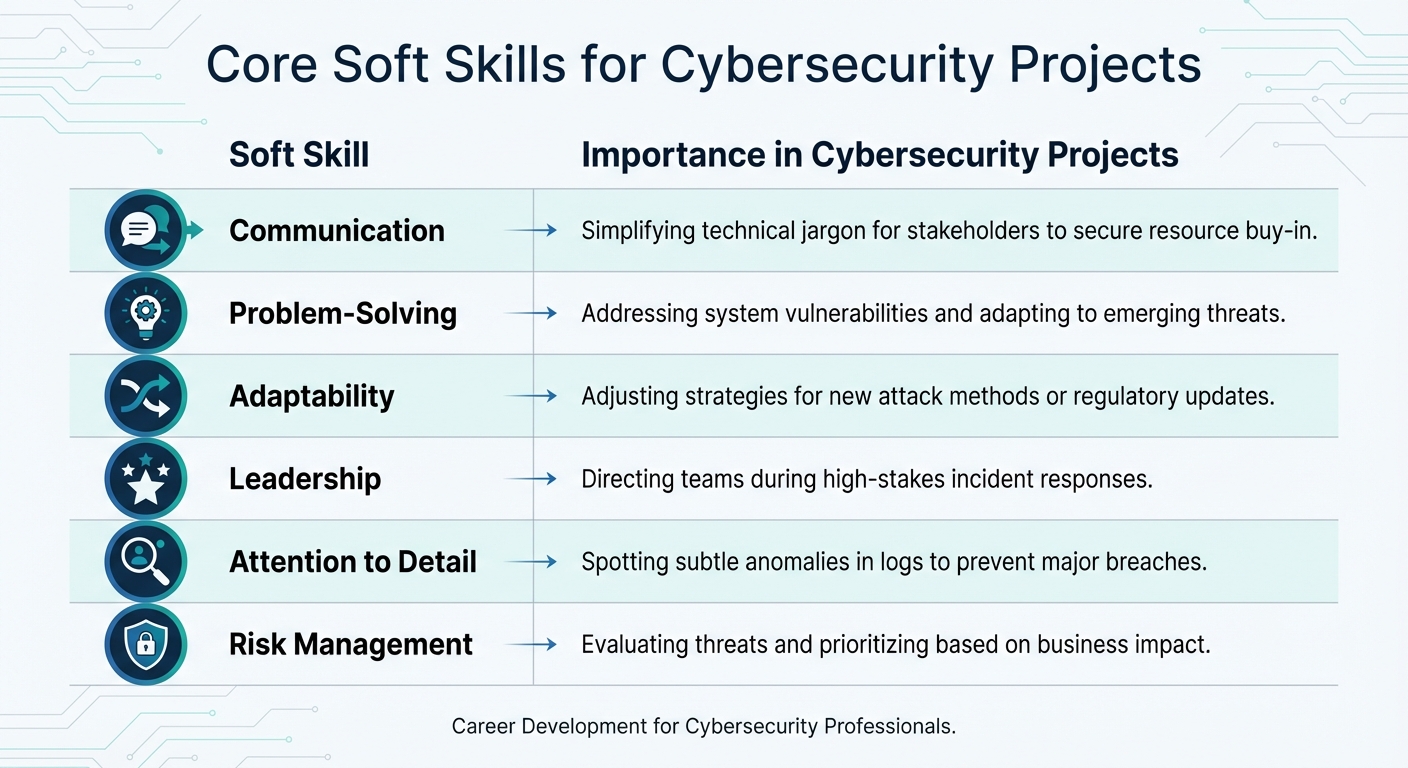
Key Soft Skills for Cybersecurity Professionals and Their Impact
Core Soft Skills for Cybersecurity Professionals
Before integrating soft skills into your project narratives, it's crucial to identify the ones that have the most impact. Communication tops the list - you need to explain complex technical threats in a way that executives, legal teams, and HR can grasp and act on. This could mean writing concise incident reports or clearly outlining how an issue affects business operations [[4]](https://www.cyberswaves.com/articles/The Best Soft Skills That Every Cybersecurity Professional Should Possess).
Problem-solving and critical thinking are indispensable for analyzing security incidents and crafting solutions to counter ever-changing attack strategies. These skills also help in prioritizing threats based on their potential impact [[4]](https://www.cyberswaves.com/articles/The Best Soft Skills That Every Cybersecurity Professional Should Possess). Equally important is adaptability, as cybersecurity professionals must stay agile - whether it's learning new tools, responding to emerging threats, or complying with updated regulations, often on short notice.
Since cybersecurity is rarely a solo endeavor, collaboration and teamwork are essential. You'll often need to bridge gaps between departments, fostering trust and dismantling silos [[4]](https://www.cyberswaves.com/articles/The Best Soft Skills That Every Cybersecurity Professional Should Possess). During an incident, leadership and the ability to remain calm under pressure can make all the difference, helping to contain damage and prevent further data loss. Finally, attention to detail is critical - it enables you to catch small errors or subtle log anomalies before they escalate into significant security breaches.
With these skills in mind, the next step is learning how to present them effectively using the STAR method to craft compelling stories.
| Soft Skill | Importance in Cybersecurity Projects |
|---|---|
| Communication | Simplifying technical jargon for stakeholders to secure resource buy-in [[4]](https://www.cyberswaves.com/articles/The Best Soft Skills That Every Cybersecurity Professional Should Possess) |
| Problem-Solving | Addressing system vulnerabilities and adapting to emerging threats |
| Adaptability | Adjusting strategies for new attack methods or regulatory updates |
| Leadership | Directing teams during high-stakes incident responses |
| Attention to Detail | Spotting subtle anomalies in logs to prevent major breaches |
| Risk Management | Evaluating threats and prioritizing based on business impact |
Soft Skills in Action: Cybersecurity Examples
It's one thing to understand these skills in theory, but seeing them in action makes their value clear. For instance, during a ransomware attack, leadership shines when you assign tasks based on team strengths and keep calm while isolating affected systems. Adaptability comes into play when you quickly implement new security protocols, learn unfamiliar tools, and communicate policy changes effectively.
Collaboration is evident when working alongside legal teams to ensure compliance with new privacy regulations.
"Understanding who the stakeholders are is very important. Having to uninstall a cybersecurity product or re-engineer the implementation of it because we find we don't have all the necessary eyes on it at the beginning... it causes projects to fail."
– James Burton, Senior Security Consultant, Delta Risk LLC
When presenting findings to non-technical executives, focus on business risks and financial implications to make your case compelling. Your attention to detail might be the reason you detect a slight drop in server performance - an early indicator of malware. These real-world scenarios showcase how soft skills can shape the outcomes of cybersecurity projects, laying a foundation for using frameworks like STAR to narrate your achievements effectively.
sbb-itb-8a31326
Structuring Project Narratives Using the STAR Method
Breaking Down the STAR Framework
The STAR method is a straightforward way to craft a compelling professional narrative. It breaks down into four parts: Situation (the context), Task (your role), Action (what you did), and Result (the outcome). This approach is especially useful in cybersecurity, where technical work often needs to be translated into relatable stories that highlight your interpersonal and problem-solving abilities.
Begin with the Situation by describing a specific challenge. For example, your organization might have experienced a spike in phishing attacks due to low employee awareness. Then, move to the Task by explaining your role, such as leading a team or acting as a bridge between technical experts and executives. In the Action phase, detail how you tackled the issue - whether by mentoring, fostering collaboration, or using strategic thinking . Finally, wrap up with the Result, quantifying your impact. For instance, you might share that your efforts led to a 29% drop in successful phishing attempts.
Now, let’s explore how to adapt the STAR method to highlight your soft skills.
Tailoring STAR for Soft Skills
When aiming to showcase soft skills, focus on how you approached your tasks rather than just listing the technical tools you used. In the Action phase, explain how you navigated challenges, resolved conflicts, or gained stakeholder support. Reviewing job descriptions can help you identify which soft skills - like leadership or adaptability - are most relevant and should be woven into your narrative.
Even for qualities that are harder to measure, like composure or perseverance, support them with concrete outcomes. Instead of saying, "I communicated effectively", describe how you simplified complex technical concepts for non-technical teams, which led to faster implementation of security measures or reduced response times during incidents. Providing measurable results strengthens your case and ties your soft skills to real-world impact.
Let’s put this into practice with an example that emphasizes leadership within the STAR framework.
Example: STAR Narrative for Leadership
Here’s a sample STAR narrative that highlights leadership and its direct impact on improving security.
Situation: The organization identified a significant gap in security awareness across departments, leaving it vulnerable to basic cyber threats.
Task: You were assigned to develop and roll out new onboarding security training modules and lead a team to ensure their implementation organization-wide.
Action: You established strong relationships with senior leadership to gain their support, collaborated with the learning and development team to design effective training materials, and mentored team members on security best practices.
Result: These efforts led to a company-wide shift toward a more security-conscious culture, contributing to a 29% decrease in the likelihood of successful attacks.
This example demonstrates leadership through collaboration, mentorship, and strategic relationship-building, all while tying those efforts to measurable results. It’s a clear reminder that soft skills, backed by data, can significantly amplify your professional story.
Writing and Presenting Project Narratives
Once you've crafted your STAR-based narratives, the next step is to refine and present them in a way that grabs attention and conveys your skills effectively. Each story should highlight the soft skills you’ve structured using the STAR method.
Tips for Writing Effective Narratives
Start your narratives with strong action verbs to show ownership and impact. Swap out passive phrases like "responsible for" or "helped with" for more dynamic choices such as "spearheaded", "orchestrated", "facilitated", or "streamlined." This immediately communicates confidence and initiative rather than just participation.
Whenever possible, quantify your achievements with clear metrics. Keep it concise - aim for 20–25 words per bullet point on resumes or 3–4 sentences in portfolios. Studies show recruiters spend an average of just 6 seconds scanning a resume. For example, instead of saying, "improved team communication", write, "facilitated weekly stakeholder meetings that reduced incident response time by 30%." If exact numbers aren’t available, use proxies like team size ("coordinated a cross‑functional team of 12") or project scope ("supported 5,000+ active users") to provide context.
Avoid buzzwords or jargon that don’t add value. Let your actions and results demonstrate your expertise.
Adding Evidence and Artifacts
To make your narratives even stronger, include tangible proof of your work. Mention specific tools and technologies you’ve used - like Wireshark, Nessus, or Splunk - to boost credibility and help with keyword matching in applicant tracking systems. You can also link directly to relevant resources, such as GitHub repositories, project portfolios, or code samples, by hyperlinking project titles or adding notes like "Code available on GitHub."
Attach supporting artifacts to back up your claims. These could include project reports, screenshots, or certifications. For instance, if you mention leading a security awareness initiative, link to the training materials you created or include a certificate from a relevant professional course. Artifacts like these provide hiring managers with concrete evidence of your skills and achievements.
Once you’ve added evidence, refine your narrative to ensure every detail contributes to showcasing your accomplishments.
Polishing Narratives for Clarity
Cut out passive language. Replace phrases like "worked on" or "was responsible for" with action-oriented verbs that highlight your role and results. This simple change can make a big difference - candidates who use narrative-driven language are 23% more likely to land interviews.
Don’t hesitate to seek peer feedback or use editing tools to fine-tune your stories. A colleague or mentor can point out gaps where the connection between your soft skills and outcomes isn’t clear. Online tools can also help you avoid overusing buzzwords and keep your language sharp. Finally, read your narratives out loud to identify awkward phrasing or overly complex sentences. If it doesn’t sound natural when spoken, it’s a sign that revisions are needed.
Using Project Narratives in Portfolios and Interviews
Showcasing your polished project narratives in both portfolios and interviews is a powerful way to highlight your soft skills. The way you present and reference these stories can determine whether you leave a lasting impression or blend into the background.
While a well-crafted portfolio grabs attention, structured interview storytelling solidifies your value.
Formatting Narratives for Portfolios
Make your project entries easy to scan and impactful. On average, hiring managers spend just 7.4 seconds reviewing a resume during the initial screening. To stand out, start each entry with a clear headline (e.g., "Network Intrusion Detection System – Python, Wireshark, Splunk"). Follow this with a one-sentence summary of the project’s purpose, then include 1–2 bullet points that outline your approach and the measurable results.
Your README files are another opportunity to highlight your soft skills. Include setup instructions, screenshots or GIFs showcasing the project in action, and a clean commit history to demonstrate your technical writing skills and attention to detail. For cybersecurity projects, document each step of your process - reconnaissance, scanning, exploitation, and remediation - to show thoroughness and professionalism. Adding a "Limitations" section to discuss areas for improvement or missing elements further demonstrates self-awareness and critical thinking.
It’s worth noting that 80% of hiring managers consider personal projects when assessing candidates. A couple of well-documented projects with clear narratives can make a strong impression. A well-organized portfolio sets the stage for meaningful interviews.
Referencing Narratives in Interviews
Select 2–4 standout projects and prepare a structured pitch for each. Start with a one-sentence hook, provide a 90-second explanation of your process, and wrap up with a 60-second summary of the impact. Use the STAR method (Situation, Task, Action, Result), but go one step further by adding a "Reflection" component to discuss what you learned and how it ties into the role you’re pursuing.
Adjust the complexity of your narrative depending on your audience. For non-technical stakeholders like HR or executives, simplify technical details into relatable terms - such as comparing a vulnerability to an "unlocked front door" - and focus on how your work reduced business risks. Highlight the reasoning behind your technical decisions to showcase problem-solving and critical thinking. This approach not only emphasizes your technical abilities but also demonstrates essential soft skills like communication and flexibility.
Numbers tell what you did; stories tell why it mattered.
Be ready to share narratives for high-pressure scenarios, such as breach responses or conflict resolution, to illustrate resilience and adaptability. During interviews, practice active listening and tailor your narrative to directly address the questions being asked. Keep in mind that stories are 22 times more likely to stick in someone’s memory compared to standalone facts.
Comparison Table: Narrative vs. Bullet Points
Choosing the right format for your content depends on the context. Here’s a quick breakdown:
| Format | Strengths for Highlighting Soft Skills | Weaknesses |
|---|---|---|
| Narrative | Offers deeper context, shows growth, highlights problem-solving, and is 22x more memorable | Takes up more space and requires careful editing to stay concise |
| Bullet Points | Easy to scan, ideal for recruiters with limited time, and effective for ATS keyword optimization | Lacks storytelling depth and fails to convey the reasoning behind decisions |
Use narratives in portfolios and case studies where you have room to tell the full story. Save bullet points for resumes and summaries where quick readability is key.
For more tips on using project narratives to shine a spotlight on your soft skills - and to guide your path toward a cybersecurity career - check out Root School.
Conclusion
Your project narratives act as the bridge between your technical skills and the soft skills that employers value most. These narratives don’t just showcase what you’ve accomplished - they reveal how you work, communicate, and solve problems under pressure. In cybersecurity, technical skills alone aren’t enough; hiring managers want to see how you collaborate, lead, and adapt in challenging situations. Using the STAR method and including measurable outcomes ensures your stories are clear, impactful, and memorable.
"Quantifying soft skills transforms them from 'nice‑to‑have' to 'must‑have.'" - Resumly
The difference between a portfolio that gets overlooked and one that stands out often comes down to how effectively you tell your story.
Key Takeaways
Soft skills matter as much as technical expertise in cybersecurity. Whether you’re responding to incidents, explaining risks to non-technical teams, or collaborating across departments, your ability to communicate, problem-solve, and work as part of a team is critical. Project narratives bring these skills to life. Replace vague claims like "strong communication skills" with specific examples, such as leading cross-team meetings to resolve vulnerabilities within tight deadlines. The STAR method helps structure your story - breaking it into Situation, Task, Action, and Result for clarity and impact.
"The goal is to show impact, not just activity." - Resumly
Quantify your contributions wherever possible. Use metrics like percentages, time saved, or stakeholder feedback to add weight to your claims. Even if financial data isn’t available, proxy metrics like survey results or project timelines can work. Keep resume bullet points concise (one to three per role) and expand on these details in your portfolio or case studies.
Use these strategies to refine your professional portfolio and prepare for interviews.
Next Steps for Aspiring Professionals
Start by selecting 2–4 projects where your STAR narratives highlight key soft skills. Choose examples that align with the roles you’re pursuing - whether it’s a collaborative network security project, a vulnerability assessment that required creative problem-solving, or an incident response that tested your ability to adapt under pressure.
Gather measurable data to back up your stories. Metrics like time saved, errors reduced, or team feedback can showcase your impact. Then, draft your narratives with clear cause-and-effect statements. For instance: "Led weekly cross-functional meetings between IT and compliance teams, cutting policy approval time by 40% in three months." Use strong, active verbs like "led", "resolved", or "streamlined" to make your contributions stand out.
Incorporate these narratives into your resume and portfolio. Highlight high-impact points in your professional summary and include detailed write-ups in your experience or projects sections. Ensure your portfolio is polished with README files, setup instructions, and screenshots to demonstrate attention to detail and technical writing skills. For applicant tracking systems, include specific soft skill keywords (e.g., "collaboration" or "communication") in both your skills section and project descriptions.
Finally, practice weaving these narratives into your interview responses. Prepare concise 90-second summaries for each project, adjusting the complexity of your explanation based on your audience. For HR or executives, simplify technical details; for technical interviewers, dive deeper. Be ready to discuss high-pressure situations like breach responses or conflict resolution to emphasize your adaptability and resilience.
For more resources tailored to aspiring cybersecurity professionals, visit Root School. Their tools and guidance can help you build a standout portfolio and land your first role in cybersecurity.
FAQs
How do I choose the best projects to turn into narratives?
When choosing projects to showcase, aim for ones that demonstrate essential soft skills like leadership, teamwork, and problem-solving. Highlight examples where you tackled challenges, made a noticeable impact, or drove successful outcomes. For instance, in a field like cybersecurity, you might focus on projects where you collaborated with a team to identify vulnerabilities, led efforts to implement secure protocols, or devised creative solutions to complex security issues.
Be specific about your role and contributions - did you lead a team, introduce a new approach, or resolve a critical problem? These details not only underline your skills but also show your ability to grow and adapt in professional settings. Tailor your project selection to align with the skills and qualities valued in your target industry.
What metrics can I use if I don’t have exact numbers?
If you don’t have specific numbers to back up your achievements, focus on qualitative metrics instead. Think about project outcomes, success in solving complex problems, or your influence as a leader. For instance, you could explain how your communication skills boosted team collaboration or how your leadership ensured deadlines were consistently met. Emphasize real improvements or results that showcase the impact of your soft skills, even if exact data isn’t available.
How do I tailor the same STAR story for HR vs. technical interviewers?
To craft a STAR story that resonates with your audience, adjust your focus depending on who you're speaking to. For HR, lean into soft skills like communication, teamwork, and leadership. Show how your actions contributed to positive team dynamics or resolved interpersonal challenges. When presenting to technical interviewers, shift the emphasis to problem-solving, technical expertise, and measurable outcomes.
How to do it:
- Pinpoint a core story that fits multiple scenarios.
- For HR, spotlight collaboration, adaptability, and leadership moments.
- For technical interviews, detail the challenges, your approach, and the results.
- Practice tailoring your delivery to align with the priorities of each audience.
By adapting your STAR story, you’ll effectively connect with both HR and technical interviewers.