Automation is changing cybersecurity jobs, but it is not wiping out demand. I’d sum it up like this: routine SOC work is being pushed to AI tools, while hiring is shifting toward people who can review output, handle edge cases, work in cloud security, and keep AI use under control.
Here’s the short version:
- There are still millions of open cybersecurity roles. One estimate puts the global gap at 4.8 million.
- Entry-level Tier-1 tasks are under the most pressure. That includes log parsing, alert triage, and basic ticket work.
- Human judgment still matters. Teams still need people to investigate, verify AI output, make decisions, and communicate risk.
- Demand is moving toward higher-skill work. Areas like Cloud IAM, Zero Trust, GRC automation, and AI oversight stand out.
- The risk is not just fewer junior tasks. It’s also a tougher entry path, since many “entry-level” roles now ask for prior hands-on work.
- The data is mixed on headcount. Some reports show job growth from AI use, while some European data points to cuts in large firms and softer entry-level demand.
What this means for you: if you want to start in cybersecurity, basic skills alone may not be enough. I’d focus on security basics first, then add AI workflow knowledge, cloud access control, and output checking. That mix fits where hiring appears to be moving.
100 Cybersecurity + AI Jobs Analyzed (What Employers Want in 2026)
sbb-itb-8a31326
Quick comparison
| Topic | What the article shows |
|---|---|
| Overall hiring | Demand still outpaces supply |
| Main effect of automation | Repetitive work moves to tools |
| Most affected roles | Junior SOC / Tier-1 work |
| Lower-risk work | Investigation, review, decisions, governance |
| Skills gaining weight | Cloud IAM, Zero Trust, GRC automation, AI output validation |
| Main problem for newcomers | Fewer simple starting tasks and more proof-of-skill needed |
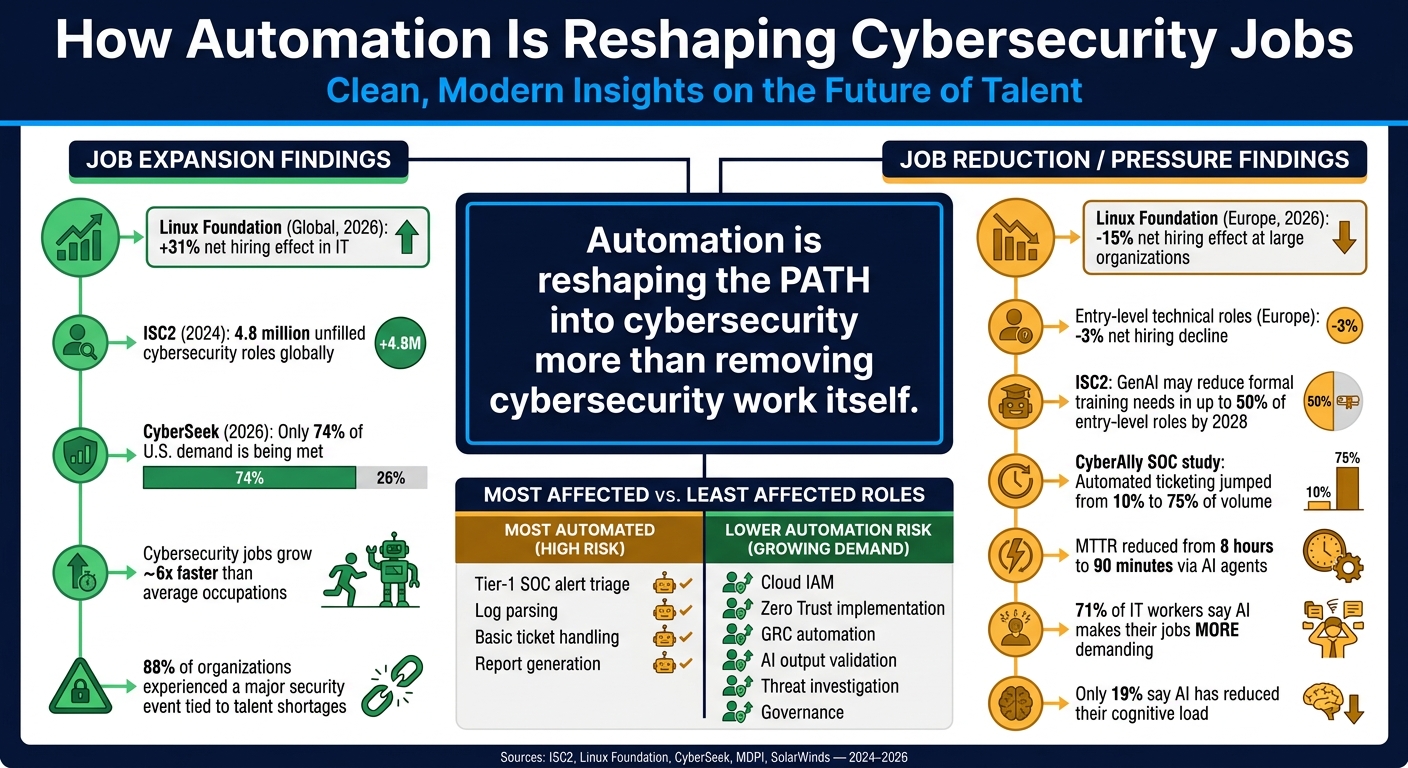
If I had to put the whole article into one line, it would be this: automation is changing the path into cybersecurity more than it is removing cybersecurity work itself.
Global Cybersecurity Demand Still Outpaces Supply
As automation takes routine work off people's plates, it also creates more need for people who can run, check, and respond to the systems behind it. Repetitive tasks may shrink, but oversight, analysis, and tool governance don't go away. In many cases, they grow.
And the hiring gap is still there. U.S. employers continue to face more open roles than qualified applicants, and CyberSeek says only 74% of demand is being met.
What Recent Studies Say About the Workforce Gap
Across major reports, the message is pretty clear: demand is still ahead of supply. Cybersecurity jobs are growing about six times faster than average. At the same time, 88% of organizations have dealt with at least one major cybersecurity event tied to talent shortages.
SANS puts it bluntly: the shortage is mainly a skills problem, not just a headcount problem. That point matters. It's not only about filling seats. Employers need people who can do the work, use the tools well, and make sound calls when something goes wrong.
How AI and Automation Can Drive More Hiring, Not Less
AI is adding to security work, not shrinking it. AI-generated phishing and deepfake risk are pushing up demand for defenders with detection, response, and governance skills. For people entering the field, that's a big shift. Employers aren't just looking for people who work around automated systems. They want people who can work with them.
The Linux Foundation's 2026 State of Tech Talent Report projects a +31% net hiring effect in IT for 2026. The same report says security concerns are the top barrier to getting value from new technologies. Put simply, more AI adoption means more security work, not less.
Study Comparison Table: Workforce Gap Estimates Across Major Reports
The size of the gap changes from report to report, but the direction stays the same.
| Organization | Report Year | Estimated Gap / Key Metric | Key Demand Driver |
|---|---|---|---|
| ISC2 | 2024 | 4.8 million unfilled roles globally | Rising attack volume and AI-generated threats |
| Horsefly Analytics | 2024 | 4.0 million unfilled roles | Cloud adoption and regulatory requirements |
| CyberSeek | 2026 | 74% of U.S. demand met | Mismatch between talent and enterprise needs |
| Linux Foundation | 2026 | +31% net hiring effect in IT | AI adoption and full-stack readiness |
The next step is to look at which tasks automation handles first, and which roles grow because of that shift.
How Automation Is Changing Roles and Headcount
Cybersecurity Jobs vs. Automation: What the Data Really Shows
Even with a global skills shortage, automation is changing who teams hire and what they expect those people to do. It’s taking routine security work off people’s plates while pushing more value toward oversight, review, and higher-level judgment. So the effect on headcount isn’t one-size-fits-all. It shifts by role level.
Which Cybersecurity Tasks Are Most Likely to Be Automated
Automation is hitting Tier-1 SOC work hardest. Tasks like log parsing, alert triage, ticket handling, and basic report generation are now being handled more often by automated systems. In 2025, the AI-driven agent CyberAlly was tested in simulated SOC environments and cut Mean Time To Respond (MTTR) from 8 hours to 90 minutes, while lifting automated ticketing from 10% to 75% of total volume.
That kind of jump takes a lot of repetitive work out of the queue. But it also makes the path into entry-level security jobs tougher. If software can handle the first pass, teams have less reason to hire people just to sort alerts all day.
Where automation still falls short is judgment. Rule-based systems do well with repeatable tasks, but more complex investigations still need human judgment. Advanced investigation, decision-making, and cross-team communication still depend on a human in the loop.
Where Studies Disagree on Job Loss Risk
This is where the picture gets messy. Global and regional findings point in opposite directions. The Linux Foundation's 2026 report projects a +31% net hiring effect in IT globally, treating AI as a driver of growth. But its European data points the other way: large organizations there report a -15% net hiring effect, and entry-level technical roles show a -3% decline in demand.
ISC2 adds another twist. Its research says GenAI could reduce the need for formal training in up to 50% of entry-level cybersecurity roles by 2028, with demand shifting toward mid-level and senior expertise. In plain terms, entry-level roles face the most pressure, while mid- and senior-level roles are still being sought out.
At the same time, 71% of IT workers say AI is making their jobs more demanding, and only 19% say AI has reduced their cognitive load. So even when headcount doesn’t drop, the work itself gets harder. That change puts more pressure on entry-level hires to verify outputs, tune systems, and keep automated tools under control.
Comparison Table: Job Reduction vs. Job Expansion Findings Across Studies
| Study / Report | Reported Headcount Impact | Main Automated Tasks | Job-Loss Risk | Entry-Level vs. Senior Impact |
|---|---|---|---|---|
| Linux Foundation (Global) | +31% net hiring (expansion) | Full-stack IT operations, AI integration | Low - framed as a skills crisis | Senior roles prioritized; upskilling emphasized |
| Linux Foundation (Europe) | -15% for large orgs (reduction) | Entry-level technical tasks | Moderate | -3% net hiring for entry-level |
| ISC2 / GrowthNavigate | 4.8M unfilled roles; AI fills gaps | Phishing detection, breach identification | Moderate - up to 50% of entry-level roles may lose formal training requirements by 2028 | Demand concentrating at mid and senior levels |
| CyberAlly SOC Study (MDPI) | Efficiency scaling (no reduction cited) | Alert triage, ticketing, MTTR reduction | Low - analyst augmentation focus | Tier-1 automated; Tier-2/3 augmented |
| SolarWinds IT Trends | Increased demand and fatigue | Root cause analysis, data extraction | Low on headcount; high on cognitive load | Technical contributors feel less prepared (13%) than C-suite (50%) |
That leaves skills, not just seat count, as the main filter for new entrants.
Skills and Career Entry in an Automated Security Market
Skills That Are Growing in Employer Demand
Employers now want people who can check AI output, tune automated workflows, and deal with exceptions when the system gets things wrong. AI literacy is now high on the list. In plain English, that means knowing how to use AI tools well, understanding how automated workflows move from one step to the next, and knowing when to stop and question an answer instead of taking it at face value. So where is demand moving fastest?
Cloud IAM, Zero Trust implementation, and GRC automation are now priority areas. Employers also want people who can turn GDPR and CCPA requirements into technical controls. That shift is changing what companies expect from new hires.
"Automation doesn't eliminate the need for skilled security professionals. If anything, it changes the skills profile required, shifting emphasis toward threat analysis, decision-making, and strategic response rather than manual monitoring." - Horsefly Analytics
Why Entry-Level Paths Are Shifting
Tier-1 SOC work, like alert triage, log parsing, and basic ticketing, is being automated first. Tools like LogAssist can cut the number of log events that need human review by 99%. That changes the old starting path in a big way.
Researchers describe this as the "experience paradox." Many jobs tagged as entry-level now ask for 3 to 5 years of hands-on work, and 63% of organizations would rather train current staff than hire from the outside. For someone trying to break in, that means titles matter less than proof that you can do the work.
Candidates now need evidence that they can operate inside AI-assisted security workflows. That could mean using LLMs for log summarization or helping with automated alert triage. Skills like that can help a newcomer stand out. Root School helps aspiring professionals practice this kind of work before they apply for their first roles.
Skills Mapping Table: What Research Suggests Newcomers Should Learn
| Study / Report | Skill Gaps and Automation Requirements | Relevance for Newcomers |
|---|---|---|
| ISC2 / GrowthNavigate | 4.8 million unfilled roles; Cloud IAM, Zero Trust, GRC automation; regulatory translation | High - points to where hiring demand is concentrating |
| Linux Foundation | Full-stack readiness; 48% understaffing in cyber; broad, cross-functional security capability | Critical - highlights that broader capability matters |
| MDPI AI-Augmented SOC Survey | Log parsing, alert correlation, threat intelligence; contextual validation, human-AI collaboration, prompt engineering | Essential - shows the day-to-day work juniors are moving toward |
| SecurityWeek AI Snapshot | AI governance, prompt engineering, output validation; agentic AI risk analysis, human-in-the-loop oversight | Important - reinforces the need to validate AI outputs |
What the Research Suggests About the Future of Cybersecurity Jobs
Likely Workforce Scenarios Over the Next Few Years
Skills now play a bigger role in hiring, so the next issue is straightforward: what happens to cybersecurity job demand as automation spreads? Most research points in the same direction. Automation is reshaping cybersecurity work more than wiping roles out. Across IT, AI is expected to create a +31% net hiring effect by 2026, with less time spent on repetitive work and more demand for oversight, review, and validation.
That said, this shift won't look the same everywhere. Region and seniority still matter. Some large European organizations report a -15% net hiring decline, and entry-level technical roles are down 3%. On top of that, some forecasts say GenAI could cut the need for formal education in up to 50% of entry-level roles by 2028.
A lot will come down to governance and upskilling. Many employers are expected to lean on internal reskilling instead of outside hiring so they can keep in-house knowledge. The companies in the best spot are the ones that set clear human review checkpoints, rather than letting AI run on autopilot. Cullen Childress, Chief Product Officer at SolarWinds, put it plainly:
"Without proper planning, AI can introduce more risk through gaps in security and governance, while adding more fragmentation, reviews and sanity checks for teams that don't have the capacity to absorb it."
Key Takeaways for Aspiring Cybersecurity Professionals
For job seekers, the message is shifting a bit. You still need the basics, but now you also need to know how AI and automation fit into the work. If you're new to the field, start with strong core skills and add AI fluency on top.
That matters because cybersecurity job growth is still running at roughly six times the rate of all other occupations. At the same time, employer demand is clustering around areas like:
- Cloud IAM
- Zero Trust
- GRC automation
- Governing and validating AI outputs
AI use is becoming part of the day-to-day job, not some side skill you pick up later. People who treat AI fluency as a core part of the role will have a stronger shot as cybersecurity jobs keep changing.
FAQs
Will automation replace cybersecurity jobs?
No. Automation is mostly helping SOC teams, not replacing them.
Right now, it takes care of alert triage, log summarization, and parts of incident response. That takes repetitive work off analysts’ plates. But human oversight still matters because people need to catch errors, spot integration risks, and avoid automation bias.
Studies suggest cybersecurity is moving toward more automation at early to intermediate stages. In practice, that looks like human-in-the-loop collaboration, not full analyst replacement. So the shift is less about job loss and more about changing skills.
Which cybersecurity roles are most at risk from AI?
Entry-level cybersecurity roles face the most pressure from AI right now. Projections show that generative AI could cut the need for specialized education in as many as 50% of these junior jobs by 2028.
As automation changes the field, hiring is moving more toward people with mid-level and senior experience. Root School offers resources for people who are building their skills and trying to land their first job.
What skills should beginners learn first now?
Start with the technical basics. Learn how TCP/IP, DNS, and HTTP work, build solid Windows administration skills, get comfortable with the Linux command line, and pick up basic scripting in Python or PowerShell.
Then move into core security ideas like the CIA triad, least privilege, multi-factor authentication, and encryption. These concepts show up everywhere, so it helps to know them cold.
It also pays to understand the basics of automation and AI. They’re becoming part of day-to-day security work, from handling repeat tasks to helping teams sort through large volumes of data.
What sets people apart, though, isn’t just book knowledge. Hands-on practice matters. So does clear communication. You need to test things, solve problems, and explain what you found in plain English.