If I were picking a city for my first cybersecurity job in 2026, I would not look at salary alone. The pay gap is big - from $65,013 in Dallas to $93,249 in Washington, D.C. - but rent, taxes, and job volume change the picture fast.
Here’s the short version:
- Highest starting pay: Washington, D.C. and the Bay Area
- Best mix of pay and lower costs: Austin, Denver, and Indianapolis
- Most job openings: New York City and Washington, D.C.
- Best for finance jobs: New York City
- Best for government and clearance-track jobs: Washington, D.C.
- Best for tech-heavy hiring: Bay Area, Seattle, and Austin
- Best for stretching an early-career paycheck: Indianapolis
This article compares 8 cities using three simple filters:
- Entry-level salary
- Cost of living
- Hiring demand
That matters because a city with a $90,000+ starting salary can leave you with less day-to-day spending money than a city paying in the low $80,000s.
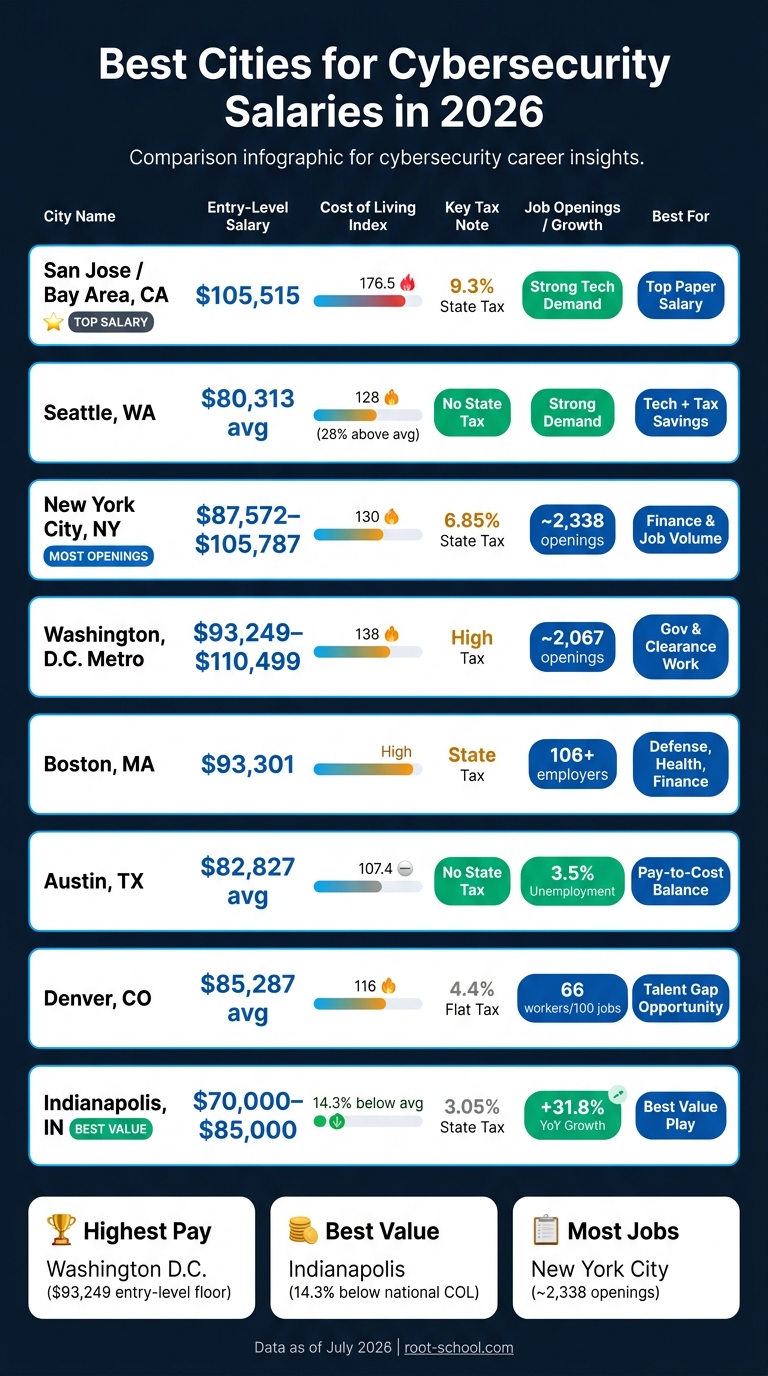
Best Cities for Cybersecurity Salaries 2026: Pay vs. Cost of Living
Where Should You Work in Cyber Security? Best Places to Work in Cybersecurity: Salary, Growth, WFH
sbb-itb-8a31326
Quick Comparison
| City | Entry-Level Pay Snapshot | Cost Picture | Hiring Snapshot | Best Fit |
|---|---|---|---|---|
| San Jose / Bay Area, CA | $105,515 | Very high costs; COL index 176.5 in San Jose | Strong tech and AI security hiring | Top paper salary |
| Seattle, WA | $80,313 average | High rent, but no state income tax | Strong demand from tech, healthcare, and public systems | Tech jobs with better tax setup |
| New York City, NY | $87,572-$105,787 | High costs and taxes | About 2,338 openings | Finance and job volume |
| Washington, D.C. Metro | $93,249-$110,499 | High costs; COL index 138 | About 2,067 openings | Clearance and federal work |
| Boston, MA | $93,301 | High housing costs | Deep employer pool | Defense, healthcare, finance, tech |
| Austin, TX | $82,827 average | Near-national costs; no state income tax | Strong cloud, IAM, and AI-related demand | Good pay-to-cost mix |
| Denver, CO | $85,287 average | Mid-high costs, but below coastal hubs | Talent gap: 66 workers per 100 jobs | Strong balance of pay and cost |
| Indianapolis, IN | $70,000-$85,000 | Low costs; rent about $1,077/month | Postings up 31.8% YoY | Best value play |
Bottom line: if I wanted the highest headline pay, I’d look at D.C. or the Bay Area. If I wanted my paycheck to go further, I’d put Indianapolis, Austin, and Denver near the top. And if I wanted the most shots at landing a job, I’d target New York City or D.C.
Now let’s break down what each city gives you - and what it costs you.
1. San Jose and San Francisco Bay Area, CA
The Bay Area offers some of the country’s highest entry-level cybersecurity salaries.
Entry-level salary
Entry-level cybersecurity roles in San Jose pay well from the start. A Cyber Incident Response Specialist I - a role that usually calls for 0–2 years of experience - earns an average of $105,515 as of July 2026. That’s far above entry-level pay in Los Angeles ($92,144) and New York City ($87,572).
Of course, that salary edge doesn’t feel quite as big once rent, groceries, and daily expenses hit.
Cost-of-living-adjusted pay
The Bay Area is expensive. San Jose has a cost-of-living index of 176.5, while San Francisco comes in at 169.3.
That means a strong paycheck can shrink fast, especially if a large share of it goes to housing.
Hiring demand
Cybersecurity hiring across the Bay Area is still strong, pushed by major tech companies and AI security work. National labs in the region - including Lawrence Livermore National Laboratory (LLNL) and Sandia National Laboratories - also hire for these roles, especially jobs tied to Department of Energy compliance and candidates who can get a security clearance.
In the broader Livermore/Bay Area corridor, Cybersecurity Analyst roles are projected to grow 367% by 2026. That kind of market tends to reward candidates who show job-ready skills, hold certifications, and can step into clearance-track roles.
Entry-level hiring pipeline
For people trying to land their first role, skills and certifications often carry more weight than a four-year degree. Common starting certifications include:
- CompTIA Security+
- CompTIA Network+
- CompTIA A+
Big Tech companies like Amazon, Google, Apple, and Meta still recruit for specialized roles. And about 35% of cybersecurity jobs in major California cities are now fully remote, which gives some people a pretty appealing option: Bay Area-level pay without Bay Area-level living costs.
2. Seattle, WA
Seattle gives you Bay Area-style tech demand without the same state tax hit. With Amazon and Microsoft headquartered nearby, the city stands out for strong cybersecurity pay and no state income tax.
Entry-level salary
Entry-level cybersecurity jobs in Seattle - including Security Compliance Analyst roles that ask for 0–2 years of experience - usually pay between $67,290 and $91,722, with an average of $80,313. And because Washington doesn't tax state income, that paycheck can go a bit further than it might look at first glance.
Cost-of-living-adjusted pay
Seattle isn't cheap. The city's cost of living sits 28% above the national average, and housing costs are about 58% higher than the U.S. average. Average rent was around $2,097 per month as of May 2026.
Still, Washington's zero state income tax is Seattle's biggest edge. For higher earners, that can mean keeping an extra 5–9% of gross income compared with working in California or Oregon. That's not a small gap.
Hiring demand
Seattle's cybersecurity market goes well past Big Tech. In March 2026, Seattle Public Utilities posted a Cybersecurity Analyst role with pay from $129,500 to $194,292, focused on protecting critical infrastructure serving 1.5 million regional customers. In that same month, CrowdStrike listed 46 open cybersecurity positions in the Seattle area.
Demand is also coming from:
- Healthcare
- Defense
- Public infrastructure
Those sectors are adding more security roles across the region.
Industry pipeline
Seattle can also be more open than people expect. Employers such as MultiCare Health System and the Port of Tacoma treat certifications like CompTIA Security+ as a direct substitute for a four-year degree. For someone trying to land that first cybersecurity job, that's a pretty clear skills-first path.
3. New York City, NY
New York City stands out for one simple reason: finance pays a lot. In this market, cybersecurity roles in finance average $164,557, which is above the citywide median cybersecurity analyst salary of $146,926. That city median is 31.2% above the national median. On paper, that looks hard to beat.
But NYC is where this guide’s main tradeoff shows up in plain sight: big salaries don’t always mean big buying power.
Entry-level salary
For entry-level cybersecurity roles in NYC, candidates with 0–1 years of experience can usually expect $91,094 to $105,787. The 10th percentile starts at $87,572, which is 33.3% above the national entry-level median of $65,700.
That same pattern shows up in public-sector hiring too. In July 2026, the MTA posted a Level 1 Cybersecurity Analyst role in Manhattan with a salary range of $82,857 to $105,000. The role asked for only an associate degree plus basic monitoring and troubleshooting skills. That’s a pretty clear signal that NYC can still offer strong starting pay even when the bar for entry isn’t sky-high.
Cost-of-living-adjusted pay
Here’s where things get more complicated.
At a cost-of-living index of 130, the median salary’s real value drops to $113,020. That puts it just 0.9% above the national average. So yes, the paycheck is bigger, but once local costs hit, the gap shrinks fast.
Taxes take another bite. After a total tax burden of about 36.5% - federal, New York state at 6.85%, and FICA - a median earner takes home about $93,298 per year.
Housing is the part that hits hardest:
- Downtown Manhattan apartments run about $5,510 to $7,346 per month
- Outer-suburb apartments run about $2,694 to $3,673 per month
- Around 75% of local cybersecurity jobs offer remote or hybrid flexibility
That last point matters a lot. If you can earn NYC pay without living in the priciest part of the metro area, the math starts to look a lot better. If not, the headline salary loses some of its shine. In this market, hiring demand matters more than salary by itself.
Hiring demand
NYC does have one big edge: volume.
By mid-2026, the New York metro area had about 2,338 cybersecurity job listings. That’s more than Washington, DC at 2,067 and Los Angeles at 2,087. For job seekers, that means more shots on goal, and that can matter just as much as pay.
Hiring also tends to bunch up around budget cycles. Peak windows usually run from January through March and again from September through October. If you’re planning applications, timing isn’t a small detail here.
Industry pipeline
The employer base is deep. Major names include JPMorgan, Bloomberg, IBM, Mastercard, PwC, Google, Amazon, Meta, and Spotify. Specialist firms like Trail of Bits, Huntress, Snyk, and DataDome add another lane for candidates who want more niche roles.
For entry-level applicants, there’s another shift worth paying attention to: many NYC employers are more open than they used to be on skills-based hiring. Certifications, CTF participation, and GitHub portfolios carry more weight now.
One credential stands out in this market. An AWS Solutions Architect certification can add a 12% to 18% salary premium.
4. Washington, DC Metro
Washington, DC pays for access. More specifically, it pays for clearance.
This is a cybersecurity job market shaped by federal agencies and defense contractors, so pay tends to run high. But there’s a catch: the bar to get in is higher, and the career path often looks different from what you’d see in other cities. The median cybersecurity analyst salary is $153,471, which is about 37.0% above the national median.
Entry-level salary
Entry-level cybersecurity jobs in the DC area pay $95,152 to $110,499, with a 10th-percentile floor of $93,249. That beats New York City’s $87,572 and sits far above the national entry-level median of $65,700.
You can see that in live job listings, too. Federal contractor Hyertek posted a Cybersecurity Analyst role supporting DoD clients at $110,000–$125,000 for candidates with an active Secret clearance and Security+ CE.
That said, a high starting salary doesn’t automatically mean more room to breathe. In DC, living costs can eat into that gap fast.
Cost-of-living-adjusted pay
DC’s cost-of-living index is 138, which cuts the median salary’s adjusted value to $111,211. That puts it slightly below the national average and below New York City’s $113,020.
After about 40.1% in taxes, take-home pay drops to roughly $91,852. Housing is where things get tight: downtown rents range from $5,755 to $7,673 per month.
One common move is to live farther out. Outer suburbs like Alexandria, VA can bring housing costs down in a big way, with median home prices about $115,500 lower than in DC proper.
Hiring demand
The DC metro area has about 2,067 open cybersecurity roles, and around 75% of them offer remote or hybrid work.
In this market, who you can work with - and what systems you’re cleared to touch - often matters just as much as the paycheck.
Industry pipeline
Government leads on pay, with an estimated average salary of $171,888. Technology follows at $161,145, and defense comes in at $150,402. Major employers include federal agencies, defense contractors, and cloud consultancies.
Clearance rules shape a lot of these jobs. Many entry-level government and contractor roles ask for an active Secret clearance and Security+ CE within months of hire. Add credentials like AWS Solutions Architect or PMP, and pay can increase by 10% to 18%.
5. Boston, MA
Boston offers strong entry-level cybersecurity pay across defense, finance, healthcare, and tech.
Entry-level salary
As of July 2026, a Cyber Incident Response Specialist I in Boston earns an average of $93,301. That's a strong number. The bigger question is whether that paycheck still feels solid once housing costs enter the picture.
Cost-of-living-adjusted pay
Boston is expensive, and job seekers know it. Many choose to live outside the city center and look at lower-cost nearby cities like Brockton, Lawrence, Lowell, or Worcester.
So Boston isn't the place you pick for cheap living. It's the place you pick when you want strong pay and access to a deep pool of employers.
Hiring demand
Boston has more than 106 specialized cybersecurity employers actively hiring. That gives entry-level candidates a lot more room to find a fit instead of chasing only one type of role.
A few examples stand out:
- PwC has 324 open positions in the Boston area, many tied to consulting, data, and AI.
- Datadog has 49 open positions, with hiring focused on engineering and sales.
Industry pipeline
For new graduates, Boston's edge isn't just salary. It's also the number of structured programs that help people get their foot in the door.
BAE Systems offers multi-year Leadership Development Programs with rotations and mentorship. Rapid7, headquartered in Boston, runs Rapid7 Academy with hands-on labs and certification prep. Huntress offers professional development stipends of about $3,300 to help new hires build credentials faster.
6. Austin, TX
Austin has turned into a solid entry-level cybersecurity market, especially for people trying to break in without heading straight to New York or the Bay Area. Tech companies, defense groups, and critical infrastructure employers are all hiring from the same talent pool, which keeps competition active. Pay is lower than in the top coastal hubs on paper, but the gap shrinks once you factor in taxes and housing.
Entry-level salary
As of July 2026, a Cyber Incident Response Specialist I in Austin earns an average of $82,827. At larger employers such as Dell Technologies, entry-level analysts can make about $109,000. So while Austin may not lead on headline salary alone, it starts to look a lot stronger when cost and take-home pay enter the picture.
Cost-of-living-adjusted pay
Austin's cost-of-living index is 107.4, with housing doing most of the damage. Housing costs run 18.6% above the U.S. median. Still, Texas has no state income tax, and that can leave someone with $8,000–$12,000 more per year on a $150,000 salary than they would keep in California.
That tax difference matters. A lot.
Other day-to-day costs stay close to, or below, national averages. Median rent for a one-bedroom apartment is $1,500, and the rental vacancy rate is about 10.2%. In plain English, renters often have a bit more room to negotiate, and landlords may offer concessions like one or two months of free rent.
Hiring demand
Entry-level hiring is strongest in a few areas right now:
- Cloud security, especially AWS, Azure, and GCP
- AI security operations
- IAM
Austin's unemployment rate is 3.5%, which is below the national average. Defense hiring is also a big part of the local market. Army Futures Command and Fort Cavazos help drive demand, and a CompTIA Security+ certification is often the minimum bar under the DoD 8570 directive. For someone aiming at defense work, that's not just a nice-to-have. It's often the ticket to the interview.
Industry pipeline
Austin gives entry-level candidates a few different lanes instead of just one. On the tech side, Dell Technologies, Amazon/AWS, Apple, and Google all have major presences in the city. Consulting and defense-related roles come through firms like Accenture, Deloitte, and KBR.
There are also paths outside pure tech. ERCOT brings in critical infrastructure roles, while healthcare systems such as Baylor Scott & White add another source of security hiring. The University of Texas at Austin also feeds the market with a steady stream of early-career talent.
7. Denver, CO
Denver offers solid entry-level pay without the sticker shock you get in many coastal cities. Defense, aerospace, and tech all hire here, which helps keep the market active. It may not top this guide for raw pay, but for entry-level candidates, Denver stands out as one of the better value picks.
Entry-level salary
Entry-level cybersecurity pay in Denver ranges from $62,061 to $111,326, with penetration testers at the top end at $111,326. Compliance jobs also pay well, including Security Compliance Analyst roles at $74,072. A Cyber Incident Response Specialist I makes about $85,287.
Those numbers look even better once you factor in taxes and housing. A paycheck doesn’t mean much if rent eats half of it.
Cost-of-living-adjusted pay
Denver has a cost-of-living index of 116, and the median rent for a one-bedroom apartment is $1,950 per month. Colorado also has a flat 4.4% state income tax, which helps workers keep more of what they earn than they might in states with steeper tax brackets, such as California.
Put simply, Denver’s pay goes further than the headline salary might suggest.
Hiring demand
Denver has only 66 qualified cybersecurity professionals for every 100 open positions, which points to a clear talent gap. On top of that, information security employment is expected to grow 35% by 2031.
Some of the most sought-after jobs include:
- SOC analysts
- Incident responders
- Penetration testers
- Compliance analysts
Employers also put real weight on certifications and hands-on work, not just a polished resume. Common asks include CompTIA Security+, GIAC Security Essentials (GSEC), and Certified Ethical Hacker (CEH). That hiring pressure cuts across defense, tech, finance, and healthcare.
Industry pipeline
Denver has a strong mix of employers across aerospace and defense, tech, financial services, and healthcare. Major names include Lockheed Martin Space, Northrop Grumman, Google, Charles Schwab, and UCHealth.
If you want defense-focused work, two places are worth watching closely: the Denver Federal Center in Lakewood and Peterson Space Force Base in Colorado Springs. For many job seekers, that adds another lane into the market beyond standard private-sector hiring.
8. Indianapolis, IN
Indianapolis doesn't get the same attention as the big coastal markets. But if you look at the data, it's hard to ignore. Pay is lower on paper, yet the mix of job growth and lower day-to-day costs makes the city one of the best value markets in 2026.
Cybersecurity job postings climbed 31.8% year over year, and wages went up 17.2%. So this isn't a top-salary market. It's a market where your paycheck can stretch much further.
Entry-level salary
Entry-level cybersecurity jobs in Indianapolis usually pay between $70,000 and $85,000. A Cyber Incident Response Specialist I earns an average of $81,397.
There’s another factor here, too. In defense roles, an active Top Secret clearance can add 15% to 25% to base pay. For someone early in their career, that can make a big difference.
Cost-of-living-adjusted pay
This is where Indianapolis starts to look especially strong.
The city's cost of living is 14.3% below the national average, and the median rent for a one-bedroom apartment is $1,077 per month. The national median is $1,402. That gap matters. A salary in the low-$80,000s lands differently when rent stays closer to $1,000 than $1,400.
Taxes also help shape the picture. Indiana has a flat state income tax of 3.05%, and Marion County adds a local rate of about 2.02%. Put that together, and early-career cybersecurity pay tends to go further here.
Lower living costs are one side of the story. The other is that demand isn't tied to just one sector.
Hiring demand
Cybersecurity hiring in Indianapolis spans:
- Healthcare
- Defense
- Pharmaceuticals
- Logistics
- Utilities
That spread matters because it gives job seekers more than one lane into the market. CompTIA Security+ shows up often in logistics and government roles, while GIAC GICSP is more common in manufacturing and utilities.
Industry pipeline
The employer base includes Eli Lilly, NSWC Crane, Booz Allen Hamilton, IU Health, and Elevance Health.
The talent pipeline is active too. The Purdue-IU corridor helps feed new workers into the market, and Camp Atterbury's annual Cyber Shield event supports both entry-level hiring and military-to-civilian transitions.
Pay, Affordability, and Opportunity: How the Cities Stack Up
The pattern is pretty simple: coastal hubs lead on headline pay, while lower-cost markets do better on day-to-day buying power. If you're picking a city to start in, three things matter most: pay, affordability, and room to grow.
Highest nominal salaries
San Jose has the highest listed entry-level salary at $105,515, followed by Washington, DC at $93,249 and New York at $87,572. That tracks with the makeup of each market. DC's government and defense employers help keep salaries high, while New York's finance sector does the same.
Strongest cost-of-living-adjusted value
DC posts higher nominal pay, but New York comes out slightly ahead on actual value after cost of living and taxes. Still, lower-cost cities can go further in practice.
Indianapolis is 14.3% below the national cost-of-living average, which gives early-career workers more breathing room. Denver also stands out here. Its flat 4.4% state income tax means workers keep more of each paycheck than they would in higher-tax states.
Hiring demand and long-term opportunity
New York and DC lead in total openings, while Indianapolis stands out for growth. New York has about 2,338 open positions, and DC has around 2,067.
Indianapolis tells a different story. Job postings there climbed 31.8% year over year, and wages rose 17.2% over the same stretch. That's a big jump. It also helps that the city isn't tied to just one lane: DC leans heavily on government and defense, while Indianapolis has roles across pharma, healthcare, and defense.
Remote and hybrid tradeoffs
Remote and hybrid work can change the math in a big way. A high-pay city can start to look a lot more appealing if you can work for a major employer without paying full metro-area living costs.
That tradeoff leads into the next part: what each city asks you to give up, and what you get back in return.
Pros and Cons of Starting a Cybersecurity Career in Each City
The numbers show a pretty simple truth: there isn't one perfect city. Each market gives you something, and each asks for something back.
The table below lays out the main upside and the main friction point for each one.
| City | Key Pros | Key Cons |
|---|---|---|
| San Jose / Bay Area, CA | Top-paying California market | California's 9.3% state income tax can cut into take-home pay |
| Seattle, WA | Strong tech employer base | Competition can be stiff, and living costs can be a challenge |
| New York City, NY | High job density creates career mobility without relocating | State income tax (6.85%); downtown rent ranges $5,510–$7,346/month |
| Washington, DC Metro | Highest nominal entry-level salary ($93,249) | Clearance requirements and cost pressure reduce take-home value |
| Boston, MA | Deep employer base across defense, finance, healthcare, and tech | Higher living costs can tighten the budget |
| Austin, TX | Growing market with no state income tax | The market is smaller than the biggest hubs |
| Denver, CO | Balanced market with lower costs than coastal hubs | Still smaller than the largest metro markets |
| Indianapolis, IN | Fast posting growth and niche defense/OT demand | Some roles require onsite presence or security clearances |
You can see those tradeoffs most clearly in two areas: employer density and how far your paycheck goes.
New York and DC have the most openings. Indianapolis, meanwhile, stands out for the fastest growth, but pay is lower. That's a big deal for entry-level job seekers. A larger job pool can give you more shots on goal, while a lower-cost city can make an early-career salary feel less tight.
Another shift is worth watching. In crowded markets like New York and DC, skills-based hiring is becoming more important, with employers putting more weight on demonstrated hands-on ability. That means labs, projects, certs, and proof of what you can do may matter just as much as where you studied.
Commute time also changes the math. A high salary can look great on paper, but long commutes add time, stress, and extra cost. In major metros, remote and hybrid work can soften some of that pressure by cutting commute and housing costs.
Conclusion
There’s no one-size-fits-all answer for cybersecurity job seekers. One thing does stand out, though: salary matters, but local living costs and the mix of employers in each city play a big part in what that salary actually gets you.
Across the eight cities covered here, the best pick comes down to what you care about most. If top-line pay is your main goal, Washington, DC comes out ahead with an entry-level salary of $93,249. But that edge shrinks once you factor in DC’s 138 cost-of-living index. Indianapolis stands out for the fastest growth in job postings and lower day-to-day costs. Meanwhile, New York and DC lead in total openings. Remote and hybrid jobs can also shift the picture, especially in places where rent and daily expenses hit hard.
If you’re still deciding where to begin, keep it simple. Look for the city that lines up with both your budget and the kind of work you want to do. Go where the employer mix fits your target role: government and defense in DC, finance in New York, or healthcare and pharma in Indianapolis. And if you’re still building the skills to land that first job, Root School can help you get ready for it.
FAQs
Which city is best for beginners?
It comes down to a simple trade-off: higher pay or lower living costs.
Cities like San Francisco and New York tend to pay more. But there’s a catch - the cost of living is much higher too.
For many beginners, Raleigh, NC stands out because it offers a strong middle ground. Indianapolis, IN, Tulsa, OK, Dallas, TX, and Chicago, IL also offer a solid mix of salary and affordability.
Should I prioritize salary or affordability?
Prioritize affordability by looking at your real buying power, not just the salary figure. A bigger paycheck in coastal cities can get eaten up fast by higher rent and day-to-day costs.
Check a city's cost of living to see how far your paycheck will actually stretch. Root School encourages aspiring cybersecurity professionals to weigh that alongside job demand for long-term stability and quality of life.
How important are certifications in these cities?
Certifications are highly important if you want an entry-level cybersecurity job in any city. They show up in more than 80% of job postings, and they often help applicants get through screening systems.
They can also add $5,000 to $10,000 to entry-level pay and boost interview chances by as much as 70%. For government or Department of Defense roles, they're often required.