In 2026, cybersecurity professionals are enjoying some of the highest salaries across industries due to a massive talent shortage and growing demand for specialized skills. Elite roles like Chief Information Security Officer (CISO) can earn over $350,000 annually, while technical experts in fields like AI security and cloud defense are seeing salaries soar to $190,000–$240,000. A key driver is the rise of AI-driven threats and an expanded attack surface from IoT and cloud technologies.
Key Takeaways:
- Median cybersecurity salary: $120,000+ (double the U.S. average).
- Top roles: CISO ($350K–$585K), Security Architect ($180K–$225K), Cloud Security Engineer ($145K–$240K), AI Security Engineer ($150K–$190K).
- Certifications matter: CISSP, CCSP, and OSCP can boost pay by $20K–$35K.
- Fast-growing fields: AI security, cloud security, and Zero Trust architecture.
- Job mobility pays: Switching roles can lead to a 20–40% salary increase.
Cybersecurity offers lucrative opportunities for both technical specialists and governance professionals. Specializing in high-demand areas, gaining certifications, and building hands-on experience are crucial for maximizing earning potential in this thriving field.
10 Highest Paying Cybersecurity Jobs (AI Safe)
sbb-itb-8a31326
How Cybersecurity Salaries Work in the U.S.
Knowing how cybersecurity salaries are structured can help you plan your career and negotiate effectively. A solid understanding of compensation components allows you to aim for roles that align with your financial goals. In cybersecurity, total compensation goes beyond just a base salary - it often includes bonuses, equity, and benefits.
What Makes Up a Cybersecurity Compensation Package
The median base salary for cybersecurity professionals is around $128,000, which is more than double the U.S. median salary of $59,000. But that’s just the starting point. Total compensation often includes performance bonuses, equity (like restricted stock units or RSUs), and additional perks. Senior executives, such as Chief Information Security Officers (CISOs), can earn total packages exceeding $400,000 annually, with bonuses and equity alone ranging from $75,000 to over $139,000 per year.
Benefits are another key part of the package. Many cybersecurity roles offer perks like a $5,000 annual budget for training and certifications. Additionally, remote or hybrid work options are becoming standard, with 78% of professionals expecting this flexibility.
What Affects Your Earning Potential
Your salary in cybersecurity depends on several factors, some of which you can control. Here are the main drivers:
Experience is one of the biggest factors. Career milestones at 3–5 years and 7–8 years often come with salary increases of $30,000–$40,000. The table below shows how salaries typically progress with experience:
| Role | Entry (0–2 yrs) | Mid (3–7 yrs) | Senior (8+ yrs) |
|---|---|---|---|
| Security Analyst | $65K–$85K | $85K–$110K | $110K–$135K+ |
| Security Engineer | $85K–$115K | $115K–$145K | $145K–$175K+ |
| Security Architect | $110K–$145K | $145K–$180K | $180K–$225K+ |
| CISO | - | $200K+ | $350K–$585K |
Source: NueCareer 2026 Data
Certifications can also significantly boost your earnings. For example, earning a CISSP credential can add $25,000–$35,000 to your salary. Pairing it with a CCSP certification can push your total compensation above $150,000 within 3–5 years. Security clearances also matter - a Top Secret clearance can increase pay by $15,000–$30,000, while a Full Scope Polygraph clearance might add $45,000–$65,000 annually.
"The median annual wage for information security analysts was $124,910 in May 2024, with employment projected to grow 29 percent from 2024 to 2034 - far faster than the average for all occupations." - Bureau of Labor Statistics
Industry and location are other important factors. Financial services and tech companies typically pay 20–35% above the national median, while industries like healthcare and retail tend to offer lower salaries. Geographically, Washington State leads with an average cybersecurity salary of $150,592, thanks to companies like Amazon and Microsoft. San Jose ranks highest among metro areas, with an average salary of $175,520. However, cost of living plays a role - a $165,000 salary in San Francisco may have the same purchasing power as $120,000 in Austin or Denver.
Finally, job mobility can have a big impact. Staying in the same job often results in annual raises of just 3–5%, while switching employers for a similar role can lead to a 20–40% pay bump. If you’ve been in the same position for over two years without a raise, you might be missing out on a significant salary increase by not exploring new opportunities.
This breakdown highlights the factors that influence cybersecurity compensation, helping you identify the roles and strategies that offer the best financial rewards.
Top-Paying Cybersecurity Jobs in 2026
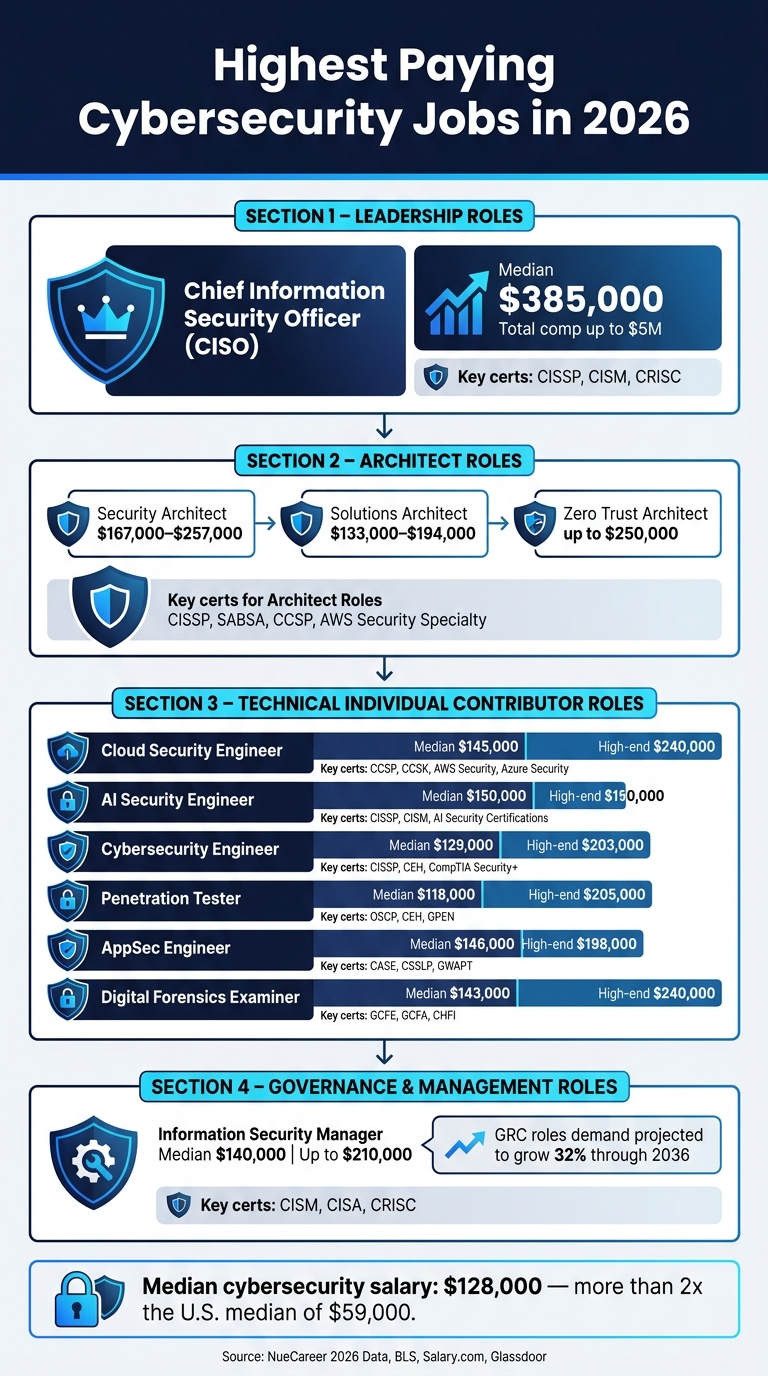
Highest Paying Cybersecurity Jobs in 2026: Salaries & Certifications
Now that we've explored what influences cybersecurity salaries, let's dive into the roles that command the highest paychecks. Leadership, architecture, technical, and governance positions each reward their unique blend of skills with competitive compensation.
Leadership Roles: Chief Information Security Officer (CISO)
The CISO role is the pinnacle of cybersecurity leadership, and the salaries reflect this level of responsibility. According to Salary.com, the median salary for a CISO is $385,000, while Glassdoor reports $321,000. In large U.S. enterprises, total compensation packages, including equity and bonuses, can soar between $500,000 and $5 million annually.
CISOs are responsible for shaping security strategies, communicating risks to boards, ensuring compliance with regulations, and making critical decisions that protect the organization. To reach this level, professionals typically need 10–15 years of experience, a solid technical foundation, and the ability to translate cybersecurity risks into financial terms. Certifications like CISSP, CISM, and CRISC are highly sought after, and many companies expect a Master's degree or MBA for this executive role.
Architect Roles: Security Architect and Solutions Architect
Security Architects are tasked with designing an organization's overall security infrastructure, ensuring compliance with frameworks like NIST and ISO 27001. Senior-level Security Architects can earn between $167,000 and $257,000 annually. Solutions Architects, who focus on creating secure IT solutions, earn slightly less, with salaries ranging from $133,000 to $194,000.
These roles often require certifications such as CISSP and SABSA for framework design, as well as cloud-specific credentials like AWS Certified Security – Specialty or CCSP. Zero Trust architecture is gaining traction as a specialty, with Zero Trust Architects earning up to $250,000 as more organizations adopt this approach.
Technical Individual Contributor Roles
You don't have to pursue a management track to earn a high salary in cybersecurity. Several technical roles offer excellent pay, with some senior individual contributors earning as much as or more than their managerial counterparts.
| Role | Median Salary | High-End Range | Key Certifications |
|---|---|---|---|
| Cloud Security Engineer | $145,000 | $224,000–$240,000 | CCSP, AWS/Azure Security |
| AI Security Engineer | $150,000 | Up to $190,000 | CISSP, Machine Learning |
| Cybersecurity Engineer | $129,000 | Up to $203,000 | CISSP, Security+ |
| Penetration Tester | $116,000–$120,000 | $190,000–$205,000 | OSCP, GPEN, CEH |
| AppSec Engineer | $146,000 | Up to $198,000 | CSSLP, GWEB |
| Digital Forensics Examiner | $143,000 | Up to $240,000 | GCFE, CCE |
Two areas are expected to see significant growth by 2026. Cloud Security continues to expand as businesses transition to hybrid environments, with top earners making up to $224,000. AI Security is a newer field, and professionals who combine machine learning expertise with cybersecurity are becoming highly sought after, with salaries reaching $190,000.
"The rise of AI means traditional roles are shifting. The biggest salary jumps in 2026 are found in AI Security (up to $190k) and Cloud Defense (up to $224k)." - Hackr.io
For offensive security enthusiasts, penetration testing remains a lucrative path. The OSCP certification is highly regarded, with holders earning between $117,600 and $151,000 on average, and top-tier professionals exceeding $190,000.
Governance and Management Roles
For those who prefer managing risk and compliance over hands-on technical work, governance roles offer another path to high earnings. Governance, Risk, and Compliance (GRC) positions, such as Information Security Managers and compliance specialists, are particularly in demand across industries like finance, healthcare, and defense.
Information Security Managers earn a median salary of $140,000, with experienced professionals making up to $210,000. These roles involve conducting risk assessments, performing compliance audits for frameworks like GDPR, HIPAA, and PCI DSS, and developing policies that bridge technical teams and regulators. Certifications like CISM, CISA, and CRISC can further enhance earning potential. With demand for GRC roles projected to grow by 32% through 2036, this field offers a stable and lucrative career path.
How to Get Into High-Paying Cybersecurity Roles
Landing a top-tier cybersecurity role requires a clear strategy, from choosing the right career path to earning in-demand certifications.
Choose Your Career Direction
Focusing your career on a specific area within cybersecurity is key to unlocking higher salaries. As CISO Larry Trittschuh wisely says:
"Success isn't a ladder, but a menu, and no one meal suits everyone's tastes."
The first step is figuring out what excites you most. If you're drawn to strategy and enjoy working with executives, leadership roles like CISO or Security Manager might be your calling. On the other hand, if you love solving technical puzzles and designing systems, roles like Security Architect or Cloud Architect may be a better fit. Prefer hands-on work like writing exploits or hunting threats? Then aim for roles such as Penetration Tester or Cloud Security Engineer.
Your early decisions about focus will shape every step of your career, from the skills you develop to the certifications you pursue. Specialists in high-demand fields like Cloud Security, AI Security, and DevSecOps often earn 15% to 30% more than generalists. So, narrowing your focus can directly impact your earning potential.
Build the Skills and Certifications You Need
Once you've chosen a direction, it's time to build the right credentials. Avoid the common mistake of collecting random certifications without a clear plan. Instead, start with foundational certifications and progress toward specialized ones that align with your chosen path.
| Career Path | Base Certification | Specialization Cert | Avg. Salary Boost |
|---|---|---|---|
| Leadership / GRC | Security+ | CISSP, CISM, CRISC | +$25K–$35K |
| Architecture | CISSP | CCSP, AWS Security Specialty | +$20K–$25K |
| Offensive Security | Security+ | OSCP, GPEN | +$20K–$30K |
| Cloud Security | Security+ | CCSP, Azure Security Engineer | +$20K |
Practical experience is just as important as certifications. Build a home lab, learn scripting languages like Python or Bash, and experiment with cloud platforms or vulnerable applications. Real-world experience helps you stand out in interviews, as employers value proof of your abilities over test scores alone. In fact, 91% of business leaders prefer candidates with professional certifications, so combining these credentials with hands-on skills is a winning approach.
By stacking the right certifications and gaining practical experience, you'll be ready to step into advanced training programs and higher-paying roles.
How Root School Supports Your Career Goals
Root School offers role-specific learning paths designed to fast-track your cybersecurity career. Whether you're starting fresh or transitioning from a role like SOC Analyst to Security Architect, their programs are tailored to guide you toward your goals.
The training includes hands-on labs and live workshops that simulate real-world scenarios, giving you more than just theoretical knowledge. Project-based learning ensures you leave with tangible work samples that showcase your skills to potential employers. Root School also prepares students for key certifications like CompTIA Security+ and GSEC, while offering 1:1 career coaching and access to exclusive job boards to bridge the gap between training and employment.
The path to a high-paying cybersecurity role is within reach - it’s all about targeted preparation and the right resources to make it happen.
Conclusion: Starting Your Cybersecurity Career in 2026
The cybersecurity job market in 2026 offers some of the highest earning potential across industries. For example, Chief Information Security Officers can expect salaries ranging from $250,000 to over $417,000, while Security Architects earn between $157,000 and $290,000. Meanwhile, AI Security Specialists see paychecks of $135,000 to $190,000. These numbers underscore a field grappling with a talent shortage - only 14% of companies report having enough cybersecurity staff to meet their needs. What sets successful professionals apart? Specialization, certifications, and practical experience.
As previously mentioned, certifications and specialized skills are essential for moving up in this field. Certified professionals, for instance, earn an average of 37% more than their non-certified counterparts. Areas like AI security and Zero Trust architecture are especially lucrative, as demand continues to grow. The key is to align your learning and career development with your strengths and long-term goals. By doing so, you'll position yourself for both job security and financial success.
If you're ready to take the next step, Root School is here to guide you. With tailored learning paths, hands-on labs, and career coaching, you'll gain the skills and experience that employers value - turning preparation into tangible job opportunities, not just another certificate.
FAQs
What’s the fastest path to a $150,000+ cybersecurity salary?
The fastest path to earning over $150,000 in cybersecurity is by moving into senior-level positions like Security Architect, Security Engineer, or Chief Information Security Officer (CISO). To get there, focus on earning certifications such as CISSP, CISA, or CISM, which are highly respected in the industry. Building expertise in areas like security architecture or leadership is also key. Additionally, working in sectors like finance or defense - or securing a Top Secret clearance - can dramatically increase your earning potential.
Which certifications give the biggest pay bump in 2026?
Certifications linked to lucrative positions, such as Chief Information Security Officers (CISOs) and Security Architects, are expected to deliver the biggest salary boosts in 2026. Some of the standout certifications include CISSP, CISA, and CISM. These credentials are well-respected in the industry and are known for significantly increasing earning potential.
How do I choose between cloud security, AI security, and GRC?
When planning your career path, think about what excites you, where your skills shine, and what you aim to achieve.
- Cloud security is all about securing platforms like AWS or Azure. It’s a great fit if you enjoy hands-on technical work and tackling real-world challenges in cloud environments.
- AI security focuses on protecting AI systems. This field is perfect if you have a background in machine learning and data science, as it requires a deep understanding of how these technologies work.
- GRC (Governance, Risk, and Compliance) leans toward policy, compliance, and managing risks. If you’re drawn to strategic roles and enjoy creating frameworks that keep organizations on track, this might be your calling.
Each of these fields is in high demand and offers excellent earning opportunities. Choose the path that aligns with your strengths and long-term goals.