Deepfakes are now a direct security risk, not just fake internet clips. In January 2024, a worker at Arup was tricked into sending $25 million after a video call with fake co-workers. For me, that sums up the issue fast: deepfakes do not need to hack a system first if they can trick a person into approving money, access, or identity checks.
If I were explaining this in plain English, I’d boil it down to this:
- Deepfakes fake trust, not just media
- Audio, video, and face swaps now support fraud, account recovery abuse, and fake onboarding
- People are bad at spotting them on sight or sound alone, with studies in the 57% to 60% range
- The best way to stop damage is process, like out-of-band call-backs, multi-person approval, and help desk checks tied to signed-in sessions
- Entry-level security roles in SOC, IAM, and risk all need to know how these attacks work
This article explains what deepfakes are, how attackers use them, what signals teams should watch for, and what skills I’d learn first if I wanted to work in cyber today.
What matters most is simple: don’t treat a face or voice on a screen as proof of identity anymore.
The Rise of Deepfakes: How Smart Security Teams Stay Ahead
sbb-itb-8a31326
What Deepfake Technology Is and How It Works
A deepfake is a form of synthetic media - an image, audio clip, or video that AI generates or alters so a person seems to say or do something they never actually said or did. The term blends “deep learning” and “fake,” which points to the neural networks behind it. And that’s the key difference from basic editing: deepfakes aren’t pieced together by hand. The AI studies patterns in training data, then generates new media that looks and sounds real.
Deepfakes work by manipulating the person who can approve the action.
That automation is what sets deepfakes apart from older media edits.
Deepfakes vs. Older Media Manipulation Methods
Older manipulation methods - Photoshop edits, audio splicing, video cropping - took manual work and a fair amount of time. That put a natural cap on both how often people could do it and how polished the end result looked. Deepfake tools change that. They automate the process, cut the skill needed, and let attackers scale fast.
A good example came in early 2024: the audio used in the Biden robocall scam cost $1 and took less than 20 minutes to create. That kind of speed and low cost is why deepfakes stopped being just an internet stunt and became a direct security issue.
The Core Technologies Behind Modern Deepfakes
From a defense point of view, the main issue isn’t the fine detail of model design. It’s what those models let attackers do.
Generative Adversarial Networks (GANs) use two neural networks in a kind of back-and-forth contest. One creates fake media. The other tries to spot it. That loop keeps going until the fake gets good enough to fool the detector.
Diffusion models sit behind many modern text-to-video and voice-cloning tools. They also cut down how much source material an attacker needs. In some cases, just 3 seconds of audio can produce an 85% voice match.
Autoencoders work by compressing a person’s facial features and rebuilding them on another face. That’s the basic engine behind real-time face-swap tools.
Multimodal AI brings these pieces together. An attacker can mix a cloned executive voice, a fake video feed, and a written pretext into one coordinated social engineering chain. That’s the same attack pattern seen in the Arup incident.
Security Concepts Tied to Synthetic Media
These are the checks and controls attackers try to get around during onboarding and identity verification.
Media provenance tracks where a digital file came from and what happened to it over time. In plain English, it helps show whether a file is what it says it is and whether someone changed it along the way.
Content authenticity is the broader practice of checking that a piece of media matches its claimed source. That supports source validation. Standards like the Coalition for Content Provenance and Authenticity (C2PA) add cryptographic metadata to files at the moment they’re created, which makes tampering easier to detect.
Liveness detection checks during remote identity verification that a face or voice belongs to a real, present human - not a recording or an AI-generated stream. One way attackers get around this is with a media injection attack: instead of using the physical camera, they feed synthetic video straight into the verification stream.
These ideas connect straight to verification controls and the gaps attackers look for.
How Deepfakes Create Risk for Organizations
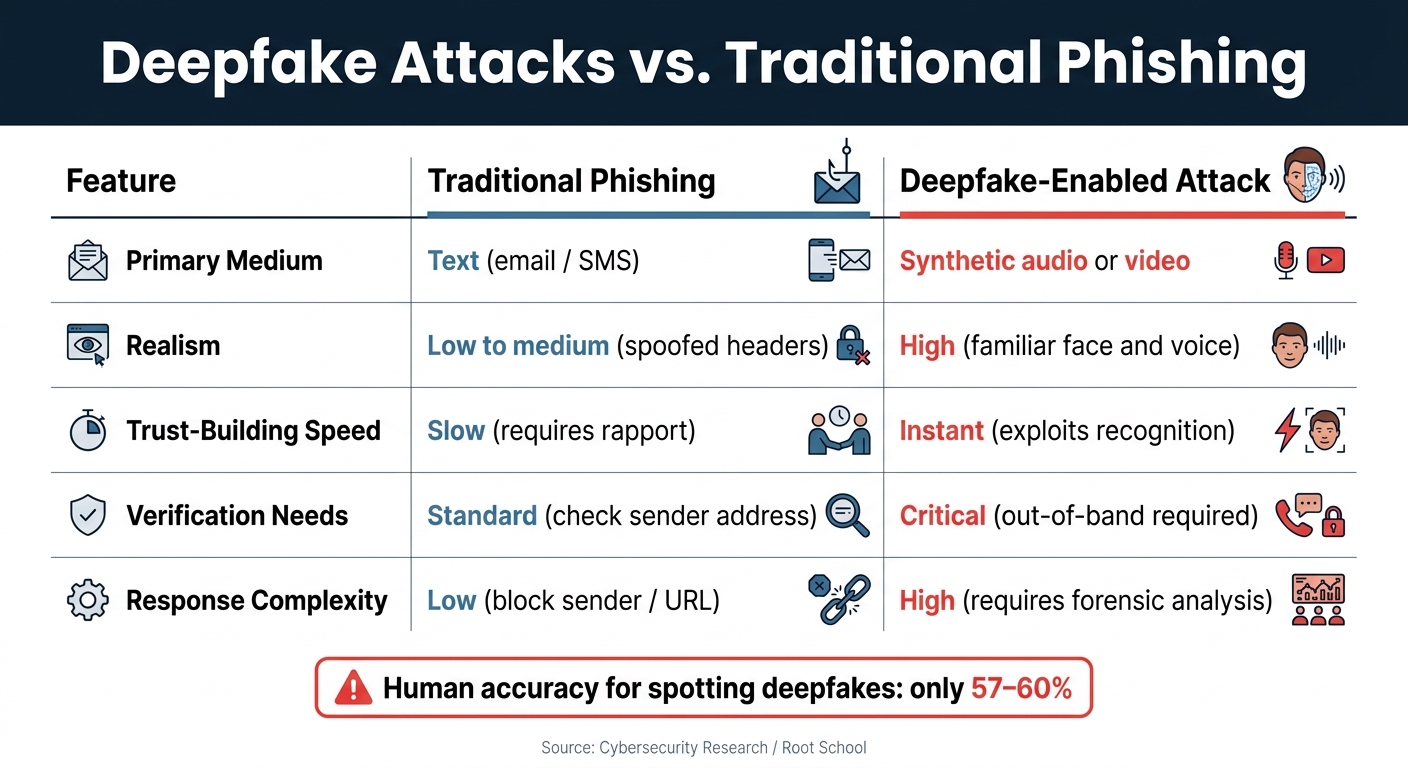
Deepfake Attacks vs. Traditional Phishing: Key Differences Cybersecurity Pros Must Know
The main risk isn’t the fake audio or video on its own. The real danger is the action it pushes someone to take. That’s the part organizations need to focus on if they want to defend themselves.
Financial Fraud, Impersonation, and Social Engineering
The clearest example is financial fraud. In January 2024, an Arup finance worker joined a video call with deepfake versions of the CFO and other colleagues and wired $25 million in 15 transfers.
That’s the heart of the problem: media that looks or sounds real enough to pressure someone into acting.
| Attack Type | Channel | Target Department | Common Clues | Impact |
|---|---|---|---|---|
| Voice Cloning | Phone / Voicemail | Finance, Help Desk | Robotic cadence, odd pacing, urgency | Fraudulent transfers or account resets |
| Video Impersonation | Zoom / Teams | Finance, Leadership | Unnatural blinking, lip-sync lag, blurred edges | Unauthorized approval of high-value transactions |
| Face Swap | Live Video | HR, Recruitment | Lighting mismatches, flickering at face edges | Fake employee onboarding and insider access |
| Synthetic Identity | Web Portals | Compliance / KYC | Pixelation in documents, fixed expressions | Account opening fraud and KYC bypass |
Finance gets hit most often, but the same playbook also affects identity checks and access workflows.
Synthetic Identity, Account Recovery, and Onboarding Abuse
Deepfakes don’t stop at payments. They also go after identity-related processes, which can be just as damaging.
Help desk teams are a common target. An attacker can use a cloned voice, pose as an employee, call IT, and ask for an MFA reset or a temporary password. If the voice sounds close enough, the request may go through.
Remote hiring has the same weak spot. Attackers have used face swaps to pass interviews and get internal access on day one. Synthetic identities can also slip past KYC checks during account opening and vendor onboarding.
What makes these attacks dangerous is simple: they exploit gaps in process, not just mistakes by staff.
How Deepfake Attacks Differ from Standard Phishing
Standard phishing usually works through text. Think suspicious links, spoofed sender addresses, and urgent emails. Most employees have at least some training to spot those signs.
Deepfake attacks take a different route. Instead of asking people to question a message, they lean on something more instinctive: trust in a familiar voice or face.
| Feature | Traditional Phishing | Deepfake-Enabled Attack |
|---|---|---|
| Primary Medium | Text (email / SMS) | Synthetic audio or video |
| Realism | Low to medium (spoofed headers) | High (familiar face and voice) |
| Trust-Building Speed | Slow (requires rapport) | Instant (exploits recognition) |
| Verification Needs | Standard (check sender address) | Critical (out-of-band required) |
| Response Complexity | Low (block sender / URL) | High (requires forensic analysis) |
When a fake call or video looks legitimate, gut instinct stops being enough. Detection has to come from process controls and independent verification, not from whether something “feels” right.
How Security Teams Detect and Reduce Deepfake Risk
No single tool stops deepfakes. The strongest defense uses layers: detection tools to flag suspicious media, process controls to slow down sensitive requests, and verification steps that do not depend on whether something looks or sounds real.
Detection Methods: Forensics, AI Analysis, and Context Checks
The goal isn't perfect detection. It's fast triage that tells the team: slow down and verify.
Detection usually works across three tracks, and each one catches things the others can miss.
Forensic review is often most useful after an incident. It gives analysts time to examine evidence closely, and it carries high evidentiary value.
AI-based analysis scans live calls for signs of synthetic audio, like unnatural pauses, pitch shifts, and audio glitches. Use it to flag risk, not to make the final decision. Today's detectors help with triage, but they still miss enough cases that human verification matters.
Behavioral and context checks don't get enough attention. That's a mistake. Deepfakes work by leaning on trust, so detection has to catch both the fake media and the pressure around it. If someone is pushing urgency, creating fear, or asking for something outside the normal process, that pressure is part of the signal. As Perry Carpenter, Chief Human Risk Management Strategist at KnowBe4, said:
"The single best thing that anybody can do is if they feel like there's an emotion that's being pulled... that should actually be a signal for them to slow down." - Perry Carpenter, Chief Human Risk Management Strategist, KnowBe4
| Detection Method | Signals Used | Deployment Point | Strengths | Weaknesses |
|---|---|---|---|---|
| AI Analysis | Unnatural pitch shifts and audio artifacts | IVR / Call Center API | Real-time automated triage | Misses high-quality clones; high false positives on poor VoIP |
| Context / Behavioral | Urgency, emotional pressure, out-of-pattern requests | Human (Employee) | Stops attacks regardless of AI quality | High human error rate under pressure |
Detection flags risk. Process controls stop the loss.
Policies and Workflows That Block High-Risk Requests
Detection helps, but process controls are what prevent losses. Voice and video should never count as proof for sensitive requests. Treat both as context, not as identity proof.
Out-of-band (OOB) verification is a strong control. If a request comes in for a wire transfer, an MFA reset, or an access change, confirm it by calling back a number from the corporate directory, not a number given by the caller.
For helpdesk teams, the pre-opened ticket requirement works well. Require callers to give a ticket number that was opened through an SSO-authenticated session, such as ServiceNow or Jira, before the call happens. An attacker may clone a voice, but they can't open a ticket inside the target's authenticated session.
Sensitive financial transactions should also require multi-person approval through separate channels. That control could have stopped the Arup incident, where a deepfake-enabled video call led to a $25 million wire-fraud loss.
| Protocol | Use Case | Implementation Complexity | User Friction | Effectiveness vs. Deepfakes |
|---|---|---|---|---|
| Out-of-Band Callback | Wire transfers, access changes | Low | Medium | High |
| Pre-Opened Ticket | Helpdesk MFA / password resets | Medium | High | Very High |
| Multi-Person Approval | Sensitive financial transactions | High | High | Maximum |
| Liveness Nonce | Voice-based IVR / helpdesk | Low | Low | Medium |
Incident Response for Suspected Synthetic Media
Treat suspected deepfake incidents as identity compromise until proven otherwise. When a suspicious audio clip, video call, or executive message shows up, the response has to move fast and in a set order.
Start with validation. Figure out what was requested and whether the target acted on it. Use out-of-band verification through a known-good channel, such as a corporate directory number or a push notification to the user's enrolled device, instead of any contact details given by the caller.
Next, preserve evidence. Save recordings, call metadata, originating phone numbers or accounts, and any related pretext messages like emails or SMS. Don't delete anything before legal reviews it.
Then scope and contain. If money moved, contact finance and the bank at once. If access was granted, treat it as full account compromise: reset credentials, revoke active sessions, and block related IPs, phone numbers, and domains. After that, search for follow-on activity, such as new login rules, forwarding rules, or access changes.
Bring in legal and communications teams early, especially if an executive was impersonated. Security teams should align response plans with guidance from NIST, the FBI, and CISA, which warn that seeing or hearing a person on a digital channel is no longer enough proof of identity.
| Response Step | Key Actions | Stakeholders |
|---|---|---|
| Validation | OOB callback, push notification, ticket verification | SOC, Helpdesk |
| Evidence | Save recordings, export call logs, preserve pretext messages | SOC, Legal |
| Containment | Freeze transfers, revoke SSO sessions, reset MFA | Finance, IAM Team |
| Communication | Alert legal, corporate communications, and law enforcement if needed | Legal, Corporate Comms |
| Recovery | Credential rotation, indicator blacklisting, threat hunting | SOC, IT Operations |
Career Roadmap: What Cybersecurity Pros Should Learn Next
Skills That Matter in Entry-Level Security Roles
Deepfake awareness is now a baseline security skill. The big change is straightforward: verify before you trust. Human accuracy for spotting deepfakes is only 57% to 60%, so entry-level analysts can't depend on sight or sound alone.
You should know the basics of how synthetic media is made and how to check provenance with metadata and reverse image search. In day-to-day work, the skills that matter most are identity and access management, social engineering defense, incident response, and enough AI knowledge to understand how synthetic media gets produced.
| Skill Area | Why It Matters for Entry-Level Roles |
|---|---|
| IAM / Identity Proofing | Deepfakes can get past facial recognition and voice authentication; tightening these controls is a core IAM task |
| Social Engineering Defense | Spotting emotional pressure like urgency, fear, and authority helps you identify the attack behind the media |
| Incident Response | Reviewing reported impersonation attempts, preserving call metadata, and scoping follow-on activity are common Tier 1 SOC tasks |
| AI Literacy | Knowing how synthetic media is generated helps analysts judge risk and explain threats to non-technical stakeholders |
| Digital Forensics | Use reverse image search and metadata checks to verify provenance when media authenticity is in doubt |
Where Deepfake Knowledge Fits in SOC, IAM, and Risk Roles
These skills play out in different ways across teams. SOC handles triage. IAM tightens identity proofing. Risk sets approval rules.
SOC analysts are often the first people called when someone reports a suspicious call or video. The work starts with triage: figure out what the attacker asked for, whether the target acted on it, collect key artifacts like recordings, call metadata, and originating numbers, then escalate for follow-up hunting. That follow-up can include checks for things like new login rules or email forwarding rules.
The same threat lands hard in identity proofing, where voice and face checks can no longer stand on their own. IAM analysts are dealing with a direct issue: voice authentication and facial recognition are exactly the kinds of checks deepfakes are built to beat. Entry-level IAM work now leans more toward phishing-resistant MFA and cryptographic proof to close the gap opened by cloned voices and face swaps. Treating voice as a credential is no longer defensible.
Risk teams then turn that into approval controls and escalation rules. Risk and compliance roles sit where policy meets day-to-day work. Roughly 1 in 3 organizations has already run into deepfake-related fraud. Analysts who can map high-risk workflows, find places where one person can approve a wire transfer or grant access, and write multi-person approval requirements are filling a very real gap.
Conclusion: Key Takeaways for Future Defenders
Technology alone won't stop deepfakes. Detection tools help with triage, but process is what holds up: out-of-band verification, multi-person approvals, and pre-agreed verification words that an attacker can't intercept.
Deepfake awareness is a practical skill for entry-level roles because it connects straight to controls, not just threat awareness. It shows that you understand how modern social engineering works, that you think in terms of process controls instead of just tools, and that you can connect an emerging threat to IAM, SOC, and risk work that employers are hiring for right now. For aspiring cybersecurity professionals, this is a smart area to study before landing a first SOC, IAM, or risk role. Root School is focused on helping you build exactly those core skills.
FAQs
How can a company verify identity without trusting voice or video?
Companies should stop treating voice or video as standalone proof of identity. That’s no longer a safe bet. Instead, they should use process-based, out-of-band controls.
For sensitive requests, confirm the request on a separate trusted channel, like an SSO-authenticated portal or a callback to a known-good internal number. It also helps to require multi-party approval, pre-agreed challenge words, and, in the end, hardware-rooted cryptographic proof.
What teams are most at risk from deepfake attacks?
Teams with control over high-stakes actions face the most risk.
That includes finance teams handling wire transfers and payments, IT helpdesk staff who can reset passwords or grant access, and executive assistants who manage urgent communications and scheduling.
More broadly, any employee who works with sensitive data or can approve system access by phone or video may be a target.
What should I learn first to handle deepfake threats in cybersecurity?
First, put strong process controls ahead of manual detection. Deepfakes keep getting better, which means visual and audio tells are getting much harder to spot.
The smarter move is to rely on out-of-band verification, like calling back a known number, and requiring multi-party approval for high-stakes requests. When someone tries impersonation, these workflows are the defense you can count on.